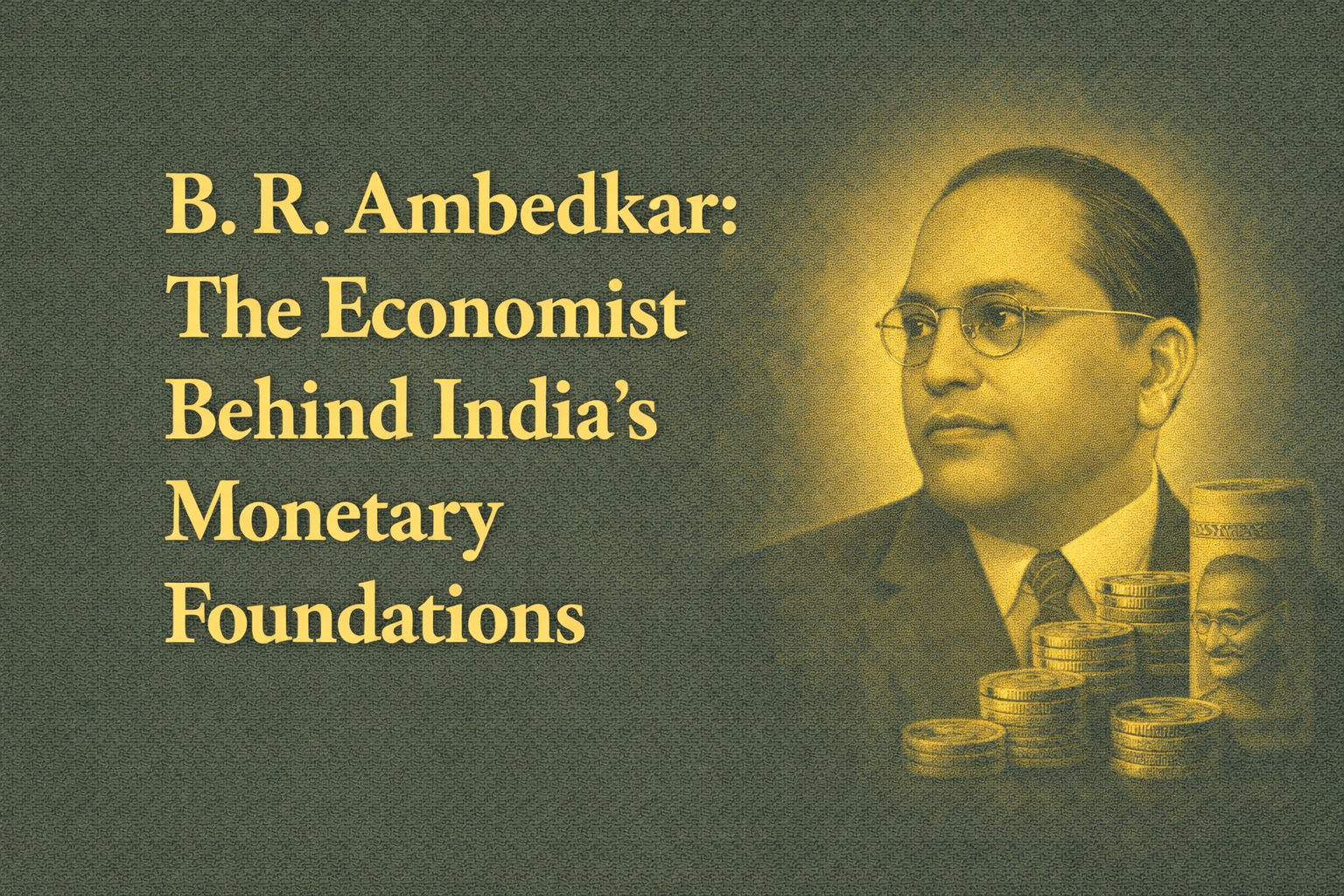
B. R. Ambedkar: The Economist Behind India’s Monetary Foundations
The Economist India Forgot to Teach
Long before institutions took shape, he was thinking in terms of stability, currency, and systemic design.
B.R. Ambedkar wrote one of the most consequential pieces of monetary economics in Indian history.
It helped shape the thinking behind the institution that manages India’s money.
It almost never appears in the economics syllabus.
The Problem of the Rupee, submitted at the London School of Economics in 1923, argued against the way the gold standard operated in colonial India, proposed principles for currency stability, and outlined structural foundations for central banking in India.
The institutional connection to the Reserve Bank of India is documented and traceable.
His name appears regularly in:
- law
- political science
- history
- sociology
The discipline where his technical work directly landed moved forward largely without assigning him.
What The Problem of the Rupee Actually Argued
This was not a political speech disguised as economics.
It was a technical monetary thesis.
Data-driven.
Structured.
Positioned within the currency debates of its time.
Ambedkar’s central claim was precise:
India’s currency system under the colonial gold standard protected imperial interests more effectively than Indian economic stability.
He examined how monetary instability transferred costs onto Indian producers, labourers, and consumers while preserving the broader colonial financial architecture.
This was 1923.
The Reserve Bank of India would not exist until 1935.
The intellectual foundations for Indian central banking were still being assembled.
Ambedkar was contributing to that assembly more than a decade before the institution formally emerged.
What makes the thesis unusually modern is not only the monetary analysis.
It is the way he linked:
- currency design
- power
- social inequality
as parts of the same system.
Who controls monetary architecture?
Who absorbs instability?
Whose prices matter most?
Whose suffering remains invisible inside “stability”?
These were not side questions in his framework.
They were embedded in the economic analysis itself.
The RBI Connection
The Reserve Bank of India was established in 1935.
The intellectual environment that shaped it drew from multiple monetary debates of the period.
Ambedkar’s proposals on:
- currency management
- price stability
- central banking structure
are documented within that institutional history.
The impact landed.
The attribution largely did not.
That distinction matters.
A discipline becomes structured through repetition:
- who gets assigned
- who gets cited
- whose work becomes impossible to omit from reading lists
Ambedkar entered India’s constitutional canon.
He did not enter its economics canon in the same way.
The result is unusual:
Indian economics can discuss central banking, monetary history, and inequality without consistently assigning the thinker whose technical work touched all three.
How Categorisation Made the Economics Invisible
Ambedkar was already being categorised primarily as a “social reformer” during his own lifetime.
That categorisation eventually became stable enough to overshadow work that did not fit neatly inside it.
Once the label hardened:
- constitutional thinker
- Dalit leader
- social reformer
the economics stopped requiring explanation.
Not because it disappeared.
Because the category itself quietly redirected attention elsewhere.
This is how disciplinary canons often work.
Not through obvious suppression.
Through:
- assignment patterns
- citation habits
- curriculum inertia
A text left off reading lists long enough eventually becomes invisible by default.
The Syllabus Gap
Many economics students complete years of formal education without encountering The Problem of the Rupee.
Not because the thesis is hidden.
It is digitised.
Archived.
Publicly available.
The RBI connection is documented.
What is missing is the institutional pointing mechanism:
- the syllabus
- the lecture
- the assigned reading list
A finance student may know Ambedkar as:
- the constitutional architect
- the face on the currency note
- a national icon
while never reading the monetary economics that helped shape India’s financial architecture.
The irony is sharp enough to feel structural.
The Framework That Never Entered Mainstream Economics
The deeper omission is not only the name.
It is the framework.
Ambedkar treated monetary policy and social inequality as connected systems.
Mainstream economics often separates them:
- monetary stability here
- social inequality there
His framework resisted that separation.
It asked:
Whose stability is monetary policy designed to protect?
That question still sits uneasily inside standard economic teaching.
If his framework entered the curriculum fully, economics would have to account for why this analytical approach remained marginal for so long.
The current structure avoids that revision entirely.
Impact Without Attribution
Three separate things happened:
- the work influenced institutions
- the attribution weakened
- the analytical framework never fully entered the discipline
Each reinforced the others.
None required a deliberate conspiracy.
Institutional inertia can produce outcomes powerful enough to resemble intent without anyone explicitly planning them.
Frequently Asked Questions
What is The Problem of the Rupee?
It is Ambedkar’s doctoral thesis submitted to the London School of Economics in 1923.
The work examined India’s currency system under colonial rule and proposed monetary and central banking reforms aimed at improving price stability and financial management.
Did Ambedkar influence the Reserve Bank of India?
Yes.
His monetary ideas are documented within the institutional intellectual history connected to the RBI’s formation.
The influence is traceable through historical and institutional records.
Why is Ambedkar rarely taught in economics courses?
The most accurate explanation is disciplinary inertia.
His public identity consolidated primarily around constitutional law and social reform, while his economic work remained outside mainstream assignment patterns.
Over time, absence from syllabi became self-reinforcing.
What made Ambedkar’s economic thinking unusual?
He linked:
- monetary systems
- institutional design
- social inequality
inside a single analytical framework.
He treated economic architecture as something that distributes stability unevenly across society rather than as a neutral technical mechanism.
Is the thesis still relevant today?
Many of its structural concerns remain relevant:
- inflation
- currency stability
- central bank independence
- who bears the cost of economic instability
The institutional context has changed.
The underlying questions remain remarkably contemporary.
What This Changes
The institutional record is not ambiguous.
Ambedkar contributed to India’s monetary and central banking thought before the RBI existed.
The surprising part is not the contribution itself.
The surprising part is how rarely economics education treats that contribution as foundational.
The absence is not really archival.
It is curricular.
And the deeper loss is not only the missing attribution.
It is the disappearance of a framework that treated:
- economic design
- power
- social inequality
as inseparable questions.
He helped shape how India manages money.
That sentence should feel obvious.
The fact that it still feels surprising explains the syllabus gap more clearly than any formal defence of it ever could.