Why People Keep Voting When They Know It Won’t Change Anything
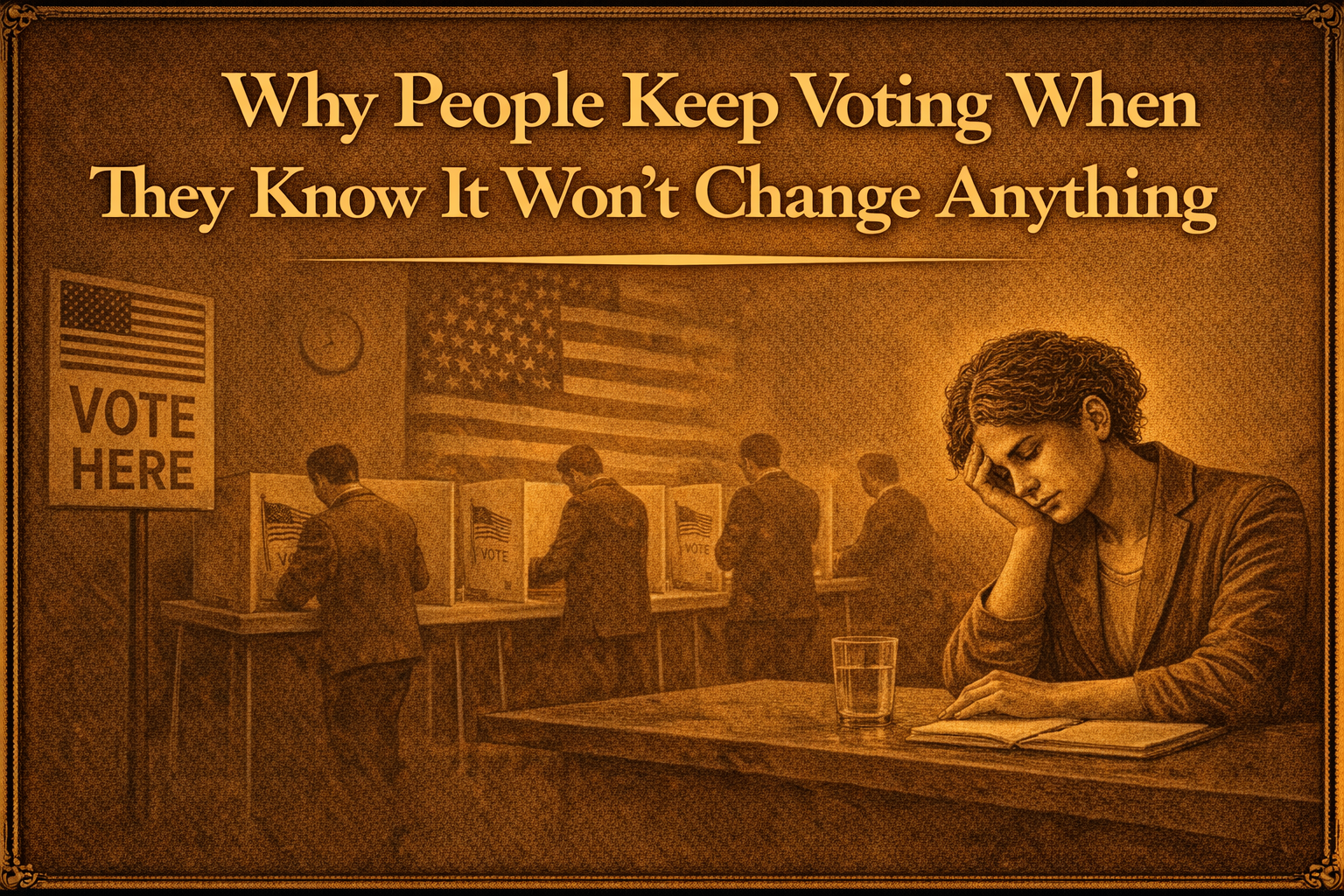
Why People Keep Voting When They Know It Won’t Change Anything
It isn’t hope. It isn’t a habit. It’s something that doesn’t have a clean name yet.
Most people who vote already know, somewhere beneath the optimism, roughly how it will end.
They stand in line anyway. They press the button. They walk home with the ink on their finger.
And when the ticker confirms what they expected — same candidate, same margin, same party — they sit with it quietly and go to sleep.
This is not a story about disillusionment.
It is an explanation of what is actually happening inside a person who votes without expectation and keeps doing it.
What the Research Actually Shows
Voting behaviour research has consistently found that citizens in low-competition constituencies — where one party or candidate wins repeatedly by large margins — do not stop voting at the rates you would expect if outcome expectation were the primary motivator.
A 2019 study from the Lokniti-CSDS data on Indian electoral participation found that voter turnout in “safe seat” constituencies dropped by only 4–7 percentage points compared to competitive ones.
The gap is smaller than most people assume.
This is the structural fact the article is built around:
Outcome expectation and participation are only weakly correlated.
Something else is doing most of the motivational work.
That something else is what this article names.
The Road Near the Nala
Before the mechanism, one concrete example.
A man votes in a constituency where the same candidate has won for twelve years.
The road outside his house has a broken patch near the drainage channel.
It fills with water every monsoon.
He has been stepping around it for four years.
His footwear knows the exact angle to avoid it without him looking down.
He does not go to the booth thinking about seat arithmetic or coalition math.
He goes thinking about that patch.
That specific broken thing.
This is not naivety.
It is precision.
He has correctly identified the only level at which his vote has any realistic chance of producing a result — the hyper-local, the immediate, the physical world he walks through daily.
National outcomes are outside his control.
The road is not outside it, quiet.
He voted.
The patch is still there.
He will vote again.
The mechanism that explains this is not about hope.
It is about something older.
What Actually Drives Continued Participation
Three things operate simultaneously inside a person who votes without outcome expectation.
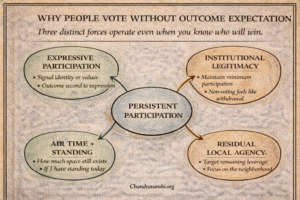
They are distinct. They are not interchangeable.
1. Expressive participation
Political scientists since the 1990s have documented what they call “expressive voting” — the act of voting as a statement of identity or values rather than as a calculation of expected impact.
When a person votes for a candidate who will lose, or in a ward where their party has never won, the act registers something about who they are to themselves.
The outcome is secondary to the expression.
This is not irrational behaviour.
It is a different kind of rationality.
2. Institutional legitimacy maintenance
This one is less discussed.
Democracies require minimum participation thresholds to function with perceived legitimacy.
Individual voters carry a distributed awareness of this — not always consciously, but behaviorally.
The person who says “my vote doesn’t matter” often still votes because not voting feels like a withdrawal from something larger than the immediate result.
The act of voting is a contribution to the system’s claim to represent the people.
3. Residual local agency
The patch near the nala.
The broken streetlight.
The primary school teacher has been absent for two months.
At the constituency level, especially in local elections, individual voting clusters can shift outcomes even when national outcomes are predictable.
The voter focusing on the local is not confused.
He is precise.
He is identifying where his participation still has an impact.
None of these three requires outcome expectation.
All three survive even when expectation disappears.
Where This Understanding Fails
This framework has real limits.
It does not explain voter abstention in genuinely contested elections.
When outcomes are uncertain, different motivations take over:
- strategic voting
- party loyalty
- candidate preference
It also does not account for the point at which continued participation stops.
There is a threshold — different for each person — beyond which the broken patch becomes a reason to stay home.
That threshold is not clearly mapped.
And it does not make a moral argument.
This article explains behaviour.
It does not judge it.
The Ticker at Midnight
The same candidate won.
Same margin.
The ticker confirmed it before midnight.
The man in the plastic chair sat with the results.
Not angry. Not surprised.
The ceiling fan turned.
The chai went cold.
He had voted that morning, thinking about a road.
The road is unchanged.
He will stand in that line again.
This is not a failure of awareness.
It is the operation of three forces:
- expressive identity
- institutional legitimacy
- residual local agency
The vote and the result are two different events with two different logics.
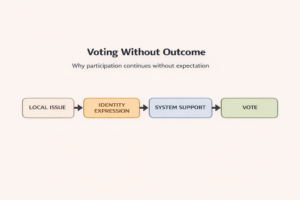
Most commentary collapses them into one.
That collapse is the misunderstanding.
Frequently Asked Questions
Is voting without outcome expectation irrational?
No.
It is rational under a different objective.
When the goal is identity, legitimacy, or local impact — not outcome — the behaviour is consistent.
Why does turnout stay high in safe-seat constituencies?
Lokniti-CSDS data (2019) shows only a 4–7% drop.
Reasons include:
- social pressure
- expressive voting
- local-level focus
What is expressive voting?
Voting based on identity or values, not outcome.
The concept originates from Geoffrey Brennan and Loren Lomasky (1993).
Does this explain voting despite disillusionment?
Partially.
Disillusionment affects expectations, not always participation.
The two are separate.
When does participation stop?
There is no clear universal threshold.
At scale, drops happen due to:
- suppression
- legitimacy crises
- lack of relatable candidates
Conclusion
Voting without outcome expectation is not a paradox.
It is three motivations operating together:
- expressive
- institutional
- local
None of them requires the ticker to show the right name.
The patch near the nala is still broken.
The man will stand in line again.
That is not confusion.
That is clarity about what his vote is actually doing.