Work Done in Physics — CBSE Class 9 Explained
Why Force Without Displacement Produces Zero Work and How Physics Redefines “Work”
You have held a heavy bag at a bus stand before.
Your arms shook. Your shoulders burned. Sweat collected on your forehead.
You were exhausted.
And according to physics, you may have done zero work.
That sounds absurd at first.
But the moment you understand what physics actually means by “work,” the idea becomes surprisingly precise.
The Porter Who Was Told He Did Nothing
Birju carries luggage at Kanpur railway station.
One afternoon, a passenger hands him two heavy suitcases and asks him to wait while buying a platform ticket.
Birju stands there for fifteen minutes.
Both bags remain lifted in his hands the entire time.
His arms ache.
His muscles strain continuously.
Now comes the strange part.
A physicist watching this would say:
Birju did zero work on the suitcases while standing still.
Not reduced work.
Not small work.
Zero.
Why?
Because physics uses a very specific definition of work.
What Physics Notices That Everyday Language Does Not
In ordinary life, work means effort.
But physics does not measure effort directly.
Physics asks a different question:
Did the applied force actually move the object?
While Birju was waiting:
- Force existed.
- Displacement did not.
The suitcases remained at the same position and height.
No physical displacement occurred.
That is why physics says no work was done on the luggage.
The moment Birju begins walking toward Coach B3, the situation changes completely.
Now:
- A force acts.
- The object moves.
- The physical state changes.
That combination is what physics calls work.
The Scientific Definition of Work
In physics:
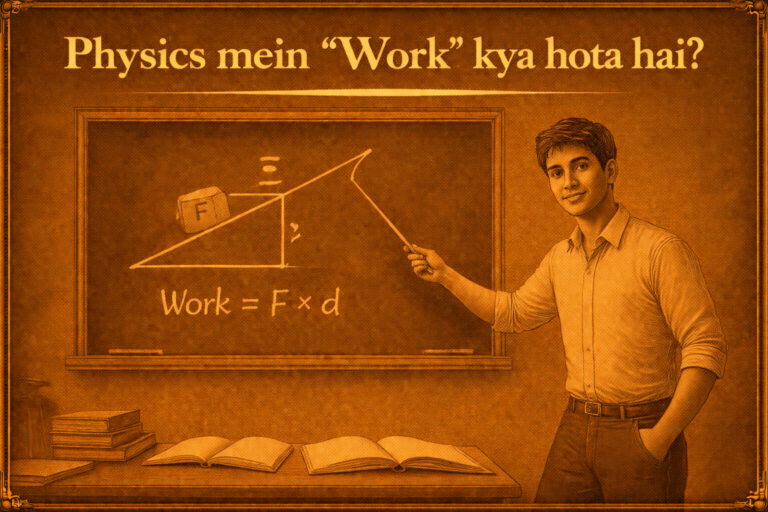
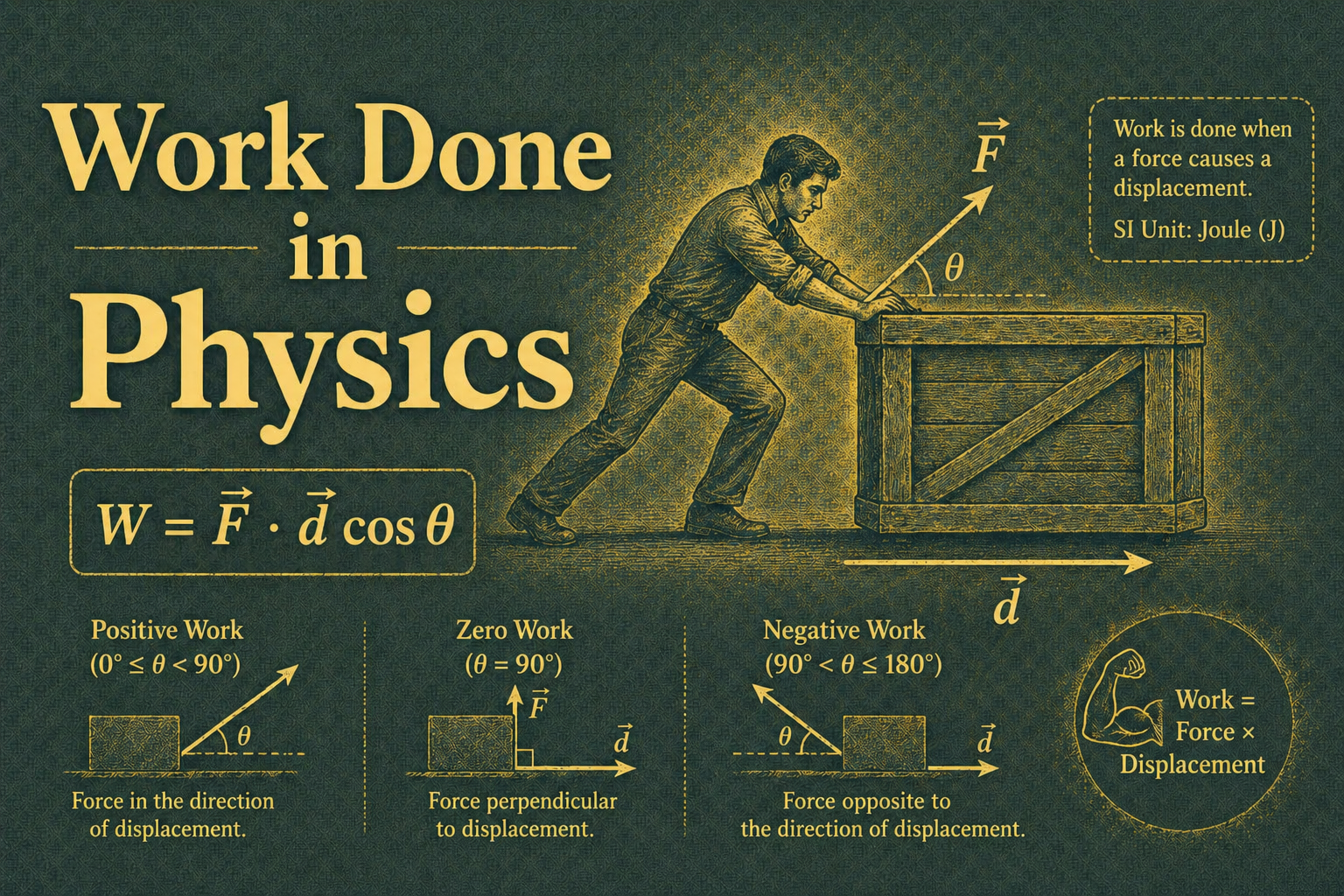
Work is done when a force causes displacement in the direction of the force.
This becomes the formula:
W = F \times s
Where:
- W = Work done (Joules)
- F = Force applied (Newtons)
- s = Displacement in the direction of force (metres)
One Joule means:
One Newton of force moving an object through one metre.
Why Birju Did Zero Work While Standing Still
Birju applied force upward on the suitcases continuously.
But:
- Displacement = 0
Using the formula:
W = F \times 0 = 0
So the work done on the suitcases was zero.
His muscles still consumed biological energy.
His body still became tired.
But mechanically, the luggage did not move.
Calculating Work Step by Step
Now Birju lifts the luggage and walks toward the train coach.
Suppose:
- Total upward force = 300 N
- Vertical lifting distance = 0.5 m
Step 1: Identify Force
Birju applies an upward force of 300 N.
Step 2: Identify Displacement
The luggage moves upward by 0.5 metres.
Force and displacement point in the same direction.
Step 3: Apply the Formula
W = 300 \times 0.5 = 150\ J
Birju does 150 Joules of work while lifting the luggage.
Why Carrying the Luggage Horizontally Produces Zero Work From the Arms
Now Birju walks 30 metres horizontally while holding the luggage at constant height.
This is where many students become confused.
The force from Birju’s arms acts upward.
But the displacement is horizontal.
The two directions are perpendicular.
When force and displacement are perpendicular:
The work done by that force becomes zero.
His legs still do work against friction and motion.
But the upward holding force from the arms does zero work on the luggage during the horizontal walk.
The Full Formula With Angle
When force and displacement are not perfectly aligned, physics uses:
W = F \times s \times \cos\theta
Where:
- θ = angle between force and displacement
Case 1: Same Direction
If θ = 0°:
cos 0° = 1
So:
W = F \times s
Maximum work is done.
Case 2: Perpendicular Directions
If θ = 90°:
cos 90° = 0
So:
W = 0
No work is done.
Case 3: Opposite Directions
If θ = 180°:
cos 180° = −1
So:
W = -F \times s
This is called negative work.
What Negative Work Actually Means
Negative work is not an error.
It means energy is being removed from an object.
Example:
- Bicycle brakes
- Friction
- Air resistance
These forces oppose motion.
Because force and displacement point in opposite directions, the work becomes negative.
That is why moving objects slow down.
Where You See Work in Everyday Life
Pushing a Scooter
Force applied forward.
Scooter moves forward.
Positive work is done.
A Satellite Orbiting Earth
Gravity pulls toward Earth.
The satellite moves sideways.
Force and displacement remain perpendicular.
Work done by gravity becomes zero.
Braking a Bicycle
Braking force acts opposite to motion.
Negative work removes kinetic energy.
Lifting Goods onto a Truck
Force upward.
Displacement upward.
Maximum positive work occurs.
The Three Biggest Mistakes Students Make
Mistake 1: Confusing Effort With Work
Effort alone does not count as work in physics.
Displacement must occur.
Mistake 2: Ignoring Direction
Students often multiply force by distance without checking direction.
The angle between force and displacement matters completely.
Mistake 3: Thinking Negative Work Is Wrong
Negative work is physically meaningful.
It represents energy leaving the system.
The ELIS Ladder: Understanding at Every Level
Level 1: Class 6 to 8
Work happens only when force moves an object.
No movement means no work.
Work = Force × Displacement.
Level 2: Class 9 and 10
The equation becomes:
W = F \times s
Work can be:
- Positive
- Zero
- Negative
The work-energy theorem states:
W_{net} = \Delta KE
Net work changes kinetic energy.
Level 3: Class 11, 12, and Beyond
For changing forces:
W = \int \vec{F} \cdot d\vec{s}
This integral form handles variable forces and changing directions.
At higher levels, work also becomes frame-dependent.
Different observers can measure different work values depending on the reference frame used.
In Five Sentences
Physics defines work as force causing displacement in the direction of the force. If displacement is zero, the work done is zero even if effort exists. When force and displacement are perpendicular, work is also zero. Work becomes negative when force opposes motion. The unit of work is the Joule.
In Three Sentences
Work requires both force and displacement. Direction matters because only displacement along the force contributes to work. Negative work removes energy from a moving object.
In One Sentence
Physics calls it work only when force actually changes an object’s position in the direction of that force.
Practice Questions
- A force of 40 N moves an object through 5 metres. Calculate the work done.
- A person holds a bag stationary for two minutes. How much work is done on the bag?
- A coolie carries luggage horizontally while applying an upward force. What work does the upward force do?
- A braking force stops a moving bicycle. Is the work positive or negative?
- Explain how the work-energy theorem connects work and kinetic energy.
Students Ask These Questions
Why does physics define work differently from daily life?
Because physics needs a measurable definition connected directly to motion and energy transfer.
Is work a vector quantity?
No. Work is a scalar quantity because the dot product produces a single numerical value without direction.
Can work happen without movement?
No. Displacement is absolutely necessary for mechanical work.
What connects work and energy?
Work transfers energy into or out of objects. Positive work increases energy. Negative work decreases it.
Why does gravity do zero work on a satellite in circular orbit?
Because gravity acts perpendicular to the satellite’s displacement, changing direction without changing speed.
Related Reading
- Kinetic and Potential Energy | Class 9 CBSE
- Newton’s Laws of Motion | Class 9
- Power and Energy | Class 9 CBSE