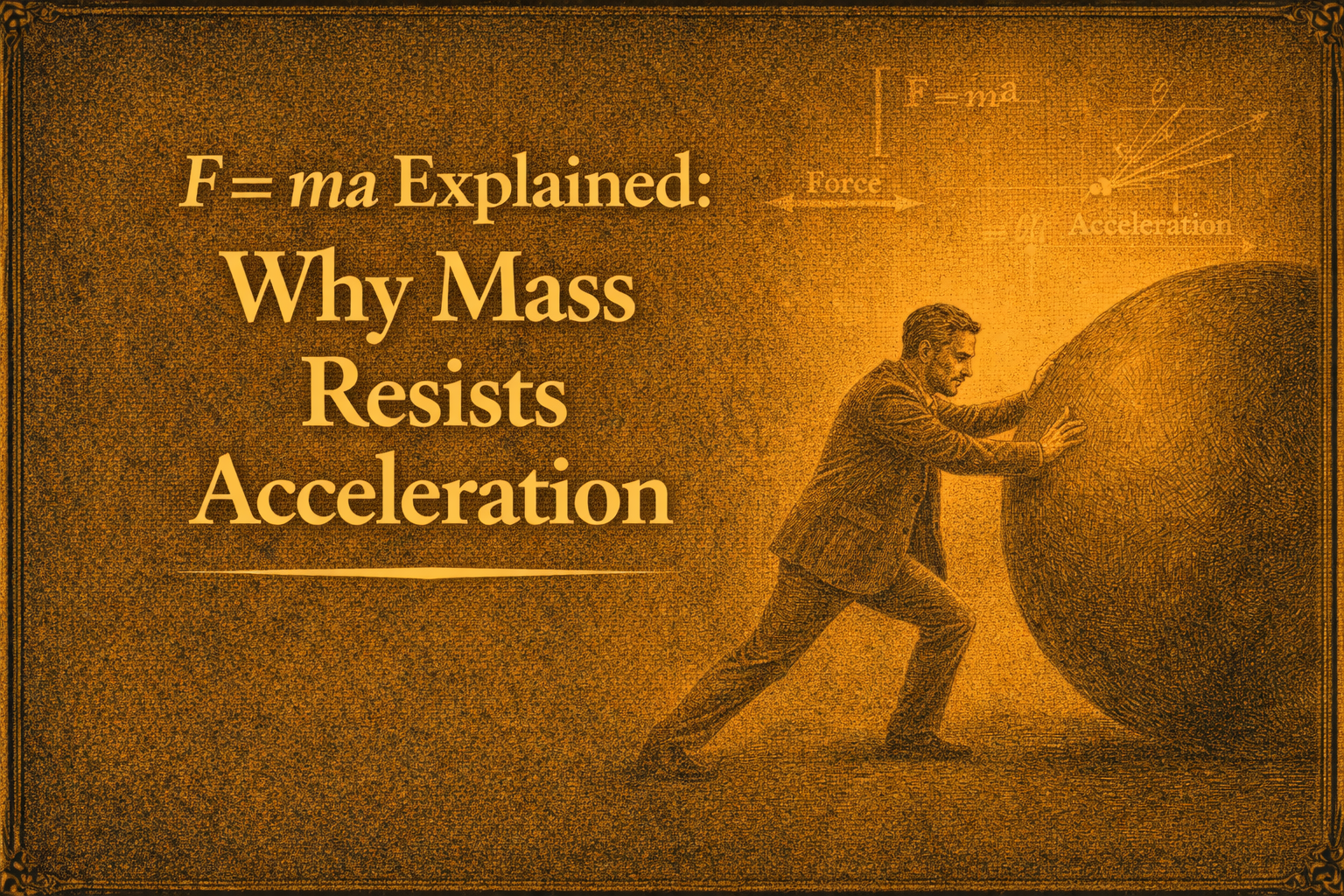
F = ma Explained: Why Mass Resists Acceleration
The Formula Is F = ma. The Idea Is That Heavy Things Resist Change More Than Light Ones.
Newton’s Second Law tells you exactly how much force it takes to change how something moves — and why a truck needs a bigger engine than a bicycle.
This chapter is not really about memorising a formula.
It is about understanding why some objects change motion easily while others resist it.
What Will You Learn in This Article?
In this article, you will learn:
- What Newton’s Second Law means before using the formula
- What F = ma actually says about motion
- Why heavy objects resist change more than lighter ones
- What inertia really means
- The difference between mass and weight
- How to solve numerical problems step by step
- Common mistakes students make in exams
By the end, you will understand Newton’s Second Law clearly in simple English.
Start With Something You Already Know
Imagine two shopping trolleys.
One is empty.
One is filled with bricks.
You push both with the same force.
The empty trolley moves quickly.
The loaded trolley barely accelerates.
Why?
Because the loaded trolley has more mass.
And more mass means more resistance to change.
Physics gives that resistance a name:
Inertia
Newton’s Second Law turns that idea into mathematics.
Where Does F = ma Come From?
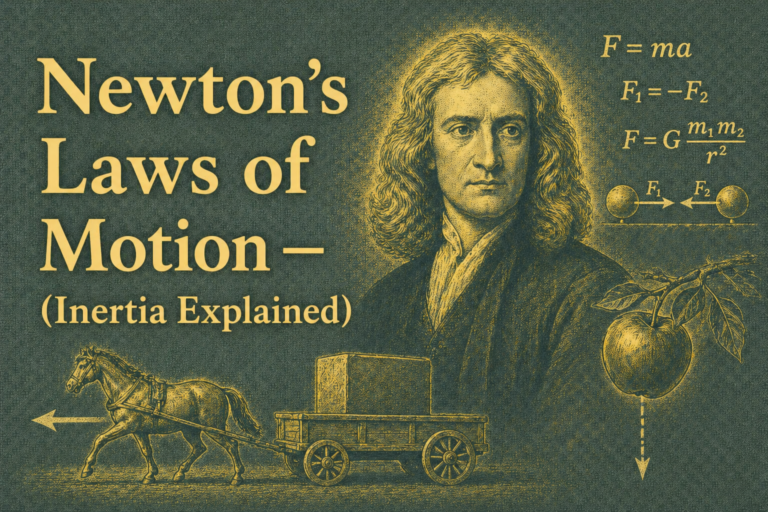
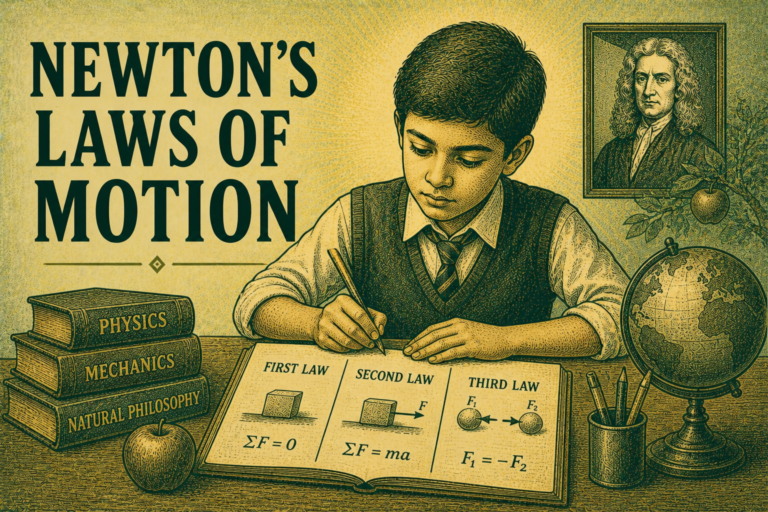
Newton gave three laws of motion.
| Law | Name | Main Idea |
|---|---|---|
| First Law | Law of Inertia | Objects keep doing what they are already doing unless a force acts on them. |
| Second Law | F = ma | Acceleration depends on force and mass. |
| Third Law | Action-Reaction | Every force produces an equal and opposite force. |
Today’s focus is the second law.
What F = ma Actually Means
Newton’s Second Law is:
F = ma
That equation connects:
- Force
- Mass
- Acceleration
But students often memorise the letters without understanding the ideas.
F = Force
Force is a push or a pull.
Force changes motion.
Without force:
- Objects do not accelerate
Unit:
- Newton (N)
Force is a vector quantity, which means:
- It has magnitude and direction
One Newton means:
The force needed to accelerate a 1 kg object at 1 m/s².
m = Mass
Mass is the amount of matter in an object.
But in Newton’s laws, mass also measures:
Inertia
More mass means:
- More resistance to changes in motion
Unit:
- Kilogram (kg)
Mass is a scalar quantity.
It has magnitude only, not direction.
Mass does not change with location.
A 10 kg rock:
- Has the same mass on Earth
- Has the same mass on the Moon
- Has the same mass in space
a = Acceleration
Acceleration means:
The rate of change of velocity
Students often think acceleration only means speeding up.
That is incomplete.
Acceleration also includes:
- Slowing down
- Changing direction
Unit:
- m/s²
Acceleration is also a vector quantity.
What the Formula Is Really Saying
F = ma describes relationships between quantities.
More Force → More Acceleration
If mass stays constant:
- More force produces more acceleration
Push the same trolley harder:
- It speeds up faster
More Mass → Less Acceleration
If force stays constant:
- More mass produces less acceleration
That is inertia in action.
Heavy objects resist motion changes more strongly.
Inertia: The Hidden Idea Inside the Formula
Newton’s First Law introduced inertia.
Newton’s Second Law measures it.
Inertia means:
Resistance to any change in motion
Objects do not “want” to stay still.
That is not how physics works.
Instead:
- Objects resist changes to their current motion state
If an object is still:
- It resists starting motion
If an object is moving:
- It resists stopping
- It resists changing direction
High Inertia
A loaded truck:
- Needs large force to start moving
- Needs large force to stop
Large mass means:
- Large inertia
Low Inertia
A football:
- Accelerates easily
- Stops easily
Small mass means:
- Small inertia
Mass and Weight Are Not the Same Thing
| Property | Mass | Weight |
|---|---|---|
| Meaning | Amount of matter | Force of gravity |
| Type | Scalar | Vector |
| Unit | kg | Newton (N) |
| Changes with location? | No | Yes |
| Formula | Given directly | W = mg |
Example:
A 70 kg person:
- Has mass = 70 kg everywhere
- Has weight = 686 N on Earth
Real-World Examples
Football vs Boulder
Suppose you apply a force of 90 N.
Football mass = 0.45 kg
Using:
a = F ÷ m
Acceleration:
90 ÷ 0.45 = 200 m/s²
The football flies away quickly.
Now take a 45 kg boulder.
Acceleration:
90 ÷ 45 = 2 m/s²
The boulder barely moves.
Same force.
Different mass.
Different acceleration.
Why Trucks Need Bigger Engines
A car:
- Mass = 800 kg
- Acceleration needed = 3 m/s²
Force needed:
800 × 3 = 2400 N
Now a truck:
- Mass = 8000 kg
- Same acceleration = 3 m/s²
Force needed:
8000 × 3 = 24,000 N
The truck needs:
- 10 times more force
That is why trucks need larger engines.
Three Forms of the Formula
To Find Force
F = ma
To Find Mass
m = F ÷ a
To Find Acceleration
a = F ÷ m
Worked Examples
Example 1: Find Force
A 5 kg object accelerates at 3 m/s².
Use:
F = ma
F = 5 × 3
F = 15 N
Example 2: Find Acceleration
Force = 24 N
Mass = 6 kg
Use:
a = F ÷ m
24 ÷ 6 = 4
a = 4 m/s²
Example 3: Find Mass
Force = 50 N
Acceleration = 2 m/s²
Use:
m = F ÷ a
50 ÷ 2 = 25
m = 25 kg
Common Mistakes Students Make
Confusing Mass and Weight
Mass is measured in:
- kg
Weight is measured in:
- Newtons
Weight is a force.
Mass is not.
Thinking Heavy Objects Accelerate More
For the same applied force:
- Heavier objects accelerate less
Because they have:
- More inertia
Forgetting Units
Force is measured in:
- Newtons (N)
Not kilograms.
Thinking Acceleration Means Only Speeding Up
Acceleration includes:
- Speeding up
- Slowing down
- Changing direction
Quick Summary
- Newton’s Second Law is F = ma.
- Force causes acceleration.
- More force produces more acceleration.
- More mass produces less acceleration.
- Mass measures inertia.
- Mass and weight are different.
- Force is measured in Newtons.
- Acceleration means any change in velocity.
Practice Questions
- A 4 kg object accelerates at 5 m/s². Find the force.
- A force of 36 N acts on an object producing 4 m/s² acceleration. Find the mass.
- A 1200 kg car experiences a force of 6000 N. Find the acceleration.
- Two objects of 2 kg and 8 kg are pushed with 16 N. Find both accelerations.
- A 70 kg person stands in a lift accelerating upward at 2 m/s². Find the apparent weight. Take g = 10 m/s².
Answers
- F = ma = 4 × 5 = 20 N
-
m = F ÷ a = 36 ÷ 4 = 9 kg
-
a = F ÷ m = 6000 ÷ 1200 = 5 m/s²
4.
2 kg object: a = 16 ÷ 2 = 8 m/s²
8 kg object: a = 16 ÷ 8 = 2 m/s²
- Apparent weight = m(g + a)
= 70 × (10 + 2)
= 840 N
Frequently Asked Questions
Does F = ma apply everywhere?
Yes.
It applies to all objects:
- From tiny particles to planets
What if multiple forces act together?
You first calculate:
- Net force
Then apply:
F = ma
What happens if force is zero?
If net force is zero:
Acceleration is zero.
The object:
- Remains at rest
- Or continues moving at constant velocity
Can objects at rest still follow Newton’s Second Law?
Yes.
If acceleration is zero:
- Net force is also zero
Balanced forces still obey Newton’s laws.