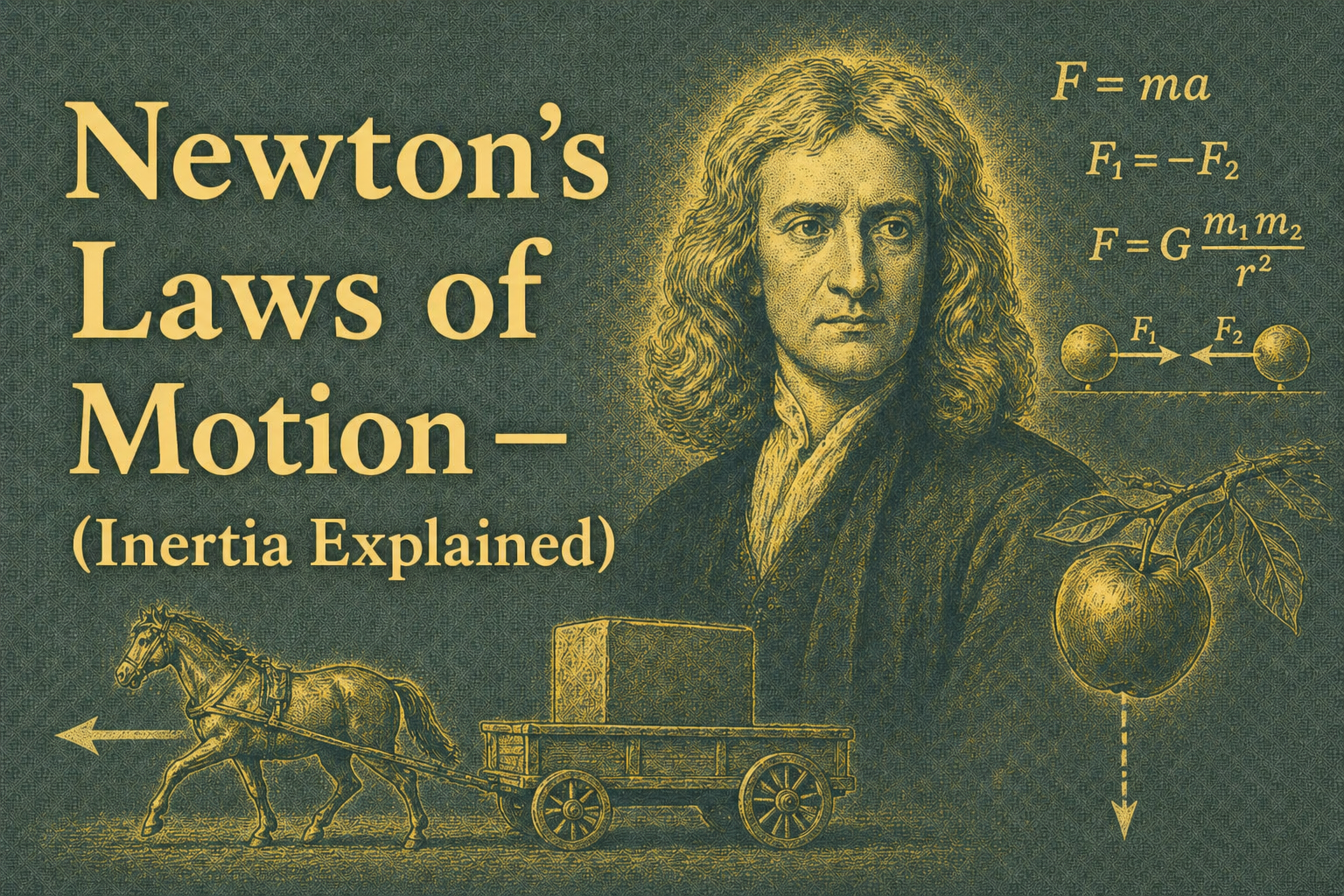
Newton’s Laws of Motion — CBSE Class 9 Physics (Inertia Explained)
From Inertia to F = ma: Understanding Resistance to Change Before Applying the Formula
You have already experienced Newton’s Laws many times without naming them.
A bus brakes suddenly and your body lurches forward. A loaded cart feels stubborn compared to an empty one. A fast cricket ball hurts more than a slow tennis ball.
These are not separate ideas.
They are different expressions of the same physical truth:
Objects resist changes to their motion.
The Cart That Would Not Cooperate
Every morning in Lucknow, Ramesh pulls a wooden cart stacked with bricks through a narrow construction lane.
The beginning is always the hardest part.
The cart sits still as if glued to the ground. Ramesh leans forward with both arms and pushes with his full body just to make it start moving.
But once the cart begins rolling, something changes.
He no longer needs the same effort to keep it moving steadily.
What changed?
The cart did not suddenly become lighter.
Ramesh did not become stronger halfway through.
The answer sits inside one of the deepest ideas in physics:
Matter resists changes to whatever state it is already in.
What the Cart Was Actually Doing
Every object has a kind of stubbornness.
If an object is still, it prefers to remain still.
If it is already moving, it prefers to continue moving at the same speed in the same direction.
Only an external force can change that state.
This resistance to change is called inertia.
More mass means more inertia.
That is why:
- A loaded cart is harder to start moving than an empty one.
- A truck is harder to stop than a bicycle.
- A cricket ball hits harder than a tennis ball at the same speed.
The surprising part for many students is this:
To physics, resting and moving steadily are actually similar situations.
In both cases, the object’s state is unchanged.
A force is needed only when the motion changes.
Newton Gives the Idea Its Name
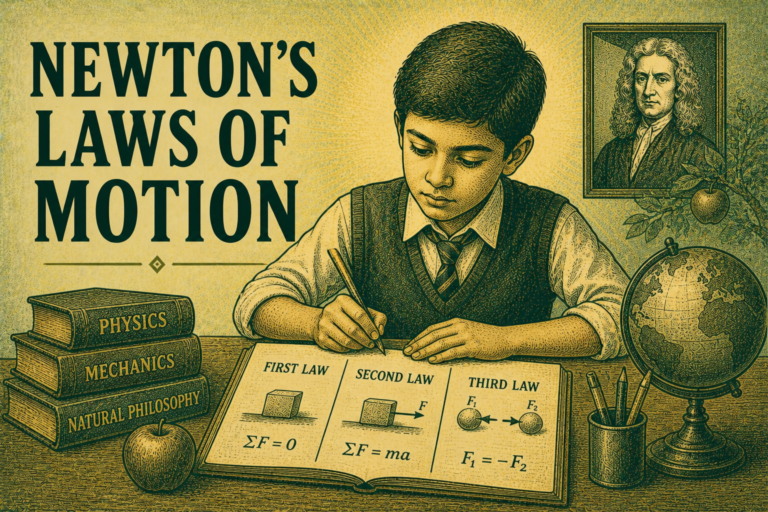
In 1687, Isaac Newton formally described the rules governing motion.
These became known as Newton’s Laws of Motion.
They explain:
- Why objects resist change
- How forces create acceleration
- Why forces always appear in pairs
Newton’s First Law: The Law of Inertia
Newton’s First Law states:
An object remains at rest or continues moving with constant velocity unless acted upon by an external force.
This is exactly what Ramesh experienced.
The cart stayed still because no net external force had yet changed its state.
Once moving steadily, the cart naturally continued moving unless friction or another force interfered.
Step-by-Step Example
Step 1:
The cart is stationary.
Its inertia resists starting motion.
Step 2:
Ramesh pushes the cart.
An external force now acts on it.
Step 3:
The cart accelerates and begins moving.
Its state changed because force was applied.
Step 4:
Once moving steadily, if Ramesh pushes just enough to balance friction, the net force becomes zero.
The cart keeps moving at constant speed.
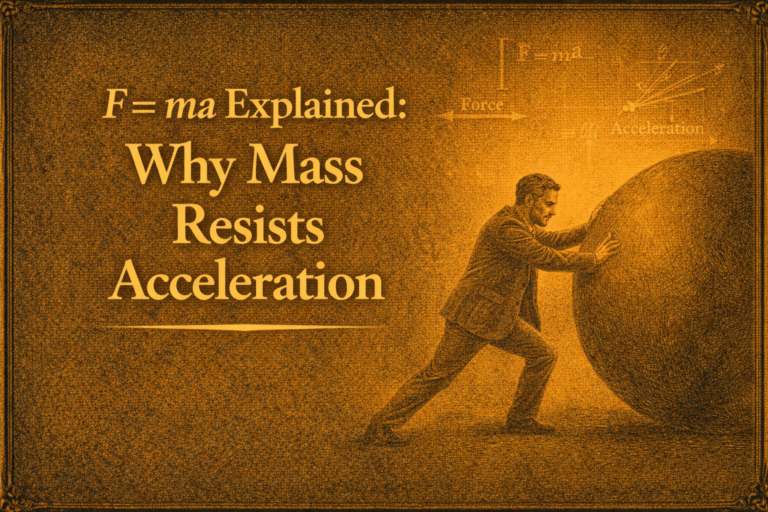
Newton’s Second Law: F = ma
Newton’s Second Law explains how force changes motion.
The law states:
Acceleration is directly proportional to force and inversely proportional to mass.
This becomes the famous equation:
F = ma
Where:
- F = Force (Newtons)
- m = Mass (kilograms)
- a = Acceleration (m/s²)
This equation explains why heavy objects require more force to accelerate.
Understanding F = ma Through the Cart
Suppose:
- Mass of cart and bricks = 200 kg
- Net force applied = 100 N
Using Newton’s Second Law:
100 = 200 × a
Now solve for acceleration:
a = 100 ÷ 200 = 0.5 m/s²
The cart accelerates at 0.5 metres per second every second.
Notice the relationships:
- More force = more acceleration
- More mass = less acceleration
That single equation explains both.
Newton’s Third Law: Forces Always Come in Pairs
Newton’s Third Law states:
For every action, there is an equal and opposite reaction.
When Ramesh pushes the cart forward:
- The cart pushes backward on Ramesh with equal force.
- Both forces exist simultaneously.
This is why pushing heavy objects physically feels difficult.
The reaction force is real.
Important Detail Students Miss
Action and reaction forces do not cancel each other because they act on different objects.
- Action force acts on the cart.
- Reaction force acts on Ramesh.
Forces cancel only when acting on the same object.
Where You See Newton’s Laws Every Day
Seatbelts in Vehicles
When a car stops suddenly, your body’s inertia keeps it moving forward.
The seatbelt provides the external force needed to stop you safely.
Without the seatbelt, your body continues forward into the dashboard or windshield.
That is Newton’s First Law in action.
Cricket Ball Versus Tennis Ball
A cricket ball hurts more than a tennis ball because it has greater mass and therefore greater inertia.
Stopping it requires greater force.
Boats Pushing Away From Walls
Push a wall while standing in a small boat.
The wall pushes back equally.
The boat moves away.
Newton’s Third Law explains the entire event.
Rocket Launches
Rocket engines push hot gases downward.
The gases push the rocket upward with equal force.
No air is required.
The reaction force alone produces motion.
The Three Biggest Mistakes Students Make
Mistake 1: Thinking Inertia Is a Force
Inertia is not a force.
It is a property of matter.
It describes resistance to changes in motion.
Forces cause changes. Inertia resists them.
Mistake 2: Thinking Action and Reaction Cancel Out
Students often assume equal and opposite forces automatically produce zero motion.
But action and reaction forces act on different objects.
That distinction is essential.
Mistake 3: Confusing Mass and Weight
Mass measures the amount of matter.
Weight measures the gravitational force acting on that mass.
Your mass remains constant everywhere.
Your weight changes depending on gravity.
The ELIS Ladder: Understanding at Every Level
Level 1: Class 6 to 8
Objects resist changes to their motion.
That resistance is inertia.
Forces change motion.
Newton described these rules using three laws.
Level 2: Class 9 and 10
Newton’s First Law explains inertia.
Newton’s Second Law gives the relationship:
F = ma
Newton’s Third Law explains action-reaction force pairs.
Momentum also connects here:
p = mv
Where:
- p = momentum
- m = mass
- v = velocity
Force can also be written as:
F = Δp ÷ Δt
This means force equals the change in momentum divided by the time taken for that change.
Level 3: Class 11, 12, and Beyond
At higher levels, Newton’s Second Law is treated in its more general form:
F = dp/dt
This becomes important when mass changes, such as in rocket motion.
Newtonian mechanics also has limits:
- At speeds near light, relativity becomes necessary.
- At atomic scales, quantum mechanics replaces classical physics.
But for ordinary life, engineering, vehicles, buildings, sports, and planetary motion, Newton’s Laws remain extraordinarily accurate.
In Five Sentences
All objects resist changes to their motion, and this resistance is called inertia. Newton’s First Law describes this tendency to remain in the current state unless acted upon by an external force. Newton’s Second Law connects force, mass, and acceleration through F = ma. Newton’s Third Law states that every force has an equal and opposite reaction force acting on another object. Together, these laws explain nearly all ordinary motion around us.
In Three Sentences
Inertia is the resistance of matter to changes in motion. Force overcomes inertia, and F = ma describes how force creates acceleration. Every force also produces an equal and opposite reaction force.
In One Sentence
Objects resist change, forces create acceleration, and every force appears with an equal and opposite partner.
Practice Questions
- A force of 50 N acts on an object of mass 10 kg. Calculate the acceleration.
- A stationary book lies on a table. Explain why it does not move using Newton’s First Law.
- Two objects of masses 5 kg and 20 kg experience the same force. Which accelerates more?
- Why does a passenger lurch forward when a bus brakes suddenly?
- A swimmer pushes the wall of a swimming pool backward. Explain what happens next using Newton’s Third Law.
Students Ask These Questions
If moving objects stay moving, why do things eventually stop?
Because friction and air resistance apply external forces that slow them down. In a perfectly frictionless environment, motion would continue indefinitely.
Do heavier objects fall faster?
No. In the absence of air resistance, all objects accelerate equally under gravity because mass cancels out mathematically in the equations.
How can a horse pull a cart if forces are equal?
The horse pushes backward against the ground. The ground pushes the horse forward. That forward ground force moves the horse-cart system.
Is inertia the same thing as mass?
Not exactly. Mass measures how much matter an object contains. Inertia is the resistance to changing motion produced by that mass.
Do Newton’s Laws work in space?
Yes. Rocket launches, satellite orbits, and planetary motion are all calculated using Newtonian mechanics with excellent accuracy for ordinary space travel speeds.
Related Reading
- Gravitation | Class 9 CBSE
- Work, Energy and Power | Class 9
- Laws of Motion | Class 11 CBSE