The Ambedkar You Weren’t Taught: Beyond the Constitution
The Ambedkar Most Schools Never Assigned
The constitutional architect is one chapter of a much longer argument.
Most people who went through Indian schools received one version of Dr. B. R. Ambedkar:
- a man in a suit
- a pen in hand
- the Constitution on the table
That version is real.
It is also the version that costs the least to teach.
The rest:
- Annihilation of Caste
- the resignation from Nehru’s cabinet
- the Buddhist conversion as a decades-long political argument made physical
all exist in archives, speeches, letters, and public records.
Accessible.
Digitised.
Available.
Just rarely assigned.
The gap was never in the record.
The gap was in what the curriculum decided you needed to know.
What the Photograph Says — And What It Leaves Out
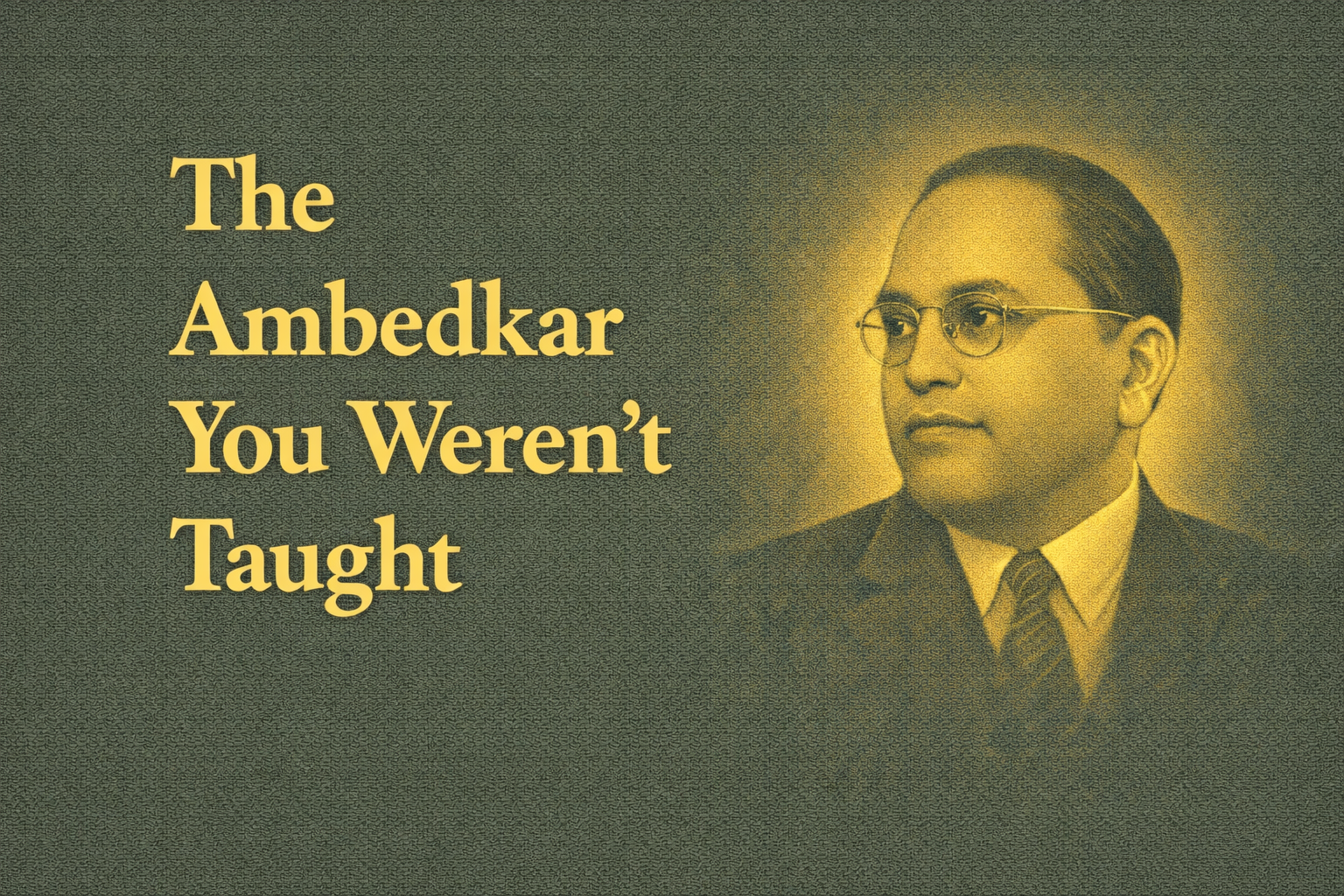
The schoolbook image barely changes across states or decades.
A suited figure.
A serious expression.
A Constitution on the desk.
Below it:
- Father of the Indian Constitution
- Chairman of the Drafting Committee
- Architect of modern India
The image communicates something very specific:
Here is a man who worked within institutions.
And therefore:
Here is a man the state can safely celebrate.
What the image usually does not say:
Six weeks before his death, Ambedkar converted to Buddhism publicly alongside hundreds of thousands of followers.
That conversion was not spiritual wandering.
It was a conclusion.
The final movement in an argument he had been making for decades.
He did not simply leave Hinduism.
He argued that caste was structurally inseparable from it.
Even the Buddhism he chose was deliberate.
He constructed Navayana Buddhism consciously:
- stripping metaphysical emphasis
- centring social equality
- turning religion itself into political philosophy
Most textbooks reduce this to:
“A personal religious choice.”
The political meaning quietly disappears.
Annihilation of Caste: The Speech That Was Never Allowed
Annihilation of Caste was originally written as a speech for a Hindu reform conference in 1936.
The organisers invited Ambedkar.
Then they read the draft.
And withdrew the invitation.
Because the speech was not asking for small reform.
It was arguing something much more dangerous:
Caste was not a distortion of Hinduism.
It was embedded inside its structure, texts, and authority.
Ambedkar was not proposing repair from within.
He was questioning whether the structure itself could survive moral examination.
He published the speech himself.
Reading it today feels different from reading textbook summaries about him.
Not because the language is difficult.
Because the implications arrive faster than expected.
This is not the safe constitutional figure.
This is someone making an argument sharp enough that even reformers stepped away from it.
The Resignation Most Students Never Hear About
In 1951, Ambedkar resigned from Jawaharlal Nehru’s cabinet.
That alone should make it one of the central political moments taught about him.
The man who helped draft India’s Constitution left the government of independent India within four years of its formation.
And he explained exactly why.
The conflict centred around the Hindu Code Bill.
Ambedkar spent years working on legal reforms that would give Hindu women rights involving:
- inheritance
- property
- divorce
The bill faced resistance.
It was diluted, delayed, fragmented.
Ambedkar treated that failure as structural, not procedural.
His resignation letter is not emotional rhetoric.
It is precise.
Detailed.
Deliberate.
He names what failed and what the failure revealed:
Political independence had arrived faster than social transformation.
Most Indians educated through school systems never encounter this letter.
Not because it is hidden.
Because nobody assigned it.
The Idea of “Two Constitutions”
One of Ambedkar’s most important insights rarely survives simplified summaries.
He believed India effectively had two constitutions:
- the written Constitution
- the social Constitution
The written Constitution could be amended.
The social Constitution:
caste
was far more durable.
Because it lived socially rather than legally.
He understood something deeply uncomfortable:
A society can legally declare equality while socially continuing hierarchy almost unchanged.
A person can be constitutionally equal and socially untouchable on the same day.
The Constitution, for Ambedkar, was not magic.
It was leverage.
A tool powerful enough to create openings.
But not powerful enough by itself to dissolve centuries-old social architecture.
The curriculum usually gives students the document.
It rarely gives them his anxiety about whether the document would be enough.
What Sanitising a Radical Looks Like
Erasing someone entirely creates obvious absence.
Sanitising works differently.
You keep:
- the photograph
- the national holiday
- the statue
- the approved quotes
Then you quietly narrow the argument.
The parts that disturb foundational comfort become:
- “controversial”
- “personal choices”
- “political disagreements”
The result is a public figure large enough to honour but small enough not to unsettle.
That is not accidental editing.
It is a form of historical management.
The Version Communities Already Knew
A woman once pointed to Ambedkar’s photograph hanging beside a lamp in her grandfather’s house.
Not as decoration.
As something sacred.
She asked him why it mattered so much.
He paused before answering:
“He told us we were human.”
That sentence contains more of Ambedkar’s lived significance than many official summaries.
Communities who lived inside the conditions he was writing against did not require textbooks to explain why he mattered.
The educational gap existed elsewhere.
Specifically among those who would never naturally encounter the rest of his argument unless institutions pointed them toward it.
What the Complete Version Costs
The constitutional Ambedkar already asks difficult things of society:
- affirmative action
- representation
- legal equality
But the deeper argument asks something harder:
Whether the social structure itself can survive moral scrutiny.
That question is far less comfortable to institutionalise.
You can celebrate constitutional morality while avoiding the social critique that made it necessary.
You cannot read Annihilation of Caste comfortably that way.
You cannot understand the Buddhist conversion as merely spiritual once you see it as the conclusion of a forty-year political argument.
You cannot read the resignation letter casually once you realise it records the limits of reform inside independent India itself.
Each part carries cost.
The curriculum selected the version with the lowest immediate cost and archived the rest.
Frequently Asked Questions
What did Ambedkar do beyond writing the Constitution?
Ambedkar worked as:
- a legal thinker
- economist
- social theorist
- anti-caste activist
- labour reformer
- writer
His work included:
- Annihilation of Caste
- the Hindu Code Bill
- labour protections
- water rights movements
- Buddhist conversion movements
Why is Ambedkar mostly taught as the “Father of the Constitution”?
Because the constitutional role is easier to integrate into a national narrative without confronting the full force of his critique of caste and religion.
The institutional version creates less discomfort than the structural critic.
Why was Annihilation of Caste controversial?
Because Ambedkar argued that caste was inseparable from Hindu scriptural authority itself.
He was not asking for mild reform.
He was questioning whether the structure could ethically survive.
Why did Ambedkar resign from Nehru’s cabinet?
Primarily over the weakening and delay of the Hindu Code Bill, which aimed to reform women’s legal rights within Hindu personal law.
He saw the resistance as evidence that political freedom had not transformed social hierarchy.
What was the meaning of Ambedkar’s Buddhist conversion?
It was a political and philosophical conclusion to decades of anti-caste argument.
He framed conversion not as withdrawal, but as rejection of a structure he believed could not internally reform itself.
What This Changes
The constitutional Ambedkar is real.
But it is incomplete.
The Constitution was not the entirety of his argument.
It was one instrument inside it.
The more difficult writings:
- the speeches
- the resignations
- the conversions
- the critiques
were never absent.
They were archived.
And the distance between:
- the textbook figure
- the archived argument
is where the fuller understanding of Ambedkar actually begins.