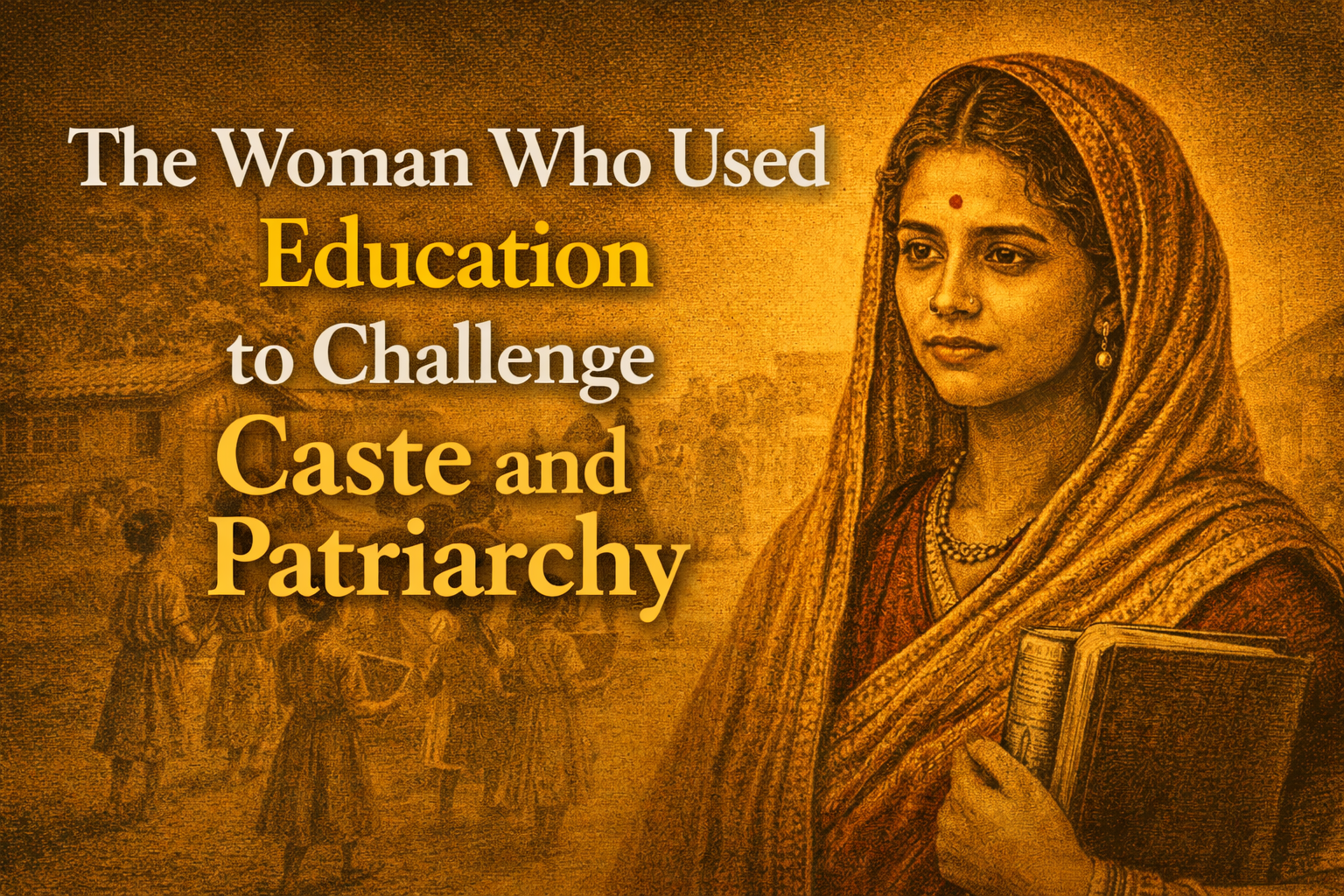
Savitribai Phule: The Woman Who Used Education to Challenge Caste and Patriarchy
How Opening Schools for Girls Quietly Disrupted the Social Order of 19th-Century India
In 1848, a young woman walked through the streets of Pune carrying a second sari in her bag, not for warmth, but because neighbours regularly threw mud, stones, and dung at her on the way to school.
That woman was Savitribai Phule.
She was seventeen years old.
She was a teacher.
And she had just opened India’s first school for girls.
Savitribai Phule did not work from a safe intellectual distance.
She worked inside the exact structures that resisted change:
- Caste hierarchy
- Gender restrictions
- Religious orthodoxy
- Control over literacy
What she built between 1848 and 1897 was not simply a school system.
It was a direct challenge to the social logic deciding:
- Who deserved education
- Who deserved dignity
- Who was allowed to think publicly
This article examines:
- Who Savitribai Phule was
- Why opening schools became socially disruptive
- How caste and gender operated together
- What her institutions actually did
- Why her legacy remains politically important today
Who Was Savitribai Phule?
Savitribai Phule was born on January 3, 1831, in Naigaon village in present-day Maharashtra.
She came from the Mali community, a lower-caste farming background placed outside the Brahminical hierarchy controlling education and religious authority in 19th-century India.
She was married at nine years old to Jyotirao Phule, who later taught her to read and write at home.
That act itself was socially transgressive.
Female literacy was discouraged across many communities, especially among lower-caste women.
Savitribai later completed formal teacher training in Pune and Ahmednagar.
On January 1, 1848, Savitribai and Jyotirao Phule opened their first girls’ school at Bhide Wada in Pune.
The school began with:
- Nine students
- Two teachers
- Enormous resistance
India’s first female teacher had arrived.
Why Opening a School Became Socially Dangerous
The hostility toward Savitribai Phule was not accidental.
It reflected the structure she was disrupting.
In 19th-century Maharashtra:
- Caste restricted access to knowledge
- Gender restricted mobility and public participation
Literacy among lower-caste women challenged both systems simultaneously.
A literate Dalit or lower-caste woman represented something larger than education.
She represented:
- Independent thought
- Public visibility
- Resistance to inherited hierarchy
That is why neighbours attacked Savitribai on the road to school.
The violence carried a message:
Certain people were not supposed to learn.
Savitribai’s response was practical.
She carried an extra sari, changed after arriving, and continued teaching.
The Schools Were Not Symbolic Experiments
The Bhide Wada school was not a single isolated project.
Savitribai and Jyotirao Phule built:
- Eighteen schools across Pune and nearby regions between 1848 and the early 1850s
The schools shared three important features:
- They educated girls
- They admitted lower-caste students
- They taught in Marathi rather than Sanskrit
Teaching in Marathi mattered politically.
Sanskrit functioned as the preserve of Brahminical authority.
Using Marathi implied:
- Knowledge was not sacred property restricted to upper castes
The schools therefore challenged:
- Educational exclusion
- Caste hierarchy
- Control over language itself
What the Work Actually Looked Like
Savitribai’s work extended far beyond classrooms.
Education alone could not solve social exclusion if women still lacked:
- Shelter
- Safety
- Social protection
The Balhatya Pratibandhak Griha
In 1853, Savitribai and Jyotirao established:
Balhatya Pratibandhak Griha
The name roughly translates to:
Home to prevent the killing of children
The institution supported:
- Pregnant widows
- Abandoned women
- Rape survivors
At the time, widows who became pregnant faced:
- Social expulsion
- Violence
- Pressure toward infanticide
The home provided:
- Shelter
- Safe childbirth
- Care regardless of caste background
Savitribai later adopted a child born there:
- Yashwant, the son of a Brahmin widow
The adoption itself directly rejected caste purity norms.
The Mahila Seva Mandal
Savitribai also organised:
Mahila Seva Mandal
This organisation focused on:
- Women’s awareness
- Widow support
- Public participation for women
- Social equality
At the time, even gathering women publicly for discussion was considered socially inappropriate.
The meetings therefore served a deeper purpose:
- Moving women from private suffering into public voice
The underlying message remained consistent:
Women deserved dignity independent of caste or marital status.
The Satyashodhak Samaj and Rational Reform
Much of this work connected to:
The Satyashodhak Samaj
Founded by Jyotirao Phule in 1873, the organisation rejected:
- Caste hierarchy
- Priestly authority
- Superstition-based social control
The movement promoted:
- Scientific thinking
- Rational inquiry
- Self-respect among oppressed communities
Savitribai played a central role in this work.
After Jyotirao’s death in 1890, she effectively led major parts of the movement herself.
She even conducted:
- Satyashodhak marriage ceremonies without Brahmin priests
- Inter-caste social events
- Public gatherings challenging untouchability
The Poetry That Functioned Like Activism
Savitribai Phule was also a poet.
Her first major collection:
Kavya Phule (1854)
Addressed women and lower-caste communities directly in Marathi.
The poems argued:
- Ignorance was imposed, not natural
- Education was liberation
The poetry was not ornamental literature.
It functioned as:
- Political communication
- Educational outreach
- Mass social messaging
Her later collection:
Bavan Kashi Subodh Ratnakar (1892)
Focused more deeply on caste structure and social injustice.
Why Her Work Challenged Caste, Not Just Gender
Many historical summaries describe Savitribai Phule primarily as a pioneer of women’s education.
That description is accurate but incomplete.
Her work consistently targeted:
- Caste exclusion
- Gender exclusion
- Their interaction together
The schools were explicitly open to:
- Lower-caste students
- Dalit communities
- Marginalised groups excluded from education
Savitribai and her colleagues actively visited lower-caste neighbourhoods to encourage enrollment.
This mattered because caste hierarchy operated psychologically as well as materially.
The Satyashodhak Samaj argued:
- Oppressed communities had been taught to internalise inferiority
Restoring dignity and self-respect therefore became central to reform.
Savitribai’s institutions consistently reinforced one message:
Lower-caste communities deserved education, dignity, and public visibility.
The Final Years: Famine and Plague
During the Maharashtra famine of 1876–77, Savitribai and Jyotirao organised:
- Food distribution
- Shelter
- Support for labourers and farming communities
In 1897, bubonic plague spread across Pune.
Savitribai and her adopted son Yashwant opened:
- A clinic for plague victims
Savitribai personally carried sick patients to treatment facilities.
While transporting a sick child, she contracted plague herself.
She died on March 10, 1897.
She was sixty-six years old.
Her death reflected the same pattern as her life:
- Direct service inside the most difficult conditions
Where Her Legacy Stands Today
Savitribai Phule is officially recognised in India as:
- A pioneer of women’s education
- A major social reformer
Institutions and commemorations include:
- Savitribai Phule Pune University
- Balika Din celebrations on January 3rd in Maharashtra
- Public memorials and state recognition
But her legacy remains politically debated.
Dalit feminist scholars argue:
- Mainstream narratives often soften the caste dimension of her work
Presenting her only as:
- A generic education reformer
Can obscure the deeper reality:
- Her work directly confronted Brahminical authority and caste hierarchy
That debate itself reflects something important.
The structures Savitribai challenged:
- Have not disappeared entirely
Frequently Asked Questions
Who was Savitribai Phule?
Savitribai Phule (1831–1897) was a social reformer, educator, poet, and India’s first female teacher. She opened the first school for girls in India in Pune in 1848.
Why is Savitribai Phule important?
She challenged both:
- Gender inequality
- Caste hierarchy
Through schools, shelters, public organising, poetry, and direct social reform work.
What was the first girls’ school she opened?
The first girls’ school opened at:
- Bhide Wada, Pune, on January 1, 1848
What was the Balhatya Pratibandhak Griha?
It was a shelter established for:
- Pregnant widows
- Abandoned women
- Women facing social exclusion
The institution worked to prevent infanticide and provide safe childbirth support.
Why is Savitribai Phule connected to Dalit feminism?
Because her work treated:
- Caste oppression and gender oppression as interconnected systems
Her schools and reform work specifically included lower-caste and Dalit communities.
How did Savitribai Phule die?
She died from plague in 1897 after contracting the disease while carrying a sick child to a treatment clinic she helped run.
Final Perspective
Savitribai Phule’s work was never only about education.
The schools mattered because they were connected to a larger structure:
- Shelter for widows
- Resistance to caste hierarchy
- Public dignity for women
- Rational social reform
- Direct community organising
The school was the visible institution.
The deeper project was changing who society believed deserved knowledge and humanity in the first place.
That is why her work produced such resistance.
And that is why it still matters.
Savitribai Phule did not merely teach girls to read.
She challenged an entire social order built around deciding who should remain unread.