AI Isn’t Replacing Jobs. It’s Replacing How Work Gets Done
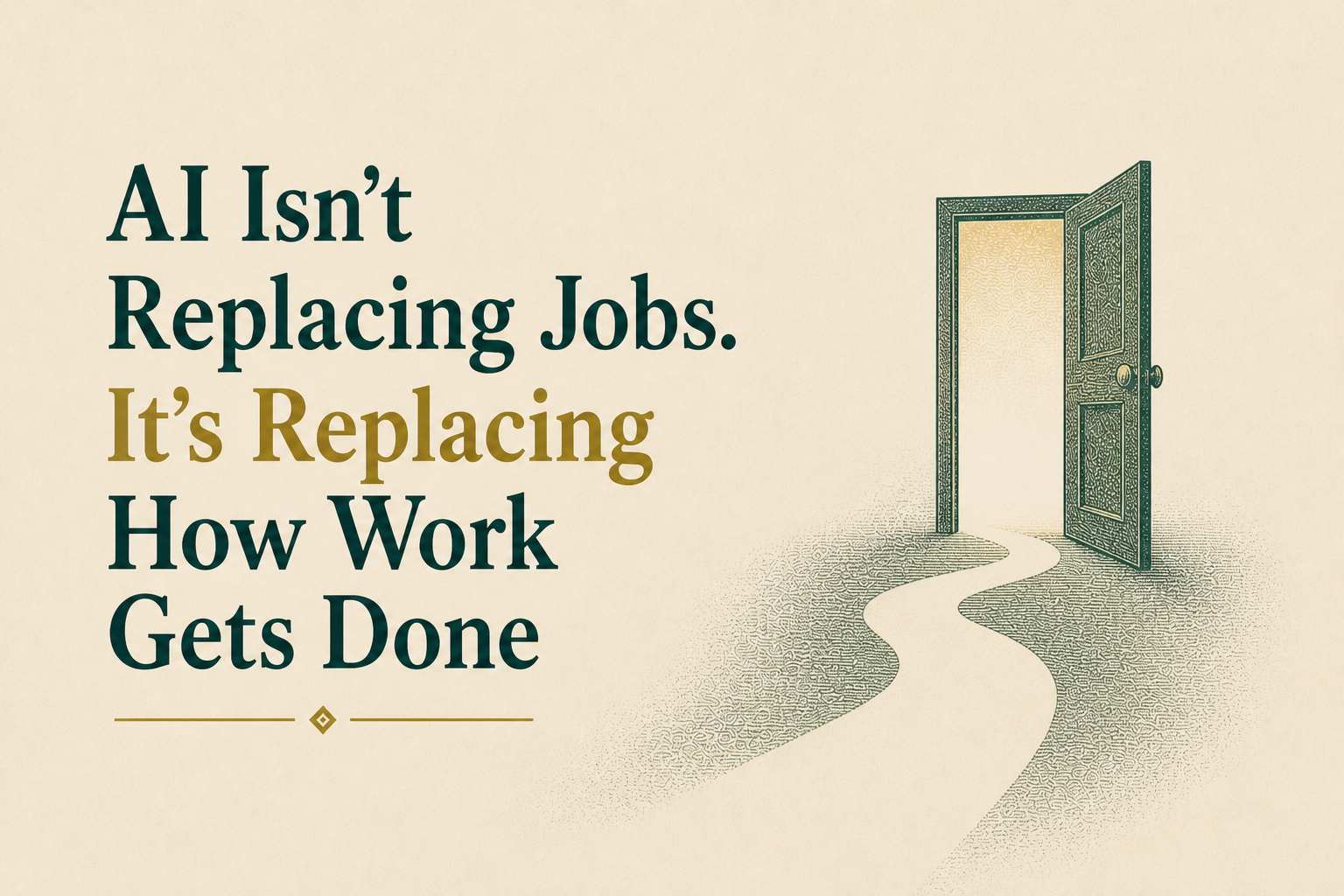
AI Isn’t Replacing Jobs. It’s Replacing the Old Method of Doing Them
Two people join the same company in the same role.
Same experience level.
Same manager.
Same targets.
Twelve months later, one of them is completing complex projects before the other has cleared their inbox.
The difference is usually not:
- Intelligence
- Seniority
- Access to better software
Both employees often have:
- The same subscriptions
- The same AI tools
- The same meeting calendar
The real difference sits somewhere quieter:
Where AI is positioned inside the workday.
The Split Happens Before Anyone Notices It
Most professionals inserted AI into their existing workflow.
They use it the way they once used search engines:
- To look something up
- To accelerate drafting
- To avoid starting from a blank page
That produces genuine improvement.
Tasks become faster.
But the structure of the day remains largely unchanged.
The person who once spent two hours writing a brief now finishes it in forty minutes and fills the remaining time with the next task waiting in the queue.
The output improves.
The method stays mostly intact.
A smaller group approached the shift differently.
They did not add AI on top of their workflow.
They redesigned the workflow around AI.
Their central question became:
“How do I structure this so AI handles the first layer entirely, and I focus on the layer that actually requires judgment?”
That question quietly changes the job from the inside.
No title change.
No announcement.
No visible transition.
Just a different operating model.
What Cognitive Leverage Actually Looks Like
Before this shift, a marketer might spend:
- Forty minutes staring at a blank document
- Another hour drafting one positioning angle
- Additional time revising it repeatedly
Then the draft enters a review meeting where it either survives or gets dismantled.
After redesigning the process:
- Eight positioning angles are generated rapidly
- The strongest two are selected
- Likely objections are pressure-tested in advance
The review meeting now serves a different function.
It no longer debates whether there is a viable direction at all.
It evaluates strong candidates.
The output improved.
The process improved.
But the larger shift is cognitive.
The mechanical portion of thinking:
- Generating first options
- Creating rough structures
- Producing starting points
Gets compressed.
What remains becomes:
- Selection
- Interpretation
- Judgment
- Strategic trade-offs
Those are usually the parts of work that actually move outcomes.
The Divide Is Not Between Users and Non-Users
Most professionals already use AI in some form.
The divide is not:
- Users vs non-users
The divide is:
- People who redesigned their work around AI
- People who layered AI on top of old methods
Adding AI on Top
Produces incremental gains.
A one-hour task becomes a forty-minute task.
Useful.
But structurally similar.
Redesigning Around AI
Produces a different category of workflow entirely.
The researcher who once delivered:
- Three insights per week
Now delivers:
- Twelve insights
- Comparisons attached
- Trade-offs already mapped
The strategist who once arrived with one recommendation now arrives with:
- Multiple viable options
- Second-order implications already explored
That difference compounds over time.
Over six months, it becomes visible.
Why Most Professionals Don’t Fully Make the Shift
The redesign requires a specific kind of discomfort.
It requires examining which parts of your work are mechanical and admitting they may not fundamentally require you.
An eight-hour day containing:
- Searching
- Formatting
- Drafting
- Organising
- Rewriting
Often includes only a smaller number of hours where genuine judgment is happening.
That is not unusual.
It has always been the structure of knowledge work.
Historically, the mechanical layer was necessary because it was how the judgment layer got reached.
AI compresses much of that layer.
What remains becomes exposed.
For many professionals, that exposure feels uncomfortable.
The mechanical effort created the feeling of having done the work.
Reports existed because someone spent hours building them.
Slides existed because someone spent time assembling them.
Replacing that process with a twenty-minute interaction changes not just output speed, but emotional understanding of what work itself looks like.
What the Fastest Adapters Actually Do Differently
The fastest adapters are not necessarily the smartest people in the room.
They are often the people most willing to:
- Release the mechanical layer
- Trust compressed workflows
- Operate directly at the judgment layer
That changes what their time gets spent on.
Less time producing.
More time deciding.
What AI Does Not Replace
AI does not replace professional judgment itself.
It does not replace:
- Reading a room
- Understanding a client’s hidden concern
- Knowing which contradictory report to trust
- Building credibility with a team
- Delivering difficult feedback effectively
The output layer and the relationship layer are different things.
AI compresses the output layer:
- Research
- Drafting
- First-pass analysis
- Formatting
The relationship layer remains human.
Which means it becomes proportionally more valuable over time.
The Professionals Likely to Gain the Most
The professionals who become most valuable over the next few years are unlikely to be:
- The people who resisted AI entirely
- The people who delegated all thinking to it
The strongest position sits somewhere else.
Offload the mechanical layer deliberately.
Retain ownership of:
- Judgment
- Interpretation
- Decision-making
- Trust
Then spend more time operating at the level where outcomes are actually decided.
The Real Shift Is Invisible Until It Isn’t
When someone finishes a week of work before the week is half over, the first instinct is often to explain it through:
- Talent
- Experience
- Natural speed
Sometimes those factors matter.
But increasingly, what you are observing is method.
A method that:
- Compresses the mechanical layer rapidly
- Routes remaining effort toward judgment
From the outside, the output looks normal:
- The email
- The report
- The slide deck
- The strategy brief
What changed is invisible:
- The cost of producing it
- The time consumed by it
- What the professional was free to do while it was being created
Conclusion
AI is not primarily replacing jobs.
It is replacing an older method of performing them.
The professionals pulling ahead are usually not working less.
They are operating at a different layer of the work itself.
The machine did not replace the role.
The method changed first.
The machine simply made the new method possible.