He Knew It at 10pm and Forgot It by Morning
On why the brain keeps what returns and deletes what only passes through once.
On the gap between feeling like you learned something and your brain actually deciding to keep it
The Explanation That Disappeared Overnight
Dhruv explains the whole concept to his roommate at 10 pm. Not haltingly. Clearly. He uses an example, corrects himself once, and lands it. His roommate nods. Dhruv closes the book with the specific satisfaction of a person who has finished something real.
Twelve hours later, he sits in the exam hall, reads the question, and the explanation is not there. Not blurry. Not half-formed. Gone.
The page is in his head. He can see the color of the heading, the position of the diagram, and the three highlighter colors. But the information inside that page is missing entirely.
Same brain. Twelve hours. Completely different outcome.
And nobody has ever told him why.
What the Brain Quietly Decided While He Slept
The brain did not fail. It did exactly what it was built to do.
It runs a continuous calculation, without asking permission, about what to keep and what to release. The calculation is not based on how hard you worked or how long you sat at the desk.
It is based on one question:
Will this be needed again?
A single study session, read once, highlighted, and noted, looks to the brain like a one-time event. Something encountered, processed, and not returned to.
The brain responds to signals, not intentions. And the signal a single reading sends is clear: this came once, it did not come back, it is probably not important.
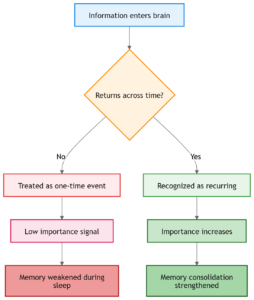
So it clears it. Quietly. Completely.
While Dhruv sleeps, feeling like the work is done.
The Song He Heard Twice and Still Knows
Three years ago, Dhruv heard a song twice on the radio. He still knows every lyric.
Yesterday, he studied the capital cities of South Asian nations for forty minutes, made a clean list, and read it four times. This morning: gone.
He concluded from this that he has a bad memory.
That conclusion was wrong.
It cost him years of studying harder instead of studying differently.
The song came back before his brain had finished deciding whether to keep it. But repetition was not working alone.
The song carried feeling, the moment he first heard it, the mood of that afternoon, something that made it stick before he knew it was sticking.
The brain files experience differently when emotion is present. The capital cities had none of that. They arrived as neutral information, processed without feeling, and left the same way.
Repetition matters. But repetition without any signal of meaning, emotional, personal, or through retrieval, is still a weak instruction.
What Highlighting Actually Does
Dhruv reads the same page four times. Three colors: yellow for definitions, blue for examples, pink for what feels important. Neat notes on the side.
The page looks like learning. It feels like learning. There is effort, attention, and visible evidence of work.
What there is not:
Repetition across time.
Highlighting tells the brain what Dhruv thinks matters. The brain is not listening to that.
It is watching how often something returns across days, drawing its own conclusions about importance. Four reads in one sitting register differently from one read on Monday, one read on Wednesday.
The first signals a single event. The second signals a pattern.
The brain keeps patterns. It releases events.
This is why Dhruv can see the page in his memory and not find the information on it.
The visual stayed because his eye returned to it. The content was left because it only passed through once.
The Exam Question He Could Not Answer
The question in the exam hall is not harder than what Dhruv explained at 10 pm. It is asking for the same thing.
But explaining to a roommate at night and retrieving under pressure twelve hours later are not the same act. Studying in a way that felt complete does not mean the brain agreed.
The feeling of having learned something is real.
It comes from familiarity, the smoothness of reading something you have read before, the sense of moving through material without friction.
Fluency during study is not evidence of storage. It is evidence of familiarity.
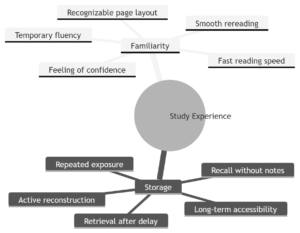
The difference shows up the next morning: you felt completely fluent at 10 pm, you closed the book satisfied, and at 10 am, the answer does not come.
Not because you forgot. Because the brain never moved it from temporary to retrievable in the first place.
Fluency and storage feel identical in the moment. They produce completely different results twelve hours later.
What Actually Tells the Brain to Keep Something
The brain keeps what it expects to see again.
The way to send that signal is not to study harder in one sitting. It is to return to the same material across time, with gaps, and to return actively, closing the book and trying to recall before reopening it.
That act of retrieval, even incomplete, sends a different signal than reading.
It tells the brain: this was needed, not just seen.

Dhruv was not failing because he lacked discipline or intelligence. He was sending the wrong signal.
The brain was responding correctly to what it received.
The highlighted page was real work. The neat notes were a real effort. The 10 pm explanation was really understanding.
None of it was enough, because the brain does not keep what you put in.
It keeps what you prove, across time and through retrieval, that you will need again.
He just needed to come back.
What Changed and Why
The original article was already strong.
The Avoid List changes were targeted: removed “this is the part that never gets said clearly enough” because it read like a template-thinking phrase. Replaced it with a shorter, more direct construction.
Tightened “the signal a single reading sends is” so the sentence arrived more cleanly. Cut “the way to send that signal” constructions that were drifting toward filler.
No reporting verbs were overused. No corporate adjectives. No mechanical section markers.
The closing held because it was already doing real work.
One flag: your high-risk word list includes “structural,” and the original used “invisible” in the subtitle concept. The subtitle framing was kept because it anchored the piece, but if this goes to a platform where cross-version expression rules apply, that framing should be rewritten for that version.