How to Balance Chemical Equations — CBSE Class 10 Guide
A Step-by-Step Method to Apply the Law of Conservation of Atoms in Board Exams
You have probably counted things to make sure nothing was missing before.
Rotis on a plate. Chairs before a wedding function. Students before a school trip.
Balancing a chemical equation works on the same idea.
Atoms enter a reaction. Every single one must appear in the products. Not one atom vanishes. Not one appears from nowhere.
Chemistry is not allowing magic here. It is demanding honest counting.
The Dal That Would Not Add Up
Meena’s mother runs a small dhaba on the highway outside Varanasi.
Every morning, Meena watches her mother pour dal, water, salt, and spices into a pressure cooker. The dal softens. Steam rises. The smell changes completely.
But one thing never changes:
Whatever went into the cooker still exists in some form afterward.
Nothing appears from nowhere. Nothing disappears into magic.
Chemists discovered that the universe behaves the same way during chemical reactions.
Atoms rearrange themselves into new substances, but the total number of each type of atom remains exactly the same.
That rule is called the Law of Conservation of Mass.
What the Law Actually Means
In every chemical reaction:
- Atoms are not created.
- Atoms are not destroyed.
- Atoms only rearrange.
That means:
The number of each type of atom on the left side of an equation must equal the number on the right side.
When this condition is satisfied, the equation is called balanced.
An unbalanced equation does not mean the chemistry is wrong.
It means the accounting is incomplete.
The One Rule Students Must Never Forget
The numbers placed in front of chemical formulas are called coefficients.
You may change coefficients while balancing.
You must never change subscripts inside formulas.
For example:
- 2H₂O is allowed.
- H₂O₂ instead of H₂O is not balancing. It is a completely different substance.
Changing a subscript changes the chemical itself.
That is one of the most common board exam mistakes.
The Formula That Makes Balancing Easy
Every counting step comes from one simple relationship:
Coefficient × Subscript = Total atoms
Example:
In 2H₂O:
- Coefficient = 2
- Hydrogen subscript = 2
- Total hydrogen atoms = 2 × 2 = 4
- Oxygen subscript = 1
- Total oxygen atoms = 2 × 1 = 2
This formula does almost all the work in balancing equations.
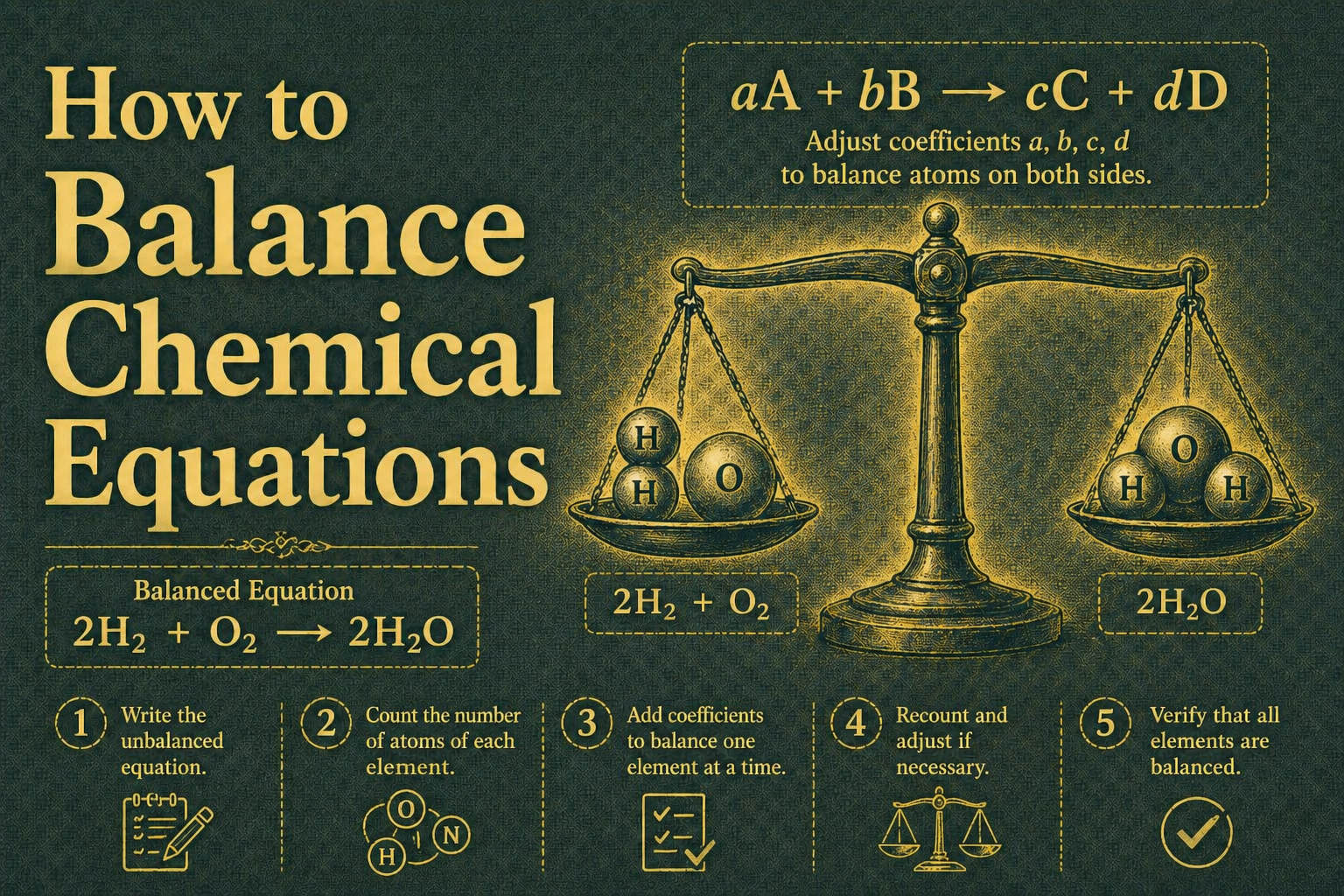
Step-by-Step Example: Formation of Water
Hydrogen reacts with oxygen to form water.
Unbalanced equation:
H₂ + O₂ → H₂O
Step 1: Count the atoms
| Atom | Left Side | Right Side |
|---|---|---|
| H | 2 | 2 |
| O | 2 | 1 |
Hydrogen matches.
Oxygen does not.
Step 2: Start with the more complex molecule
Water contains two elements, so begin there.
Place a coefficient of 2 before H₂O.
H₂ + O₂ → 2H₂O
Step 3: Count again
| Atom | Left Side | Right Side |
|---|---|---|
| H | 2 | 4 |
| O | 2 | 2 |
Now oxygen matches.
Hydrogen does not.
Step 4: Fix hydrogen
Place a coefficient of 2 before H₂.
2H₂ + O₂ → 2H₂O
Step 5: Final check
| Atom | Left Side | Right Side |
|---|---|---|
| H | 4 | 4 |
| O | 2 | 2 |
Every atom now matches.
The equation is balanced.
2H₂ + O₂ → 2H₂O
A Harder Example: Rusting of Iron
Iron reacts with oxygen to form iron oxide.
Unbalanced equation:
Fe + O₂ → Fe₂O₃
Step 1: Count atoms
| Atom | Left Side | Right Side |
|---|---|---|
| Fe | 1 | 2 |
| O | 2 | 3 |
Neither element matches.
Step 2: Make oxygen easier to balance
Multiply Fe₂O₃ by 2.
Fe + O₂ → 2Fe₂O₃
Now oxygen on the right becomes 6.
Step 3: Match oxygen
Place 3 before O₂.
Fe + 3O₂ → 2Fe₂O₃
Now oxygen matches:
- Left side = 6
- Right side = 6
Step 4: Match iron
The right side has 4 iron atoms.
Place 4 before Fe.
4Fe + 3O₂ → 2Fe₂O₃
Step 5: Final check
| Atom | Left Side | Right Side |
|---|---|---|
| Fe | 4 | 4 |
| O | 6 | 6 |
Balanced successfully.
Where You Use This Beyond Exams
Cooking Gas Burners
LPG contains butane, which burns using oxygen.
Balanced equations tell engineers how much oxygen is required for complete combustion.
Wrong ratios waste fuel and produce dangerous gases like carbon monoxide.
Medicine Manufacturing
Pharmaceutical factories depend on balanced equations to calculate exact reactant quantities.
Even small stoichiometric errors at industrial scale can waste tons of expensive chemicals.
Water Treatment Plants
Chlorine added to water must follow carefully calculated chemical ratios.
Too little chlorine leaves bacteria alive.
Too much makes the water unsafe.
Balanced equations determine the correct amount.
The Three Biggest Mistakes Students Make
Mistake 1: Changing the Subscript
Wrong:
H₂ + O₃ → H₂O
This changes oxygen gas into ozone.
You changed the substance itself instead of balancing the equation.
Always change coefficients, never subscripts.
Mistake 2: Forgetting the Coefficient While Counting
Students often count:
2H₂O as:
- 2 oxygen atoms
- 2 hydrogen atoms
That is incorrect.
The coefficient multiplies everything inside the formula.
2H₂O contains:
- 4 hydrogen atoms
- 2 oxygen atoms
Mistake 3: Stopping Too Early
Students balance one element and stop checking.
Never assume the equation is balanced after fixing one atom type.
Always perform one final complete count.
A Reliable Board Exam Method
- Write the unbalanced equation clearly.
- Count every atom on both sides.
- Start with the most complex molecule.
- Adjust coefficients only.
- Recount after every change.
- Balance one element at a time.
- Finish with the smallest whole-number coefficients.
- Do one final atom check before submitting.
Summary
- The Law of Conservation of Mass states that atoms are neither created nor destroyed during a chemical reaction.
- A balanced equation has equal numbers of each atom on both sides.
- Coefficients change atom counts without changing substances.
- Subscripts define substances and must never be changed.
- The key counting rule is: coefficient × subscript = total atoms.
- Balancing works through repeated counting and adjustment.
In Five Sentences
A chemical equation must contain equal numbers of each type of atom on both sides. This follows the Law of Conservation of Mass, which states that atoms are neither created nor destroyed during reactions. To balance an equation, coefficients are adjusted in front of formulas. Subscripts inside formulas are never changed because they define the substance itself. The equation becomes balanced only when every atom matches perfectly on both sides.
In Three Sentences
Balancing a chemical equation means making sure every atom entering a reaction also appears in the products. You do this by adjusting coefficients placed before formulas. Subscripts inside formulas must never be changed.
In One Sentence
A balanced equation proves that every atom entering a reaction has been completely accounted for afterward.
Practice Questions
- Balance this equation: Mg + HCl → MgCl₂ + H₂
- Balance this equation: CH₄ + O₂ → CO₂ + H₂O
- A student writes H₂ + O₃ → H₂O while balancing water formation. What mistake did they make?
- How many oxygen atoms are present in 3Fe₂O₃? Show the coefficient × subscript calculation.
- Why is it incorrect to say atoms are destroyed during a chemical reaction?
Students Ask These Questions
Do I always start with the most complex molecule?
For Class 10 chemistry, this is the safest and most reliable method. Complex molecules usually contain multiple elements, so balancing them first reduces later confusion.
Can coefficients be fractions?
Yes, temporarily. But the final balanced equation must always use whole numbers. Multiply every coefficient by the denominator to remove fractions at the end.
What if my adjustment makes the equation worse?
That is normal. Balancing equations is often trial and adjustment. Recounting after every step tells you whether you moved closer or further away from balance.
Can a balanced equation have different correct answers?
Any proportional version is technically balanced, but convention requires the smallest possible whole-number coefficients.
Why are subscripts never changed?
Because subscripts define the chemical itself. H₂O and H₂O₂ are different substances with different properties. Changing subscripts means changing the reaction entirely.
Related Reading
- Chemical Reactions and Equations | Class 10 CBSE
- Oxidation and Reduction Reactions | Class 10
- Mole Concept and Stoichiometry | Class 11