Why Smart Students Get Stuck in Math and Science — And What Actually Unblocks Them
How one hidden wrong assumption can block learning for years in CBSE and ICSE students from Class 7–12
What is a wrong assumption in learning?
It is one incorrect idea a student absorbed early, never questioned, and built everything else on top of.
This article explains how to find it and why finding it works faster than any amount of re-explaining.
The Girl Who Solved Three Questions in Seven Minutes
Navya sits at her study table in her room in Patna. Notebook open. Three questions on the page. Pen in hand.
The pen does not move for forty minutes.
She is not daydreaming. She reads the problem, puts it down, and reads it again. Waits. Nothing opens.
The method is in her head. She learned it, her teacher checked it, and the steps are correct. But the answer will not come.
Then something small shifts.
Not new information. A different way of reading what was already there. One small change in how she is looking at the problem.
In the seven minutes that follow, all three questions answer themselves.
She did not learn anything new in those seven minutes. She corrected one thing she did not know she had wrong.
What Confusion Is Actually Made Of
When a student cannot solve a problem, the first instinct is: something is missing.
More explanation. More examples. More time.
So the teacher explains again, a different way, then a third way, then a fourth. The student listens, nods, tries again, and stays stuck.
Every new explanation lands on top of the confusion. It adds to the structure. It does not touch the floor.
There are two different problems that look identical from the outside.
The first is a gap, something never properly taught, a chapter missed, a concept skipped, and never recovered. A gap needs filling.
The second is a wrong assumption, one incorrect idea absorbed somewhere earlier, never questioned, because it never announced itself as wrong.
A wrong assumption needs replacing.
More explanation fills a gap. Applied to a wrong assumption, it adds more weight to a tilted floor.
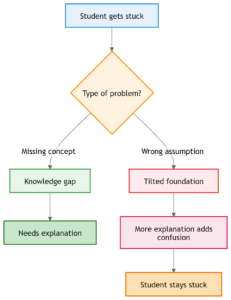
These two problems need completely different responses. But they look exactly the same from the outside: a student who cannot move forward.
Three Years. One Remark. One Minute of Quiet.
Navya has carried a wrong understanding of how a particular step works in algebra since Class 6.
Not large. Small enough that it never stopped her completely, just bent things slightly, made certain steps feel uncertain, produced errors she corrected by feel without knowing why they happened.
In Class 8, her teacher says something offhand.
Not a lesson. Not even directed at Navya. A remark made while writing something else on the board.
Something shifts.
Three years of low-level confusion dissolve. Navya goes quiet for about a minute.
That quiet is not processing new information. She understood the remark within seconds.
The quiet is the size of the cause sitting next to the size of the years.
One small wrong thing. Three years of working around it without knowing it was there.
The correction took four seconds. Not having it costs three years.
The Week That Would Not Move
A student in Class 9 is stuck on the same problem for a week.
His teacher explains it six different ways. Each explanation is clear, accurate, and carefully chosen. Each one stops at the same place.
On the seventh attempt, the teacher does not explain the content differently.
He changes the entry point, a different direction into the same problem.
The thing that would not move for seven days moves immediately.
Six explanations aimed at the top of the structure. The seventh found the crack at the base.
The content was never the problem.
The assumption the student was using to receive the content was slightly wrong, and every explanation that left that assumption in place was building correctly on a tilted floor.
Step 1: The student holds a wrong assumption that they cannot see.
Step 2: Explanations land above it. Each one is correct. None of them reach it.
Step 3: The entry point changes. The assumption becomes visible.
Step 4: The correct version replaces it. Everything built above it re-aligns.
The information did not change. The floor did.

One Image. One Sitting. Two Weeks Resolved.
Coordinate geometry. Navya spends two weeks on it.
The method is correct. She checks it, her teacher checks it, and the steps follow the right sequence.
The answers are still wrong. Every time.
Then someone says:
“Think of the x-axis and y-axis as two walls meeting at a corner of a room. The floor is where they cross.”
Navya finishes the chapter that evening without being asked.
One sitting.
The two weeks were not wasted.
The method was already there, steps practiced, procedure solid, the mechanical part ready to receive something.
What was missing was a picture underneath the procedure.
Without it, the correct steps applied to a misread space produce wrong answers every time.
The image completed what the method had already built.
Two weeks resolved, not replaced.
The Question That Reaches the Right Place
When nothing is moving, the instinct is to work harder on the part that is not moving.
Read it again. Try the method again. Ask for another explanation of the same thing.
If the problem is at the foundation, none of that reaches it.
The wrong assumption hides where a student says, “I understand this,” but cannot explain why a particular step is done.
It sits in the chapter revised four times, but still does not feel solid.
It lives in the moment where the method works, but the answer is wrong, and the gap cannot be located.
Most students ask:
What do I not know?
The question that reaches further:
What do I think I know that might be slightly off?
Harder to ask. It requires doubting something that feels settled.
But it is the only question aimed at the right floor, not where the confusion shows up, but where it was made.
Common Mistakes
Many students think being stuck means the concept is too hard.
But often the concept is fine, the entry point is wrong.
Changing the direction of approach, not the explanation, is what moves it.
Many students revise the chapter where they feel stuck.
The wrong assumption is almost never in that chapter.
It is one or two chapters earlier, in something that felt understood at the time.
Many students think a fast correction means the confusion was small.
Navya’s correction took four seconds.
The confusion lasted three years.
Speed of correction and size of the problem are not connected.
Practice Questions
- You have revised the same chapter four times, and it still does not feel solid. What is the more useful question: what don’t you know, or what do you think you know that might be slightly off?
- Your method is correct, and your steps are right, but your answer is wrong every time. Where is the problem most likely sitting?
- A student understands a concept fully in one session after six sessions of not understanding it. What changed, the information or something else?
FAQ
Why does more explanation sometimes make things worse?
If the block is a wrong assumption, each new explanation adds to the structure above it.
The foundation does not change.
The weight on top of it increases.
The student works harder on the wrong floor.
How do you find a wrong assumption if it feels correct?
Look for the place where the method works, but the answer is wrong.
Look for the step you do correctly but cannot explain.
Look for the chapter that never quite feels solid, no matter how many times you revise it.
The assumption is hiding near that feeling.
Why does the correction sometimes feel like something releasing rather than something learned?
Because nothing new entered.
Something that was bent got straightened.
The knowledge was already there; it was just sitting on a tilted base.
When the base corrects, everything above it re-aligns at once.