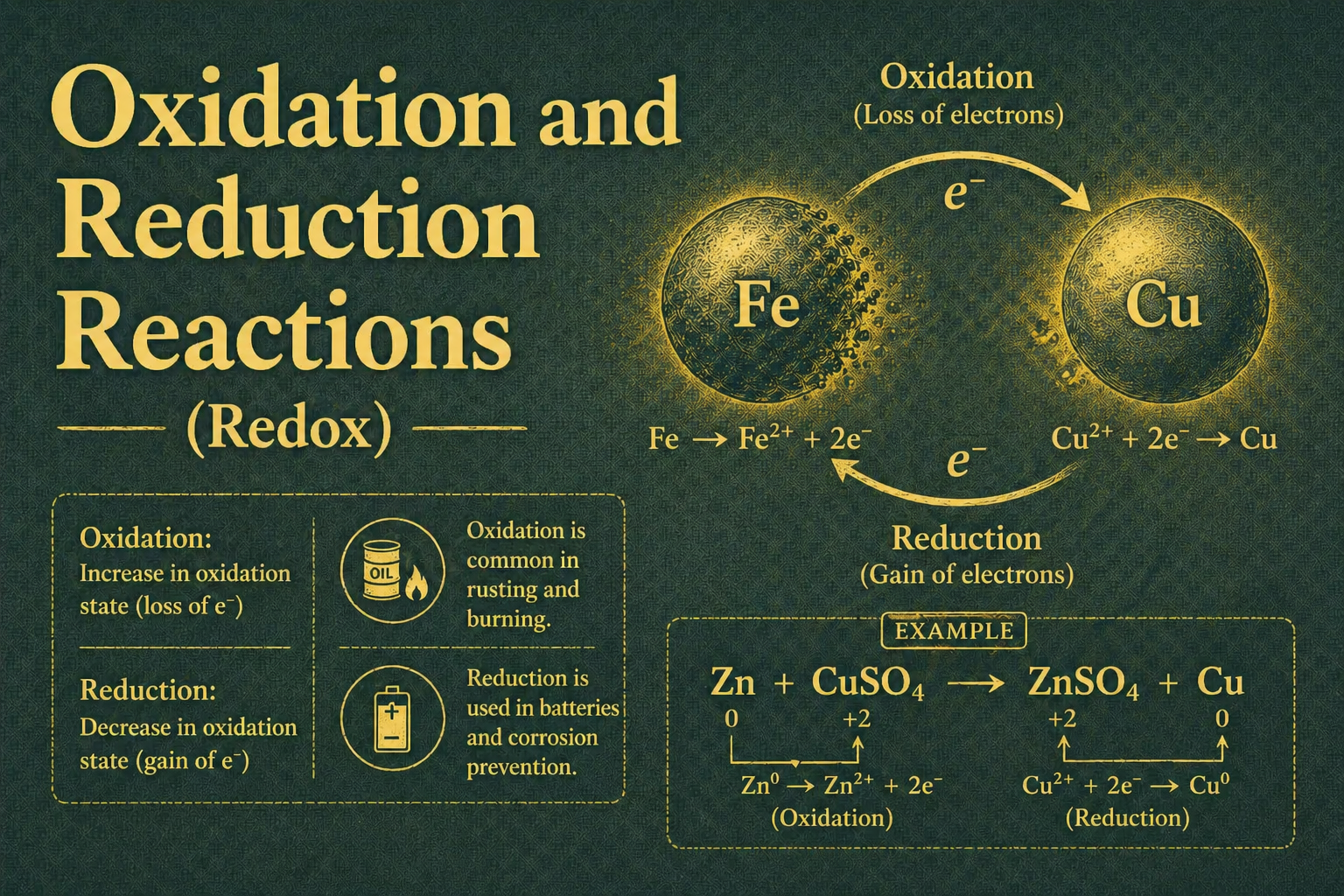
Oxidation and Reduction Reactions (Redox) — CBSE Class 10 Chemistry
OIL RIG Made Simple: How Electron Transfer Helps You Truly Understand Redox Reactions
You have already seen redox reactions many times.
An iron gate turning orange after the monsoon. A sliced apple slowly becoming brown. A matchstick bursting into flame.
Different situations. Same invisible process underneath:
Electrons moving from one substance to another.
That movement is the heart of every redox reaction.
The Boy at the Forge
Suresh is fourteen.
His father runs a small iron forge outside Muzaffarpur in Bihar. Before every monsoon, Suresh helps coat iron tools with a thin layer of oil:
- Hammers
- Chisels
- Iron rods
- Farming tools
One evening, Suresh asked why the oil mattered.
His father replied:
“Oil keeps the air away. Air takes something from iron.”
The tools covered properly stayed shiny for months.
The tools left exposed became rough, flaky, and orange.
Something invisible was leaving the iron.
What Was Actually Leaving the Iron
Iron does not rust because chunks disappear physically.
The deeper change happens at the atomic level.
Iron atoms contain electrons.
Oxygen in the air strongly attracts those electrons.
When iron and oxygen meet:
- Iron loses electrons
- Oxygen gains electrons
That transfer changes both substances permanently.
The iron becomes iron oxide, which you recognise as rust.
And this leads directly to the central idea of redox reactions:
One substance loses electrons while another gains them.
These two events always happen together.
Now the Reaction Gets Its Name
Scientists gave separate names to each side of the electron transfer.
Oxidation
Oxidation means loss of electrons.
When iron loses electrons to oxygen, iron is oxidised.
Reduction
Reduction means gain of electrons.
When oxygen gains electrons from iron, oxygen is reduced.
The easiest memory trick for this is:
OIL RIG
- Oxidation Is Loss
- Reduction Is Gain
These four words are enough to solve a large number of Class 10 redox questions.
Oxidising Agent and Reducing Agent
Students often confuse these terms initially.
The key is understanding what each substance does.
Oxidising Agent
An oxidising agent causes another substance to lose electrons.
It accepts those electrons itself.
In rusting:
- Oxygen pulls electrons from iron.
- So oxygen is the oxidising agent.
Reducing Agent
A reducing agent causes another substance to gain electrons.
It donates electrons.
In rusting:
- Iron gives electrons away.
- So iron is the reducing agent.
How Electron Transfer Happens Step by Step
Step 1: Iron Holds Electrons
Iron atoms at the surface contain loosely held electrons.
Oxygen strongly attracts them.
Step 2: Oxygen Pulls Electrons Away
When iron contacts oxygen:
- Iron loses electrons
- Oxygen gains electrons
This is the actual redox process.
Step 3: Iron Becomes an Ion
After losing electrons, iron is no longer neutral.
It becomes:
Fe²⁺ or Fe³⁺
The positive sign shows electrons have left.
Step 4: Rust Forms
The iron ions combine with oxygen to form iron oxide:
Fe₂O₃
That reddish-brown material is rust.
Step 5: Oil Prevents the Process
Oil blocks oxygen from reaching the iron surface.
No contact means:
- No electron transfer
- No oxidation
- No rust
Suresh’s father understood the chemistry long before hearing the word “electron.”
The Half-Reactions Explained Simply
Chemists often split redox reactions into two smaller equations called half-reactions.
For rusting:
Oxidation Half-Reaction
Fe \rightarrow Fe^{2+} + 2e^-
Iron loses electrons.
Reduction Half-Reaction
O_2 + 4e^- \rightarrow 2O^{2-}
Oxygen gains electrons.
The symbol e⁻ represents electrons.
The arrows show the direction of electron movement.
Together, these two half-reactions form the complete redox reaction.
Where You See Redox Reactions Every Day
Burning Wood or Paper
Carbon in wood loses electrons to oxygen during combustion.
Heat and light are released as electrons move between substances.
Every fire is a redox reaction.
Bleaching Clothes
Bleaching agents remove electrons from coloured molecules.
The molecules change structure and lose colour.
Batteries
Inside a battery, chemicals exchange electrons continuously.
That electron flow through a wire becomes electric current.
Every torch battery works through controlled redox reactions.
Rusting of Wet Iron
Water speeds up electron movement between iron and oxygen.
That is why wet iron rusts faster than dry iron.
The Three Most Common Mistakes Students Make
Mistake 1: Mixing Up the Agent and the Substance
Students often write:
“Iron is the oxidising agent because iron gets oxidised.”
That is incorrect.
The oxidising agent causes oxidation in another substance.
Oxygen pulls electrons from iron.
So oxygen is the oxidising agent.
Mistake 2: Treating Oxidation and Reduction Separately
These are not independent reactions.
If one substance loses electrons, another must gain them simultaneously.
Oxidation and reduction always occur together.
Mistake 3: Thinking Oxidation Always Requires Oxygen
Historically, oxidation was linked with oxygen.
Modern chemistry defines oxidation differently:
Oxidation means loss of electrons, even if oxygen is absent.
Electron transfer matters more than the element involved.
The ELIS Ladder: Understanding at Every Level
Level 1: Class 6 to 8
Iron loses electrons to oxygen.
That loss is oxidation.
Oxygen gains those electrons.
That gain is reduction.
OIL RIG helps remember both.
Level 2: Class 9 and 10
A redox reaction involves simultaneous oxidation and reduction.
Key ideas:
- Oxidation = loss of electrons
- Reduction = gain of electrons
- Oxidising agent accepts electrons
- Reducing agent donates electrons
Half-reactions show each side separately.
Level 3: Class 11, 12, and Beyond
Higher chemistry introduces oxidation numbers.
Instead of directly tracking electrons, chemists track changes in oxidation state.
At this level:
- Increase in oxidation number = oxidation
- Decrease in oxidation number = reduction
Electrochemistry builds directly on this foundation.
In galvanic cells, redox reactions are physically separated into half-cells, and electron movement generates measurable voltage.
Students who genuinely understand OIL RIG usually find later electrochemistry far easier.
In Five Sentences
A redox reaction involves electrons moving from one substance to another. The substance losing electrons undergoes oxidation. The substance gaining electrons undergoes reduction. Oxidation and reduction always occur together because electrons lost by one substance must be gained by another. OIL RIG helps remember this: Oxidation Is Loss, Reduction Is Gain.
In Three Sentences
Redox reactions involve electron transfer between substances. Losing electrons is oxidation. Gaining electrons is reduction.
In One Sentence
A redox reaction is the simultaneous transfer of electrons from one substance to another.
Practice Questions
- In the rusting of iron, which substance is oxidised and which is reduced?
- In the reaction 2Mg + O₂ → 2MgO, identify the oxidising agent and reducing agent.
- Why can oxidation never occur alone?
- Give one example of oxidation where oxygen is not involved.
- Write the oxidation and reduction half-reactions for rusting.
Students Ask These Questions
Is OIL RIG useful only in Class 10?
No. OIL RIG forms the foundation for oxidation numbers, electrochemistry, and galvanic cells studied later. Higher chemistry extends the idea rather than replacing it.
Why is the oxidising agent not the substance being oxidised?
Because the oxidising agent causes oxidation in another substance by accepting electrons itself. The name describes what it does, not what happens to it.
Is every fire a redox reaction?
Yes. Combustion always involves electron transfer between fuel and oxygen.
Can one substance be both oxidised and reduced?
Yes. This is called disproportionation and appears in higher-level chemistry.
Why does oil stop rusting?
Oil blocks oxygen and moisture from contacting iron, preventing electron transfer from starting.
Related Reading
- Chemical Reactions and Equations | Class 10 CBSE
- Electrochemistry | Class 12
- Metals and Non-Metals | Class 10