
She Said “I’ll Have Whatever”
She Learned to Want Less Before Anyone Asked
On the woman who made herself easy to handle and then couldn’t find where she put herself.
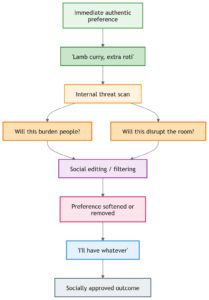
Navya knows what she wants before the waiter finishes his round. Lamb curry, extra roti. Thirty seconds, no hesitation. Then she looks up, sees three people still deciding, and puts the preference down.
Not because she changed her mind. Because wanting something, in that moment, felt one step from burdening someone. And she does not do that.
“I’ll have whatever,” she says.
The table moves on.
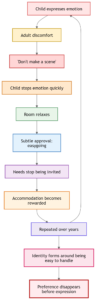
She learned this at nine. Not from a lecture. From a room.
She was crying, and someone said, quietly but clearly: ” Don’t make a scene. She stopped in under thirty seconds. The room moved on. What nobody said out loud, what nobody needed to say, was: this is the right way to be. The crying that stopped was called composure, and composure was called good.
Then the praise stopped being necessary.
Not loudly. Not with a certificate. In the small, continuous way that shapes a person: the relief on adult faces, the way a room relaxes when you don’t push, the word “easygoing” offered like it is the finest thing a girl can be. The praise was the water. The silence around her needs did the deeper work. Nobody asked what she wanted after the crying stopped. Nobody made a space where her preference was invited.
The praise said: This is good. The silence said: this is all there is.
Both ran together for years. She absorbed both without separating them. Accommodation was the behavior. Given enough time, the plant stopped being a plant and became the shape of the pot.
She is thirty-one now. She eats standing at the kitchen counter at 11 pm.
Not because she forgot to eat. She served everyone. She cleaned while they sat. She told herself she’d sit after, and after came, and the table was empty, and sitting at an empty table felt stranger than standing where at least the solitude had its own shape. So she eats standing. Three minutes. Plate rinsed before she’s finished.
Nobody asked her to do this. Nobody is watching. The house is quiet.
She is doing it anyway.
The behavior stopped being a response to pressure a long time ago. It is now just how she moves.
She speaks last in meetings, not from shyness, but from something older: a trained hesitation that checks the room before it lets her mouth open. She takes the seat near the door. She orders a second so she can scan what others want and not disrupt the shape of the order. She says “I’m fine” to questions she was not even asked.
She is not performing. She is not being polite on top of a real feeling. The accommodation runs underneath, before feeling gets a chance to form.
She knew what she wanted. She knew it at the restaurant within thirty seconds. The problem is that knowing and acting sit on opposite sides of something she was never given permission to cross. What reaches the surface is the approved version: smaller, quieter, easier to carry.
The preference was formed and removed before it reached her mouth. Nobody at the table knew a preference had existed.
The anger, when it comes, comes sideways.
Not at the table. Not at anyone specific. In the car on the way home, or at 2am when she’s tired enough that the editing slows down. It arrives as irritation at particular people, particular silences she still cannot bring herself to break. Then, because she cannot justify the irritation without sounding unreasonable, it turns inward and becomes something quieter and harder to move.
If someone had forced her, she’d know what to do with it.
But the accommodation was chosen. Chosen so many times, for so long, under so much approval and so much silence, that it stopped being a choice and became the person choosing. She cannot locate the self that existed before she learned to disappear into other people’s comfort. She does not know what she wants at restaurants, in meetings, in the quiet moments when nobody is watching, and she still makes herself small.
The identity that formed around being easy to handle is not a wound. It was a solution. It worked. It kept the rooms calm. It made her useful. It made her loved, in the particular way that people love those who do not inconvenience them.
That love was real. She felt it. She built her sense of herself around being the person who gave it.
But the solution has a cost that only becomes visible late.
Not that she gave too much. She gave so consistently, for so long, that permission to want something became a thing she needed from outside herself and stopped being able to generate alone. She doesn’t know what she’d order if she ordered first. If she stopped accommodating, she would meet a version of herself she had never been introduced to. That version has preferences. Takes up space. She doesn’t know if she’d like her. She doesn’t know if anyone else would.
So she keeps the menu closed. She says, “I’ll have whatever.” She eats standing at the counter.
Not because it is asked of her.
Because the woman who sits down, orders first, and leaves the plate for later is someone she hasn’t become yet. And she cannot tell whether that version is waiting to be found, or whether the years of not asking have already answered the question for her.
Both things have been true long enough that she cannot tell them apart anymore.
That’s the actual situation. Not the beginning of something. The middle of it, with no clear edge on either side.