
US Sector Analysis: Defense & Aerospace Industry
USA Sector Analysis Series: Defense & Aerospace
Why Supply Chains Will Decide the Winners, Not Contract Size
Governments are no longer asking whether to spend more on defense. They are asking how fast they can. That shift in the question changes what gets built, who captures the value, and where the real constraint in the system now sits. This article works through each of those consequences in sequence, using sourced figures throughout. Claims that cannot be verified have been removed.
Reading time: approximately 18 minutes. Sources listed at the end.
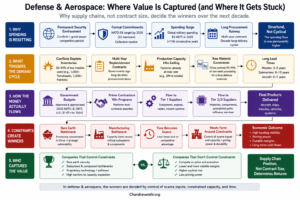
What Actually Changed
For thirty years, the dominant assumption across NATO was that military spending could stay low because the conditions requiring it had passed. That assumption is now gone, and the spending reset that followed is not a temporary response to active conflict. It is a formal, institutionalized shift in how member states budget.
In June 2025, NATO raised its collective spending target from 2% of GDP to 5% by 2035. Poland reached 4.3%. Lithuania reached 4.0%. Germany, which spent decades treating defense budgets as politically toxic, crossed 2% of GDP for the first time since 1990, growing its defense spending 24% in a single year to reach $114 billion, without being in active combat. Spain increased its defense budget by 50% to $40.2 billion, also crossing 2% for the first time since 1994.
European NATO members collectively spent $574 billion in 2025, a 20% increase in real terms in one year. Total NATO expenditure reached $1.581 trillion, representing 55% of all global military spending.
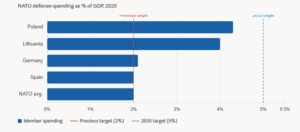
Europe is not responding like a continent expecting temporary instability. It is rebuilding military capacity as if instability has become a permanent governing condition.
That produces a different kind of procurement calendar, one that runs on decade-long contracts rather than emergency authorizations.
The United States spent $954 billion in 2025. That figure appeared to drop 7.5% from the prior year, which created confusion in financial coverage. The drop was accounting, not strategy: the 2024 figure included emergency Ukraine supplemental funding not renewed in 2025. The underlying budget did not shrink. Congress approved over $1 trillion for 2026, with figures potentially reaching $1.5 trillion by 2027 under current budget proposals.
Global military spending hit $2.887 trillion in 2025, the eleventh consecutive year of growth. The global military burden, measured as a share of world GDP, is at its highest since 2009.
Countries that spent 1% of GDP on defense for three decades cannot reach 4% or 5% without years of contracted procurement.
The spending calendar does not reset on a ceasefire. That single operational reality is what most retail analysis fails to carry forward.
What Retail Investors Get Wrong
Several beliefs are common among retail investors in this sector. Most are incomplete. Some are wrong outright.
Defense is cyclical. The assumption is that spending follows wars up and follows peace down. The NATO 5% target is encoded in formal government commitments made by 32 member states. The clock does not reset on a ceasefire.
Only active conflicts move the sector. Procurement cycles matter more than combat events. When a conflict consumes missile inventories, governments need five to ten years to rebuild stockpiles even with contracts signed immediately. A ceasefire does not pause the replenishment calendar.
Only prime contractors benefit. This is where the real analytical gap sits. Investors focus on Lockheed Martin, RTX, Northrop Grumman, and General Dynamics because they are the names on the headline contract. The constraint in defense production right now is not budget approval. It is the physical capacity to manufacture. The companies that control what the primes cannot scale without are the less-discussed part of this picture.
Revenue follows contract announcements quickly. It does not. Missile replenishment takes three to five years to convert into recognized revenue. Nuclear shipbuilding recognizes revenue over eight to ten years. A company reporting a record backlog in 2026 may not see peak revenue from that backlog until 2030 or later.
Margins are uniform across defense. They are not. Shipbuilding carries long contract durations, high capital requirements, and variable margins. Missile systems face high demand against constrained production. Defense software generates recurring revenue that scales without proportional capital investment. Electronic warfare and systems integration operate at higher margins than hardware platforms. A company with a large backlog and thin margins is a fundamentally different investment from a company with a smaller backlog and software-driven profitability.
How the Money Actually Moves
Sector writing that stops at “governments are spending more” is not analysis. The durable insight is in the chain of consequences that follows the spending commitment.
Conflicts in Ukraine and the Middle East depleted an estimated 30 to 50% of key missile inventories, including over 1,000 Tomahawk missiles and more than 1,200 Patriot interceptors. Tomahawk production runs at a rate that would require approximately ten years to replace what was deployed. Patriot interceptor production operates under the same constraints.
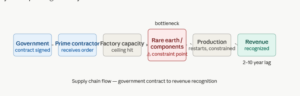
Governments signed multi-year replenishment contracts. Those contracts immediately hit a ceiling: the SM-6 missile factory is already operating at maximum production rate as of 2025. Additional contracts cannot accelerate delivery because the factory cannot run faster.
Above that production ceiling sits a constraint that most retail analysis has not yet engaged: rare earth materials.
A single F-35 contains 920 pounds of rare earth elements. THAAD interceptors depend on samarium, neodymium, and dysprosium for guidance and propulsion. China controls 93 to 99% of global refining capacity for these materials. In April 2025, China placed rare earth exports under formal licensing requirements, creating a documented chokepoint in the supply chain for the exact materials needed to manufacture the systems currently under procurement.
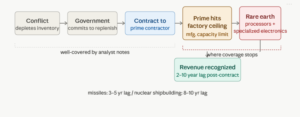
The money moves like this.
- Conflict depletes inventories.
- Governments commit to replenishment.
- Contracts are awarded to prime contractors.
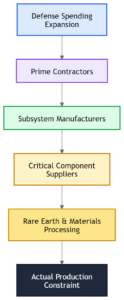
- Prime contractors hit manufacturing capacity ceilings.
- Those ceilings are set by component supply, not contract size.
- The bottleneck moves upstream to rare earth processors, specialized electronics manufacturers, and the handful of companies that can produce outside Chinese supply chains.
- Revenue recognition lags the contract by two to ten years, depending on the system.
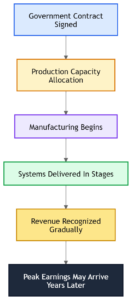
A contract does not deliver revenue if the factory cannot build what it promised.
The Shifts That Will Still Be True in Three Years
Several developments here are not news events. They are multi-year capital allocation changes.
Europe’s rearmament is not a single policy decision. It reflects a governing consensus shift that took decades to reverse and will take decades to complete. Germany is the clearest example: a country that treated defense spending as historically toxic has crossed 2% of GDP and is publicly committed to going further. That momentum does not unwind with a change in government or a diplomatic agreement in one theater.
NATO’s 5% target is a formal political commitment. 23 of 32 members crossed 2% in 2025. The trajectory from 2% toward 5% requires sustained procurement across every member state for a decade.
Taiwan-China tension is driving a parallel rearmament in the Asia-Pacific that is independent of the European dynamic. The procurement implications are equally durable.
Drone warfare has changed the economics of conflict. Ukraine demonstrated that cheap autonomous systems can accomplish what expensive legacy platforms were designed to do, at a fraction of the unit cost. This is not reducing demand for expensive systems. It is adding a new procurement category on top of existing demand, while simultaneously forcing faster production timelines for systems previously built on multi-decade schedules.
Modern warfare is shifting toward software. Electronic warfare, AI targeting, satellite systems, and cyber defense are moving procurement toward categories with recurring revenue and higher margins than hardware. That changes the financial character of the sector in ways that hardware-focused analysis does not capture.
Where the Opportunity Sits
This is a map, not a recommendation. The useful question is not just who benefits but where the crowding already is.
Prime contractors: visible, stable, crowded. Lockheed Martin, RTX, Northrop Grumman, General Dynamics. Procurement expansion benefits them directly. Huntington Ingalls reported a $53.1 billion backlog against approximately $10 billion in annual revenue, representing more than five years of forward visibility. These names are widely held and widely analyzed. The tailwind is real. How much of it is already reflected in valuations is a different question.
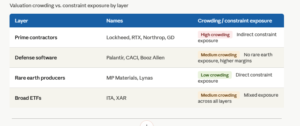
Defense software and intelligence: less crowded, higher margins. Palantir operates at the intersection of defense and AI-driven systems integration. CACI International and Booz Allen Hamilton work in defense intelligence and cybersecurity, subsectors growing faster than legacy hardware procurement and carrying more durable margin profiles.
International exposure: underweighted by most retail portfolios. BAE Systems is a direct beneficiary of UK and European rearmament. Rheinmetall is the clearest expression of the German rearmament trade, returning approximately 900% since 2022. That return raises an obvious question about what further appreciation is realistic from current levels.
Rare earth and supply chain plays: undercovered, supply-constrained. MP Materials and Lynas operate in rare earth production outside Chinese control. These are not defense companies in the traditional sense, but China’s April 2025 export licensing decision connects them directly to missile and aircraft manufacturing timelines.
ETFs for diversified exposure. ITA (iShares U.S. Aerospace & Defense ETF) holds over 35 companies, capturing second and third-tier suppliers that most retail investors overlook when focusing on primes alone. XAR (SPDR S&P Aerospace & Defense ETF) offers a different weighting. DFEN is leveraged and amplifies both direction and risk.
What Is Already Priced In, and What Is Not
The prime contractor rally began after February 2022. The European rearmament narrative has been in mainstream financial coverage since that point. NATO’s 5% target has been public since June 2025. The large-cap names carry valuations that reflect a market that has already absorbed the headline story.
What the market has not fully priced: production capacity ceilings and what they mean for revenue timing. Investors expecting 2026 earnings spikes from recent contract announcements may see that revenue arrive in 2028 or 2029. The backlog is real. The timeline is long.
What the market has not fully priced: the rare earth chokepoint. China’s export licensing decision received financial coverage, but its specific implications for missile and aircraft production have not yet filtered into how most retail investors evaluate individual companies. Exposure varies by system, by how much pre-purchasing each contractor has done, and by how aggressively they have diversified supply. That variation is not yet reflected in how the sector trades as a whole.
What the market has not fully priced: the second-tier supplier layer. When an ETF holds 35 companies, and the average retail investor recognizes three names, the remaining holdings represent companies that benefit from the same spending trajectory without carrying the same valuation premiums. The crowding is concentrated at the top. So is the analysis. So is the pricing.
Honest Limits
This analysis applies to publicly listed defense and aerospace companies with recognizable revenue. For pre-IPO defense technology companies or private contractors, the financial exposure figures used here do not apply, and separate analysis is required.
The rare earth dependency story is verifiable in outline. The specific financial exposure of individual contractors requires procurement data that is not fully public and varies by system.
Drone procurement is reshaping the supplier base in ways still developing. Some of the companies that benefit most may not yet exist as public entities.
Everything in the spending figures is sourced and verifiable. Claims about what is or is not priced in are an interpretation, not data.
Frequently Asked Questions
What does “backlog” mean in defense investing? A backlog is the total value of contracts a company has signed but not yet recognized as revenue. Huntington Ingalls, for example, reported a $53.1 billion backlog against roughly $10 billion in annual revenue. That ratio means more than five years of contracted work waiting to convert into reported earnings, but only as production milestones are met. A large backlog signals visibility, not immediate cash flow.
Why doesn’t a ceasefire in Ukraine stop the defense spending cycle? It doesn’t, because the procurement need is not combat-dependent. Governments depleted missile stockpiles and established that their reserve levels were inadequate. Replenishing those stockpiles takes five to ten years of production regardless of whether fighting continues. The procurement calendar was triggered by the depletion event, not by the continuation of the conflict.
How does China’s rare earth licensing affect U.S. defense contractors? China controls 93 to 99% of global rare earth refining capacity. In April 2025, it placed exports under formal licensing requirements. Since rare earth elements are embedded in guidance systems, propulsion, and electronics across most advanced weapons platforms, any disruption to supply extends manufacturing timelines. The financial impact varies by contractor based on inventory levels, alternative supplier relationships, and which systems they are building.
What is the difference between a prime contractor and a second-tier supplier? A prime contractor holds the main government contract and manages the overall program. A second-tier supplier manufactures specific components that the prime cannot produce internally. In a constrained production environment, second-tier suppliers often determine whether the prime can meet delivery commitments. ETFs like ITA capture both layers, which is why they offer different exposure than simply holding Lockheed Martin or RTX directly.
Where does this analysis break down? This framework applies to companies with existing defense revenue and publicly reported backlog data. It does not address pre-revenue defense technology companies, classified programs where financial data is unavailable, or the specific financial exposures of individual contractors to rare earth supply disruptions. Company-level financial analysis is required before any position.
How the System Works
The spending shift is institutional, not cyclical. NATO’s formal 5% target commits 32 member states to procurement calendars that run for a decade regardless of individual conflict timelines.
The constraint is not the budget. It is manufacturing capacity, and manufacturing capacity is determined upstream by component supply, not by contract size.
Rare earth materials sit at the center of that upstream constraint. China’s formal export licensing in April 2025 connected rare earth availability directly to weapons production timelines.
Revenue recognition lags contracts by two to ten years. A record backlog in 2026 is not a 2026 earnings story. It is a 2028 to 2032 story, depending on the system.
The valuation premium is concentrated at the prime contractor level. The production constraint, and the companies that can relieve it, sit one or two layers below.
Takeaway
For thirty years, defense analysis focused on who won the contract.
The next decade may belong to whoever controls the bottleneck.