Inside Systems 01: AI Does Not Think, It Predicts (How AI Actually Works)
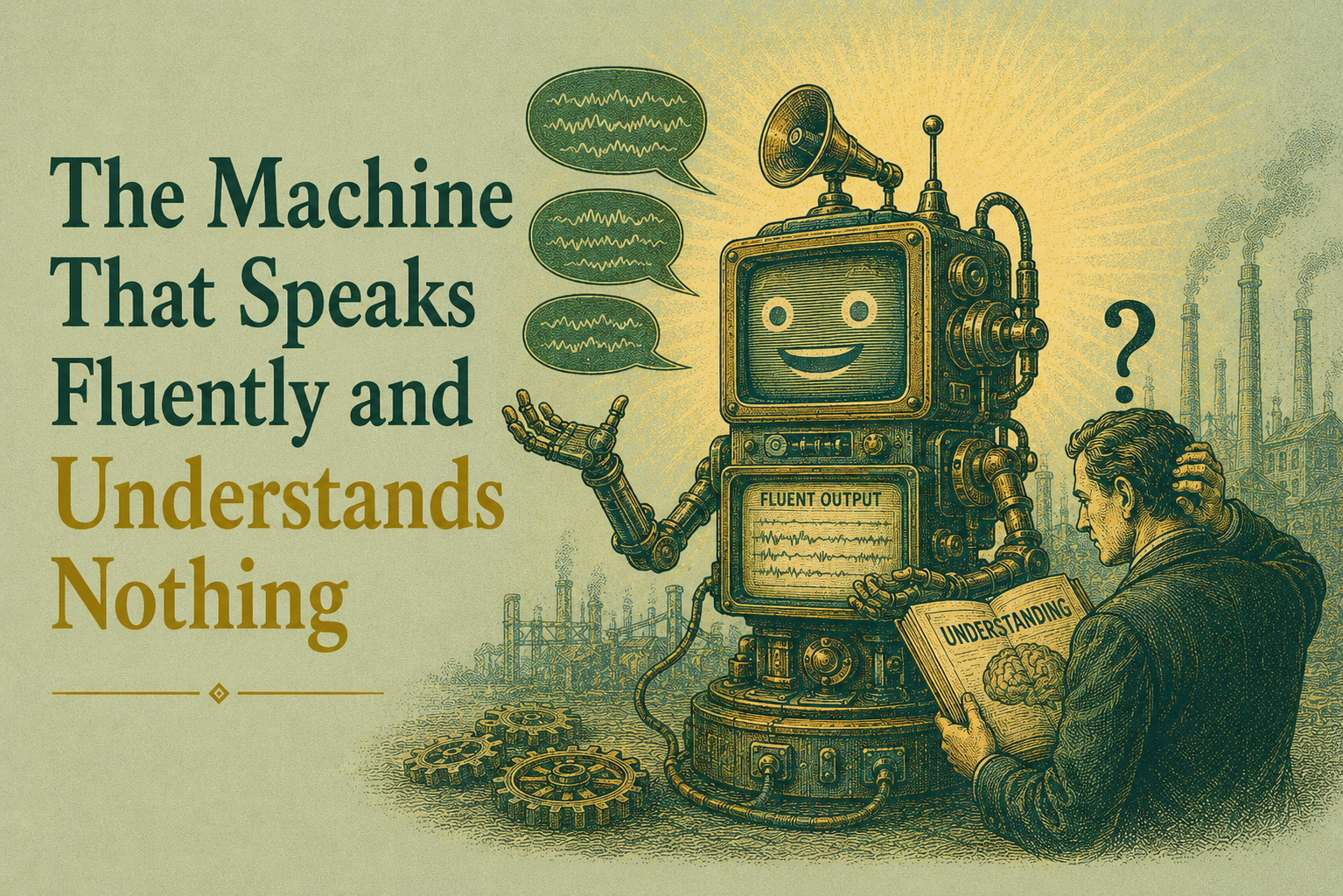
The Machine That Speaks Fluently and Understands Nothing
You are mid-sentence when it completes your thought.
Not approximately. Precisely. The words appear, and you read them back, and something in your chest settles, the way it does when someone finally gets what you mean. You think: yes, that is it exactly.
Then you sit with it for a moment.
Was that what you meant? Or did it just sound like what you meant?
That question arrives quietly. Most people push it away.
The Contradiction That Sounded Correct
Ramesh Sharma had been using the tool for four months before the morning he asked it to explain the same concept twice, from two different angles, in the same conversation. He did not notice the problem immediately. Each answer was complete. Each felt correct. He sent the second one to a client.
The client wrote back: ” This contradicts what you sent last week.
Ramesh checked. It did.
Both answers had arrived with the same tone, the same sentence rhythm, the same settled confidence of someone who has thought carefully about a question. Neither answer had flagged the other. Neither answer had paused.
The tool had not been confused. It had simply answered each question with whatever arrangement of words fit the shape of that question.
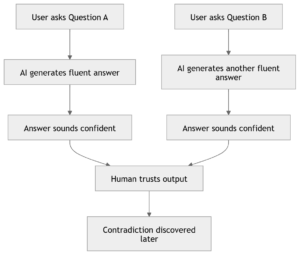
That is not an error in the ordinary sense. It is something more specific than an error.
The Moment People Stop Checking
The behavior worth examining is not the tool’s.
It is the moment Ramesh stopped checking. The moment most people stop checking.
It happens around the third or fourth week of regular use. The outputs have been good. The language is cleaner than what you produce alone. The ideas come faster. You start treating the outputs the way you treat a competent colleague’s first draft: read it, adjust a word or two, send it forward.
What you are actually doing in that moment is transferring your credibility to a system that has none. Not because the system is incompetent, but because the system has no credibility to hold. It cannot be wrong in ways it notices. It cannot hold a position it has to defend next Tuesday.
You can. And you just signed your name to its output.
Why Fluency Feels Trustworthy
The self-deception here is not laziness. That is the wrong diagnosis, and it lets people off too easily.
The belief is more considered than that. It sounds like: this tool is genuinely good at this, I am using it for what it is good at, I still bring the judgment, I have not outsourced my thinking, I am in control.
That is the version of the behavior that feels responsible. Efficient. Even intelligent.
The part that does not get examined is the last step, the one where judgment is supposed to arrive. How often does it actually arrive? What it looks like when it does. Whether it looks different from simply reading a fluent sentence and nodding.
Fluency and accuracy are not the same thing.
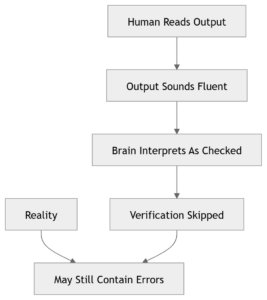
But fluency produces the feeling that accuracy has been verified. The sentence flows, the grammar holds, the confidence is steady, and somewhere in the reading of it your brain marks it as checked.
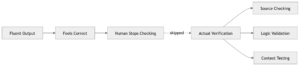
This is not a new failure. It was present long before any of these tools existed.
Confidence Changes the Room
Watch what happens in a meeting when someone explains a plan badly but confidently.
The room tightens. People look at each other. Someone asks a clarifying question, and the answer is also confident but not quite right, and three people write things down. Afterward, in the corridor, someone says: I am not sure that will actually work.
Watch what happens when someone explains the same broken plan smoothly.
The room relaxes. The pens come out. Nobody says anything in the corridor. The work starts. The gaps appear three weeks later, when it is too late to fix them cheaply.
The plan did not change. The delivery did.
The tool delivers everything smoothly. The plan, the contradiction, the wrong answer, the right answer. They arrive with identical surfaces. Your brain, which was built to read surfaces quickly, has no automatic way to catch the gap underneath.
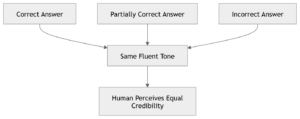
So you read the output. It flows. You feel the familiar small ease of something completed. You move on.
What the System Learned
Gary Marcus spent years asking a version of this question: when a system produces the right output, what does that actually prove about what is happening inside it?
The answer, for these tools, is less than we behave as though it does. The tool learned what tends to follow what. An enormous amount of text was processed until the word-to-word transitions became statistically reliable. A well-formed sentence about gravity and a well-formed sentence about why gravity works differently when you frame the question from the other direction can both be produced with equal smoothness, because smoothness is what was trained. The truth-value of either sentence was not part of the training signal.
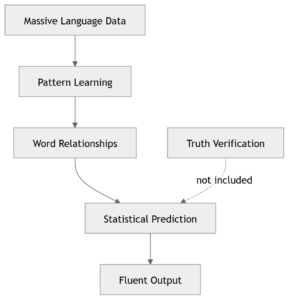
This is not a limitation waiting to be fixed. It is the shape of the thing.
What Changes in You
Ted Chiang would say the real question is not whether the output is right. It is what changes in you when you use the tool long enough.
Judgment is not a fixed property. It is something maintained through use, through friction, through the habit of checking your own thinking against something that can push back.
What happens when the friction disappears?
The tool does not push back. It agrees, elaborates, extends, and produces another smooth paragraph in whatever direction you last pointed it. The experience of having your thinking challenged, of finding the hole in your own reasoning before someone else does, of being wrong in a way you catch yourself, that experience stops accumulating.

You do not notice this as a loss while it is happening. You notice it as productivity. The output is faster. The first drafts are better. Everything moves more easily.
Six months later, someone asks you a question you used to be able to answer, and you find yourself wanting to open a tab first.
That is not a prediction. That is already happening to people who would not describe it that way.
The Identity Being Protected
The identity being protected here is worth naming precisely.
Most people using these tools consider themselves careful thinkers. People who check sources. Who ask follow-up questions. Those who do not simply accept what they are told. This is not vanity; it is often accurate history. They have been careful thinkers.
The behavior of nodding at fluent outputs without checking them is not consistent with that self-image.
Both things are true right now: the self-image and the behavior. They are running simultaneously, in the same person, and the only way they can coexist is because fluency produces the feeling of verification without the act of it.
The careful thinker who reads a smooth sentence and moves on has not stopped being careful. They have outsourced care to a tool that does not have it.
The Internal Argument
The internal argument that makes this genuinely difficult is not about the tool.
I have limited time and real demands and the outputs are good and I am still bringing the final judgment and I need to be efficient to survive professionally.
The outputs are not always good and I cannot reliably tell which ones are not and I am building habits that will hold even when I think I am not using them.
Both sides are correct.
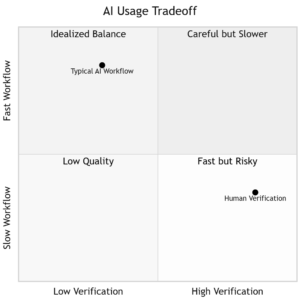
There is no arrangement that removes the friction between them. You either absorb a slower process or you absorb a subtler risk. Those are the two options. The third option, the one where you use it freely and your judgment stays sharp, and you catch everything that matters, requires that you be different from how people actually work under pressure.
Most people are not that different from other people under pressure.
Where It Already Appears
Here is where it already lives in ordinary working life.
A consultant generates a client summary, reads it once, adjusts a phrase, sends it. The summary is polished. It is also built on a framing the tool selected, not one the consultant chose. The consultant does not know this because the framing feels natural. It fits the shape of what was asked.
A writer uses the tool to draft and then edits. The edits are real. The structure, the argument’s direction, the choice of what to include and what to leave out: those arrived in the first draft. Editing inside someone else’s architecture is not the same as building your own.
A researcher uses the tool to find sources and summarize findings. The summaries are accurate for most of them. One source has been described in a way that suits the shape of the question asked rather than the shape of what the paper actually found. The researcher does not check the original because the summary reads cleanly.
None of these people is being careless. They are being normal. The tool accommodates normal use in ways that make the cost invisible until it surfaces somewhere specific.
Verification by Feeling
More data does not change this.
A smoother, faster, more accurate version of the tool does not change what you are doing when you stop verifying. It changes how rarely you notice that you stopped.
The 6 percent error rate referenced in discussions of these tools is not a number that will reach zero. But even if it approached zero, the behavior of verification-by-feeling would still produce the same gap, because the problem is not the tool’s error rate. It is the reader’s process for deciding that something has been checked.
That process is borrowed from fluency. Fluency is not a verification method.
A Different Way to Use These Tools
There is a quieter way to use these tools. It requires treating the output as raw material rather than as thinking already done. Not as a draft that is mostly ready, but as a surface that has no idea whether what is on it is right.
You bring the meaning. You do the checking. The tool generates the shape. You decide whether the shape holds anything real.

That is a slower process. It is also the one that keeps the judgment in you.
The Question Underneath the Fluency
The sentence that completes your thought is still completing it.
Right now, the output still feels like thinking together. The ease is real. The speed is real. The smoothness is real.
So is the question underneath: what you just read smoothly, have you actually verified it, or did it arrive verified by the feeling of fluency alone?
You already know which one happens more often.
That is not the same as it stopping.