Why You Sell During a Market Dip (It Has Nothing to Do With the Market)
Why You Sell During a Market Dip (It Has Nothing to Do With the Market)
The real trigger is not the chart. It is the hour, the body, and three weeks of accumulated weight.
Panic selling is not caused by bad markets. It is caused by bad hours.
The market creates the occasion. The time of night, the accumulated stress, and the isolation of the decision moment pull the trigger.
Most investors who sell during a dip are not responding to new information.
They are responding to what their body has been carrying for weeks, with nowhere to put it.

This article explains what actually happens in the moment before a retail investor sells — not the behavioural theory, but the specific conditions that make a temporary feeling become a permanent decision.
The Standard Explanation Misses the Actual Variable
Every article on panic selling gives you the same answer: loss aversion.
Humans feel losses twice as intensely as equivalent gains. The brain treats financial threat like physical threat. Cortisol rises. Rational thinking narrows. You sell.
That explanation is accurate.
It is also incomplete.
Loss aversion is a constant. It operates in you at 11 AM and at 11 PM.
But retail investors do not sell evenly across the day.
The decision to exit a position clusters around specific conditions:
- late hours
- accumulated fatigue
- isolation
- the particular silence of a room where nobody else is watching
The variable that behavioural finance rarely names is not the psychology.
It is the timing.
What Actually Happens at 11:47 PM
Nishant had been holding a mutual fund for eleven months. Not a large amount — enough to matter, which is the relevant threshold.
He had watched it climb, flatten, then fall across three weeks in a way that felt different from earlier dips.
The earlier drops had felt temporary.
This one felt like something had been decided without him.
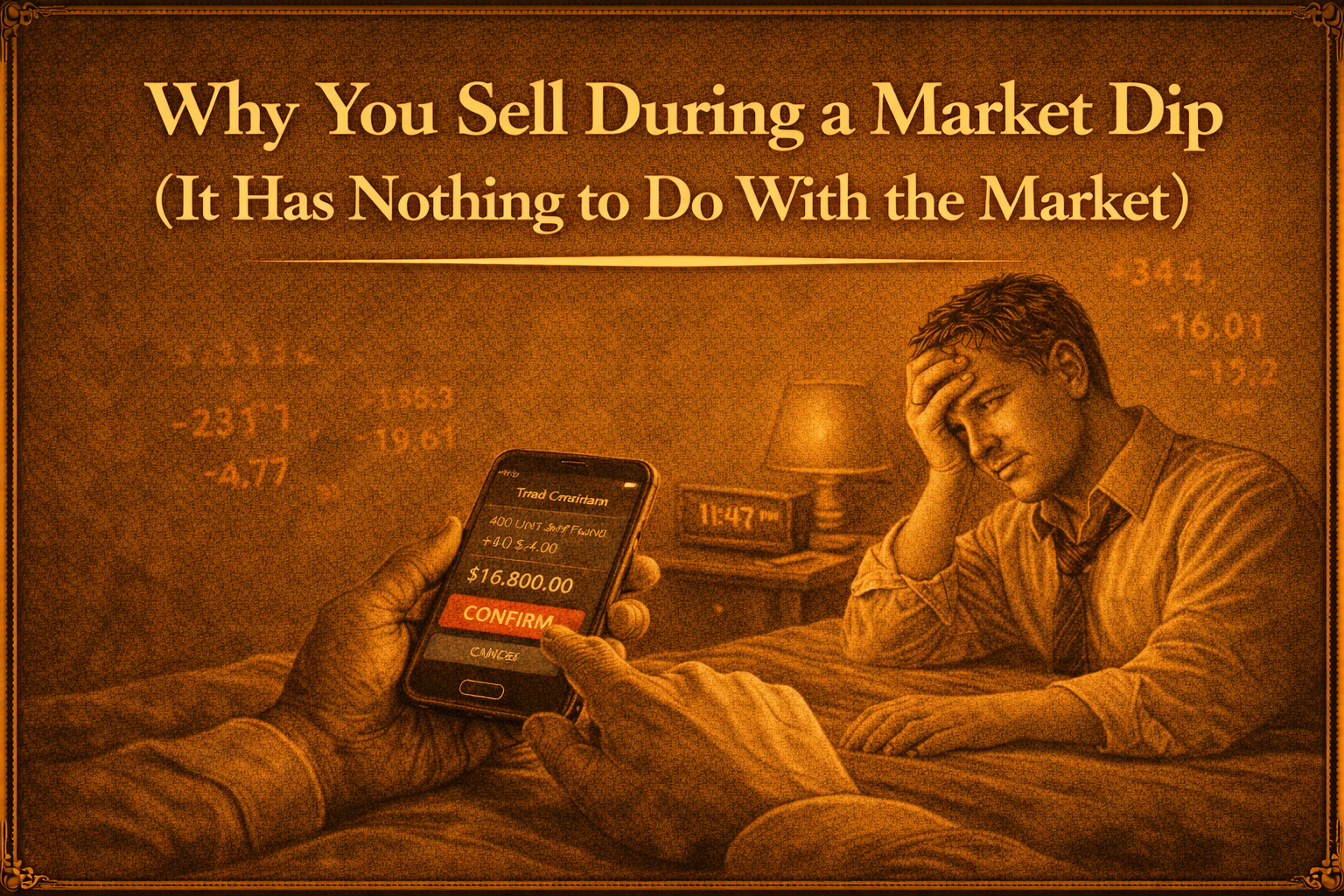
By 11:47 PM, he was back on his brokerage app. His wife was asleep. The fan was running.
The room was ordinary in every way except what was happening in his chest, which had been building quietly for three weeks and had now arrived fully.
This is the setup that precedes most retail panic selling.
Not a sudden crash.
Not a margin call.
A slow accumulation of low-level threat signals.
Red numbers checked repeatedly across days — until the body’s stress load crosses a threshold the mind hasn’t consciously registered.
At that point, the sell screen stops being a financial interface.
It becomes an exit from a feeling.
The Mechanism: Why the Hour Changes the Decision
Three things happen simultaneously in the late-night checking scenario that do not happen during daytime market monitoring.
1. Sleep deprivation compresses the time horizon
A brain running on inadequate sleep is measurably worse at evaluating future outcomes.
It weighs present discomfort more heavily than future recovery.
- “What if it falls more?” → arrives with force
- “What if it recovers” → arrives as abstraction
2. Decision fatigue removes friction
By late evening, the cognitive resources that slow decisions are depleted:
- asking a second person
- sleeping on it
- reviewing the original thesis
The path of least resistance becomes the sell button.
3. Isolation removes the social check
Investors making decisions with someone present make fewer impulsive exits.
A second person slows the thought.
A dark room removes that completely.
None of these is market conditions.
The market is the same market it was at noon.
What changed is the person looking at it.
What the Forty Seconds Actually Contains
The moment before a retail investor confirms a panic sale lasts less than a minute.
During that time, two competing calculations run:
1. “If I exit now, I stop the bleeding.”
- arrives with force,
- has a clear action,
- creates immediate relief
2. “What if it recovers?”
- arrives softer
- future-tense
- discounted under stress
This is not irrationality.
It is the stress response doing exactly what it is designed to do:
Prioritise immediate relief over long-term outcomes.
Nishant’s thumb hovered.
He did not press confirm.
Not because he resolved anything — but because the breath broke slightly and he put the phone face-down before urgency rebuilt.
He checked at 7 AM.
The number was the same.
Where This Pattern Repeats
This is not one investor’s story.
It repeats every cycle.
During the 2020 COVID crash, Indian retail investors exited equity mutual funds during peak drawdown.
Markets recovered within six months.
- sellers → locked losses
- holders → recovered
The pattern is consistent:
- hold early
- stress builds
- exit near the bottom
The market didn’t get worse enough.
The person got tired enough.
The Honest Limit of This Analysis
Not every late-night sell is panic selling.
Some exits are valid:
- deteriorating fundamentals
- structural decline
- thesis broken
The diagnostic question:
Did the investment change — or did your feeling change?
If it’s the second:
The hour is the variable.
What to Actually Do Differently
The fix is not more discipline.
Discipline breaks under stress.
1. Set a hard stop for checking
After a fixed hour (e.g. 8 PM), stop.
Not because numbers change.
Because you change.
2. Write exit conditions in advance
Define before investing:
- % loss threshold
- fundamental changes
- time horizon
If those are not met:
The sell screen does not open.
3. Don’t decide alone
Have someone present:
- partner
- friend
- advisor
Presence slows panic.
Nishant still holds the fund.
He doesn’t check after 9 PM.
Not as a rule — as understanding.
The midnight version of him is not equipped to decide for three years.
Frequently Asked Questions
What is panic selling, and why does it happen?
Panic selling is exiting due to emotional stress, not new information.
It happens when accumulated stress crosses a threshold — usually in late-hour, isolated conditions.
Why do investors sell at the bottom?
Because stress peaks at the bottom.
Not because information is worse.
Does loss aversion fully explain it?
No.
Loss aversion explains direction.
Timing comes from conditions:
- fatigue
- isolation
- late-hour checking
How do I know I’m about to panic sell?
When:
- Your written rules say “hold”
- But your body says, “Exit.”
That gap is the signal.
What is the most effective prevention?
- pre-written rules
- evening cutoff
- shared decision
Final Thought
The market creates the occasion.
The hour creates the decision.
Most investors who panic-sell had a sound strategy.
The strategy didn’t fail.
The conditions did.
The fix is not better analysis.
It is recognising this:
The version of you at midnight is not the one who should decide.
Set the cutoff.
Write the conditions.
Decide in daylight.