Why Investors Sell Right Before the Market Recovers (And What Actually Stops It)
Investors who exit at the bottom of a market rarely do so because they have analysed the situation and concluded the recovery would not come.
They exited because they ran out of the capacity to wait for it. Understanding the difference between those two things is the only way to prevent it.
The exit does not feel like a mistake when it happens
Eleven days of consecutive red. The portfolio is down. The news notification says markets fell again. The WhatsApp group has moved – someone sold everything yesterday, three people liked it, and one called it a smart move.
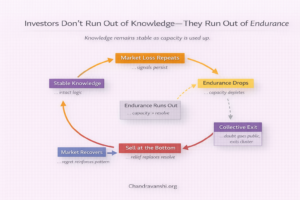
This is the moment most behavioural finance articles skip. They record the exit as an emotional decision and prescribe better emotional management. What they miss is that by day eleven, the investor is not making an emotional decision in the sense of a sudden irrational spike.
They are making a decision after an extended period of resource depletion.
That is a different problem with a different solution.
The exit feels correct in that moment. It feels like clarity after confusion.
That feeling is real. It is also the least reliable signal available to the investor at that specific point.
What loss aversion actually measures – and what it misses
Behavioural economists established through repeated studies that losses feel approximately twice as painful as equivalent gains feel good. This is loss aversion, and it is real and well-documented.
What the standard framing misses is the temporal dimension. Loss aversion research typically measures responses to single loss events. A prolonged market fall is not a single loss event.
It is the same loss event confirming itself daily across an extended period.
Each morning, the portfolio opens red, and the brain does not process a new loss. It processes confirmation that the previous loss is still active. Confirmation that the pain is not over. Confirmation that the recovery has not arrived.
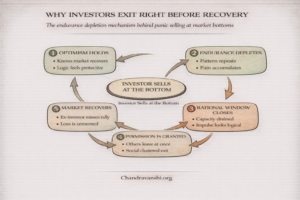
Each confirmation registers as pain. The pain accumulates differently from a single event – not linearly, but with increasing weight, because each day the investor has less psychological distance from the previous one.
By day eight or ten or eleven, the accumulated weight has crossed a threshold.
This is not emotion overriding logic.
This is a cognitive resource – the capacity to hold a position through discomfort – that has been drawn down to near zero.
Decisions made at that point are not driven by fear in the acute sense. They are driven by exhaustion.
Recency bias amplifies this. The investor’s mind, saturated with eleven days of consecutive red, assigns high probability to the pattern continuing. The rational understanding that recoveries follow falls exists in memory.
It does not feel available as lived reality.
Recent experience dominates prediction.
Why does the WhatsApp group tip the decision
Social contagion in investing is usually discussed as herd behaviour – the tendency to follow what others are doing because it feels safer. That framing is accurate but incomplete.
The investor who has reached near-zero endurance does not need the group to tell them to sell. They have already decided, or are seconds from deciding.
What the group provides is something more specific: social permission.
When someone in the group posts “I sold everything yesterday,” they are not conveying strategy. They are removing the last friction point. They are confirming that leaving is acceptable, that rational people are doing it, and that the investor would not be alone in exiting.
Many members of the group have already decided privately.
The post does not cause the exit. It removes the final hesitation.
This is why collective exits cluster at the bottom. Individual endurance depletion tends to peak at roughly the same point in a sustained fall, because all investors in the same fall are accumulating the same daily confirmations.
When individual depletion peaks, social contagion provides the permission signal.
The exits cluster. Markets experience selling pressure precisely when the fundamental case for holding is strongest.
The re-entry trap
The investor who exits tells themselves they will re-enter when things stabilise. This feels like a plan.
It is not a plan – it is a placeholder with no activation condition.
“Stabilise” is undefined. In practice, it means that investing no longer feels painful.
That condition is met when the market has already recovered significantly from the exit point.
The investor re-enters at a higher price than they exited, having realised the loss and missed the recovery.
The question they ask afterwards – why didn’t I sell earlier – is the wrong question.
It searches for a point where a smaller loss was available.
It does not search for the points where staying would have meant full recovery.
The mind in the aftermath of a painful decision does not conduct balanced retrospective analysis. It finds evidence that the decision was at least partially correct.
One important distinction: this pattern applies to investors holding sound positions – diversified funds, index investments, and reasonable asset allocation.
An investor who was overleveraged, concentrated in a deteriorating sector, or holding a genuinely impaired asset may have been correct to exit.
Exhaustion and accuracy sometimes coincide.
The problem is that at peak depletion, the investor cannot distinguish which situation they are in.
What actually prevents the exit
Telling an investor to manage their emotions during a sustained fall is not actionable advice.
It describes what needs to happen without providing the mechanism.
Emotions are not a switch. Awareness that day ten will be painful does not reduce the pain on day ten.
The only intervention that consistently works operates before the fall begins, not during it.
A pre-commitment device. A written rule established during a calm period that removes the decision from the moment of peak depletion.
Examples that function:
- “If my portfolio falls more than 20 per cent, I will review it on [specific date] and not before.”
- “I will not make any exit decision within 30 days of a new portfolio low.”
- “I will discuss any sell decision with one other person before executing it – not someone in the same WhatsApp group.”
The specificity matters.
“I will stay calm” is not a pre-commitment device.
“I will not open my brokerage app between 9 am and 4 pm on trading days during a market fall” is a pre-commitment device.
The rule must remove the decision from the moment, not instruct the person to make a better decision in that moment.
The pre-commitment device does not work because it eliminates emotional exhaustion, but because it makes the decision unavailable at the moment of peak exhaustion.
By the time the cooling period expires, the investor is no longer at zero endurance.
The decision is made from a different cognitive state.
What the recovery looks like from the outside
There is no notification that says: today is the last red day. Recoveries do not announce themselves.
The day the market turns is indistinguishable in feel from any other day during the fall. There is no visible signal that the pattern is breaking.
This is why the investor who exits on day eleven – which may be the day before the bottom, or the day of the bottom – does not know they are exiting at the bottom.
They know they are exhausted. They know others are exiting. They know the pain has been running for eleven days.
The recovery that follows three weeks later is not something they could have observed from inside the fall.
The pre-commitment device does not require the investor to predict the recovery.
It only requires them to delay the exit decision until the decision can be made from a less depleted state.
That is a much lower bar than predicting market timing – and it is the correct bar, because predicting market timing is not what this problem requires.
Frequently Asked Questions
Why do investors always seem to sell at the wrong time?
The timing pattern is not a coincidence. Individual endurance depletes at roughly the same point in a sustained fall because all investors in the same fall are accumulating the same daily loss confirmations.
When individual depletion peaks, social signals – group chats, news coverage, visible exits by others – provide permission.
The result is clustered selling at the point of maximum accumulated pain, which tends to coincide with the bottom of the fall.
The investor is not making a prediction that the fall will continue.
They are ending an experience that has become too costly to sustain.
What is the difference between a rational exit and a panic exit?
A rational exit is based on a change in the underlying investment thesis – the asset is genuinely impaired, the position was incorrectly sized, or the risk profile no longer matches the investor’s situation.
A panic exit is driven by the accumulated weight of sustained loss confirmation, regardless of whether the underlying thesis has changed.
In practice, most retail investors cannot cleanly distinguish the two at peak depletion.
The pre-writing test is useful here: if the investor cannot articulate what specifically changed about the investment case – not the price, but the case – the exit is likely driven by depletion rather than analysis.
Does loss aversion explain everything about panic selling?
Loss aversion explains why losses feel more painful than equivalent gains feel good.
It does not fully explain why exits cluster at market bottoms rather than distributing across the fall.
The additional mechanism is temporal accumulation – the way repeated daily loss confirmations compound the depletion effect – combined with social contagion providing permission at the moment of peak individual depletion.
Loss aversion is the fuel. Temporal accumulation is what brings investors to empty. Social contagion is what opens the exit.
Can SIP investors panic sell, too?
Yes. A systematic investment plan removes the entry timing decision but does not remove the exit decision.
An investor running a monthly SIP can still manually exit their existing holdings during a fall. The SIP continues adding units at lower prices – which is mechanically correct – while the investor simultaneously sells existing units at a loss due to depletion.
The two actions cancel.
SIP discipline at the entry layer does not automatically produce holding discipline at the exit layer.
What if the market doesn’t recover?
For broad market indices – Nifty 50, Sensex, global index funds – historical patterns show recovery across all major drawdown periods in India’s post-liberalisation market history.
Individual stocks, sector funds, and thematic funds do not carry this pattern.
An investor holding a broadly diversified index fund who exits at a bottom is statistically making an error, according to the evidence of Indian market history.
An investor holding a concentrated position in a sector experiencing structural deterioration may not be.
The pre-commitment device is most defensible for broadly diversified holdings where the recovery case rests on economic continuity rather than a sector-specific thesis.
The one thing to do before the next fall
The exit at the bottom is predictable. The conditions that produce it – sustained loss confirmation, endurance depletion, social permission – are consistent across investors and across market cycles.
Knowing this does not prevent the exhaustion from arriving.
It does not make day ten less painful.
What it enables is a decision made before day one: a written rule, a specific date, a named person who must be consulted before any exit is executed.
One structural anchor was installed during a calm period.
The investor who has that rule does not need to be stronger than the investor who doesn’t.
They just need to have moved the decision out of the moment of peak depletion before the depletion began.
That is the entire intervention. Everything else is a description of the problem.