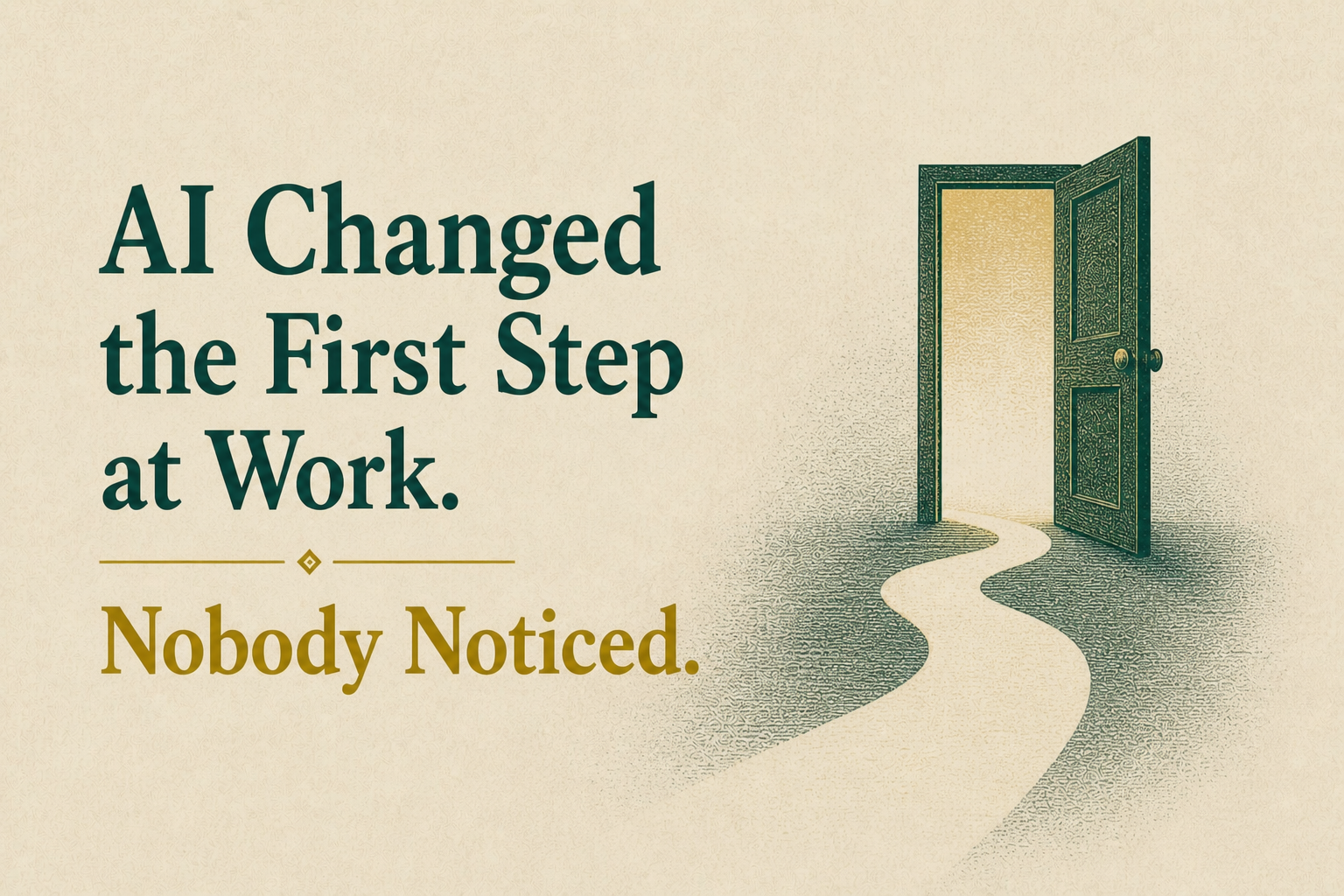
AI Changed the First Step at Work. Nobody Noticed
Before Asking a Colleague, People Now Ask ChatGPT
Work has always had an unofficial first step when something gets stuck.
A question goes to:
- The person nearby
- The team chat
- The colleague who always seems to know
That first step was built on access.
Whoever could answer fastest, with the least friction, received the question.
That first step is changing.
Not because companies formally redesigned work.
Not because managers instructed teams to behave differently.
Because one option became dramatically easier.
And behaviour followed.
Why the First Step Matters More Than the Final Decision
The final decision in professional work still belongs to the person.
The judgment call.
The sign-off.
The difficult conversation.
None of that disappeared.
What shifted happens earlier.
The moment before judgment even begins.
The point where someone is:
- Stuck on a sentence
- Uncertain about a number
- Unsure how to begin a difficult email
That moment used to involve another person.
Now, increasingly, it involves a tab.
This matters because the first step shapes everything that follows.
What gets explored.
How the problem is framed.
Which options appear possible.
Change the starting point, and over time, you change the shape of the work itself.
What the Behaviour Actually Looks Like
A product manager needs five positioning angles for a pitch.
ChatGPT generates them in under a minute.
The manager spends the next hour deciding which one actually works.
A developer encounters an unfamiliar error.
The error message goes into ChatGPT before documentation is opened.
Someone pauses mid-meeting.
Their eyes move to another screen.
Thirty seconds later, they continue with a sharper explanation and a phrase they did not have before.
None of this looks dramatic.
Nobody is replacing entire teams.
The shift is narrower than that.
It is specifically the first few seconds after getting stuck.
That small behavioural window, repeated hundreds of times across a week, accumulates into something larger than any individual use case suggests.
Why It Happened Without Anyone Deciding It Should
Speed explains part of the change.
An AI response arrives instantly:
- No scheduling
- No waiting
- No concern about interrupting someone
But speed alone does not fully explain the shift.
Better search engines existed before this.
What changed was the social cost of asking.
Every question directed at a colleague carries a small psychological calculation:
- Is this worth their time?
- Should I already know this?
- Am I interrupting at the wrong moment?
These are not large anxieties.
Most professionals navigate them automatically.
But they exist.
And they disappear almost entirely when the question goes to a machine.
That removal of social friction changed behaviour more than answer quality did.
People often rewrite, refine, or ignore the AI response completely.
They still found it useful to ask first.
What Changes When the Starting Point Changes
When thinking begins with another person, the frame itself gets challenged.
The colleague may:
- Ask a clarifying question
- Reframe the problem
- Point out a missing assumption
The conversation shapes the question before shaping the answer.
When thinking begins with AI, the frame usually remains with the person asking.
The tool responds inside the boundaries it was given.
It rarely pushes back on whether the framing itself is wrong.
Over time, that difference matters.
Not dramatically.
Not all at once.
But a workplace where the first consultation increasingly happens alone produces a different style of collaborative thinking than one where uncertainty is exposed earlier to another human mind.
This Is Not Really an Argument Against AI
The efficiency gains are real.
Producing ten draft options in the time it previously took to produce two is not a trivial improvement.
The honest limit is simply this:
Efficiency and problem framing are not the same thing.
Only one of them is becoming dramatically faster.
Where This Works Well
AI-first consultation works extremely well for well-defined problems:
- Drafting
- Formatting
- Explaining concepts
- Summarising information
- Translation
In these cases:
The problem is already understood.
The output itself is the work.
Where It Breaks Down
The model works less cleanly when the actual challenge is discovering what the problem really is.
That is the moment where another person asking:
“Are you sure that’s the real issue?”
Can completely change the direction of thinking.
AI tools usually optimise within the frame they receive.
Human conversations often challenge the frame itself.
Those are not the same function.
The Professional Habit Being Built Quietly
Habits form through repetition, not intention.
Nobody formally decided:
“AI should become the first consultation layer.”
Thousands of small rational choices produced that outcome organically.
The professional opening ChatGPT before Slack is not making a philosophical statement.
They are taking the path with the least friction.
That is what people naturally do.
But repeated behaviour trains reflexes.
The emerging reflex increasingly looks like this:
- Think alone first
- Frame the issue yourself
- Bring a partially formed answer into the human conversation
Sometimes this improves collaboration.
Arriving with a rough draft instead of a blank page often creates a better discussion.
Other times, the raw uncertainty itself was the important thing to surface.
The AI consultation smooths uncertainty into something that looks more resolved than it actually is.
What Has Not Changed
The judgment still belongs to the person.
The relationship still belongs to the colleague.
The accountability still belongs to whoever signs off.
What changed is the invisible layer before those things:
- The hesitation
- The friction
- The small moments of reaching out
Those moments are quieter now.
Whether the resulting thinking becomes better depends on what the thinking was actually for.
Final Insight
The next time you get stuck at work, the important question is not which tool you opened first.
It is whether the problem you brought into that tool was the real problem.
Or whether it was simply the version that fit cleanly into a text box.
Those are not always the same thing.