The Ambedkar You Weren’t Taught: Beyond the Constitution
The constitutional architect is one chapter of a much longer argument. Here is what the curriculum left in the archive.
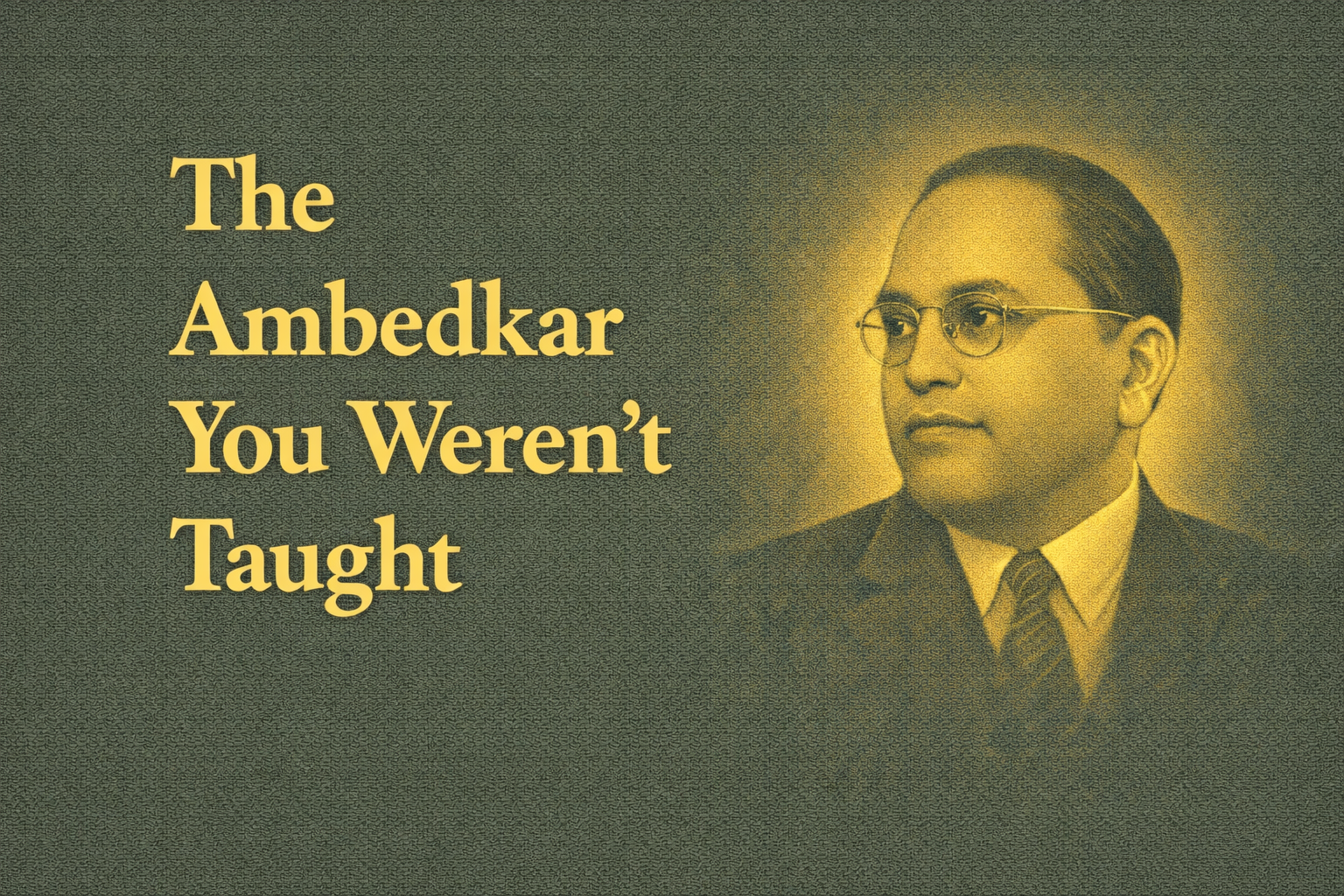
Most people who went through Indian schools received one version of Ambedkar: a man in a suit, a pen in hand, the Constitution on the table. That version is real. It is also the version that costs the least to teach.
The rest — Annihilation of Caste, the resignation from Nehru’s cabinet, the Buddhist conversion as a decades-long argument made finally physical — is available in archives, digitised, accessible. It was never assigned. The gap is not in the record. It is what the curriculum decided you needed to know.
Understanding the complete Ambedkar requires going back to what the textbook photograph was always quietly leaving out.
What the Photograph Says — and Doesn’t
The image is consistent across textbooks, states, and decades. A suited figure, a pen, a serious expression. Three bullet points: Father of the Constitution. Chairman of the Drafting Committee. Architect of modern India.
That image says: here is a man who worked within institutions. Here is a man the state can claim.
It does not say: here is a man who converted to Buddhism six weeks before he died, in a public ceremony with hundreds of thousands of witnesses, as a documented rejection of the religion he was born into. That conversion was not spiritual restlessness. It was a conclusion — the end of a long argument he had been making in writing for decades, finally made physical and irreversible.
The Buddhism he chose was not traditional Buddhism. It was Navayana — a reinvention he consciously constructed, because even in departure, he was making an argument, not just an exit.
Two lines in the textbook, if mentioned at all. Usually framed as a personal choice. The political weight was set quietly aside.
Annihilation of Caste: The Book That Got Its Invitation Withdrawn
Annihilation of Caste is not a long book. It is a speech that was never delivered.
The organising committee of the conference that commissioned it read the draft and understood immediately what it was asking of them. It was asking too much. They withdrew the invitation. He published it himself.
The argument was precise, and the target was specific: caste was not a corruption of Hinduism but a feature of it — embedded in its texts, sanctioned by its authority, impossible to dismantle without confronting that authority directly. He was not arguing for reform within the religion. He was arguing that the structure itself was the problem.
Reading it for the first time, you stop repeatedly. Not because the language is difficult. Because the implications keep arriving before you are ready for them.
This is not the Ambedkar from Chapter 4. This one disturbs something — and that disturbance is precisely why it was never assigned to the people who most needed a syllabus to find him.
The Resignation That Never Gets Taught
In 1951, Ambedkar resigned from Nehru’s cabinet.
This is a significant political event. The man who chaired the drafting of India’s Constitution left the government of that same country within four years of its formation — and wrote, in his resignation letter, exactly why.
The Hindu Code Bill. He had spent years building it — a comprehensive legal reform that would give Hindu women rights to divorce, inheritance, and property. The bill was diluted, stalled, and eventually broken into smaller pieces that could pass with less internal resistance. Ambedkar did not pretend this was acceptable.
The resignation letter is specific, detailed, and unsparing. It names what failed and what that failure revealed about the limits of working within a system that had not fundamentally changed its social architecture. He wasn’t writing for the record. He was writing because he wanted it understood — clearly, permanently — what had happened and what it meant.
For most people educated in India, this letter is completely unknown, not suppressed. Available, archived, accessible. Just never assigned. Never pointed at.
Two Constitutions, Not One
There is a line of thinking in his writing that rarely appears in the standard summary.
He believed India had two constitutions. The written one, which Parliament could change. And the social one, which it could not. The social constitution was caste — unwritten, unlegislated, and for that reason far more durable than anything a drafting committee could produce.
He said so directly in the Constituent Assembly’s final session. That speech is sometimes quoted for its celebration of independence. It is rarely quoted for its anxiety — his explicit doubt about whether legal equality could overcome a social hierarchy that had survived every previous attempt at reform.
He had watched, across decades, how a man could be equal before the law on paper and untouchable in practice on the same day, in the same town, without anyone in power finding this particularly urgent. The Constitution was his best attempt at a lever. He never mistook it for the thing itself.
The curriculum gives you the document. It does not give you a doubt about whether the document would be enough.
What Sanitising Looks Like From the Inside
A friend once pointed to a framed photograph on her grandfather’s wall — the same image, the suited figure — positioned next to a small lamp kept burning near something sacred. She asked why it was there. He was quiet for a moment. Then he said, he told us we were human.
That sentence carries more of Ambedkar’s actual work than most formal introductions do. It points not at the Constitution but at what came before the Constitution was possible — the decades of argument, legal challenge, social organising, and writing that insisted on a basic recognition that was not being offered voluntarily.
The grandfather never needed the curriculum to know this. The communities that lived inside the argument he was making didn’t require a syllabus to understand it. The gap in education was not a gap for everyone. It was specifically a gap for those the system was designed to comfort.
Sanitising a radical is not the same as erasing one. Erasure leaves evidence — a gap, a silence, an obvious absence. Sanitising is cleaner. You keep the name, the photograph, the holiday. You curate which parts of the argument get repeated and which parts get described, briefly, as personal choices or political differences and moved past.
The result: a figure large enough to display and small enough not to threaten.
What the Complete Version Costs
The constitutional Ambedkar did ask something real of the dominant castes. Reservation policy demanded concrete cost from those who benefited from its absence, and that demand continues. But the document is easier to display than the argument behind it.
You can cite the Constitution without engaging what it was built against. You cannot read Annihilation of Caste that way. You cannot read the resignation letter that way. You cannot treat the Buddhist conversion as a personal choice once you understand it was the final move in a four-decade argument about whether reform within the existing structure was ever possible.
Each of those costs something. The curriculum absorbed the version that cost the least and filed the rest under archive.
The discomfort of encountering the complete version is real. So is what produced it: a version of history that handed a fraction and called it the whole — not to everyone, but specifically to the people who were never going to find the rest any other way.
Frequently Asked Questions
What did Ambedkar do beyond writing the Constitution?
Ambedkar’s work outside the Constitution spans four decades and multiple disciplines. He wrote Annihilation of Caste in 1936 — a precise argument that caste was structural to Hinduism, not a corruption of it — which was suppressed before delivery and self-published. He built the Hindu Code Bill across years of legal drafting, resigned from Nehru’s cabinet in 1951 when it was diluted beyond recognition, and converted to Buddhism six weeks before his death in a public ceremony of hundreds of thousands — not as a spiritual departure but as the deliberate conclusion of a lifelong political argument. Each of these is documented, archived, and largely absent from standard Indian education.
Why is Ambedkar only taught as the father of the Constitution?
The constitutional Ambedkar is the version that costs the least to celebrate. The Constitution can be cited without engaging what it was built against. Annihilation of Caste cannot be taught that way — its argument requires confronting the structural role of caste in religion directly. The resignation letter requires accounting for how independent India’s early government handled legal reform for women and Dalits. The Buddhist conversion requires treating it as a political conclusion rather than a personal choice. The curriculum absorbed the chapter that required the least revision to existing social comfort and filed the rest as supplementary.
What is Annihilation of Caste, and why was it never delivered?
Annihilation of Caste was a speech commissioned by a Hindu reform conference in 1936. The organising committee withdrew the invitation after reading the draft — because the argument was that caste could not be reformed from within Hinduism, that it was embedded in the religion’s texts and sanctioned by its authority. Ambedkar published it himself. It remains one of the most precise critiques of caste as a social and religious system in Indian writing. It is not commonly assigned in Indian schools or universities.
What was in Ambedkar’s resignation letter from Nehru’s cabinet?
Ambedkar resigned in 1951 over the Hindu Code Bill — legislation he had spent years building to give Hindu women rights to divorce, inheritance, and property. The bill was diluted and stalled by internal Congress opposition. His resignation letter named specifically what had failed and what that failure revealed about the limits of working within a system whose social architecture had not fundamentally changed. The letter is archived and accessible. It is not part of standard Indian history education.
What was Ambedkar’s Buddhist conversion actually about?
The conversion in 1956 was a public ceremony attended by hundreds of thousands. Ambedkar chose Navayana — not traditional Buddhism but a reinvention he consciously constructed, stripping metaphysical elements and centring social equality. It was the conclusion of a decades-long argument: that reform within Hinduism was structurally impossible, that departure was the only coherent position, and that the form of departure should itself carry the argument forward. He had been writing toward this conclusion since at least the 1930s. Framing it as a personal spiritual choice misses what he explicitly said it was.
What This Changes
- The constitutional version is real — and incomplete. The document he drafted contains protections that matter and language invoked in courts for decades. It is one chapter of a four-decade argument, not the argument itself.
- The curation is the argument. Which version of Ambedkar gets assigned and which gets archived is not a neutral editorial decision. It reflects whose comfort the curriculum was organised around.
- The gap was not universal. Communities that lived inside the argument he was making did not need a syllabus to understand it. The educational gap was specific — it belonged to those the system was designed to comfort.
- Sanitising is not erasing. The name, photograph, and holiday remain. What gets quietly managed is which parts of the argument get repeated and which get described as personal choices and moved past.
The version on the grandfather’s wall was never waiting for a textbook to validate what it already knew. The version in the archive was always there. The distance between them is where his actual argument lives — and where, for those who needed a syllabus to find him, the education quietly stopped.
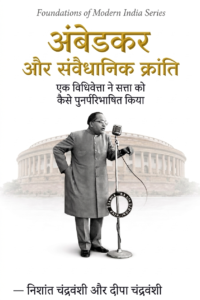
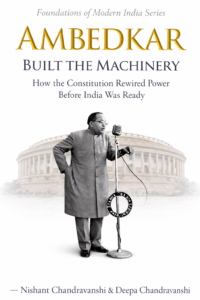
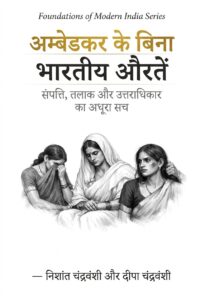
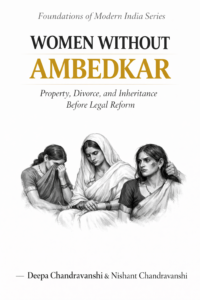
If this line of thinking stays with you, two short books—Women Without Ambedkar and Ambedkar Built the Machinery—extend it in different directions. Both are available in English and Hindi. 👇