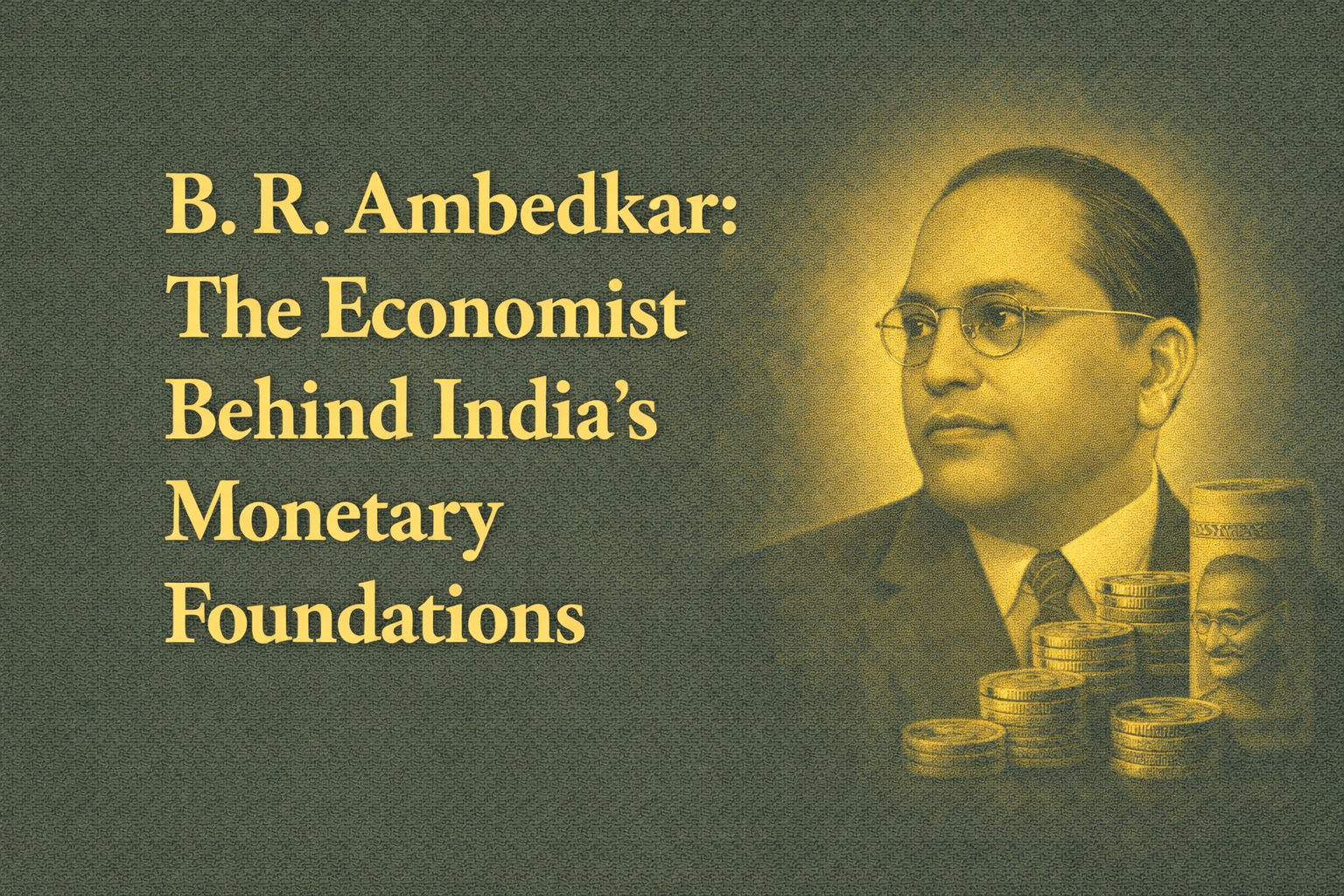
B. R. Ambedkar: The Economist Behind India’s Monetary Foundations
Long before institutions took shape, he was thinking in terms of stability, currency, and systemic design..
The Economist India forgot to teach that B.R. Ambedkar’s monetary thesis helped build the RBI. It never made it to the economics syllabus.
B.R. Ambedkar wrote one of the most consequential pieces of monetary economics in Indian history. It shaped the institution that manages India’s money. It does not appear on the economics syllabus.
The Problem of the Rupee was submitted at the London School of Economics in 1923. It argued against the gold standard as applied to India, proposed a framework for currency stability, and outlined the structural design principles for central banking in India. The proposals are documented as foundational to the thinking behind the Reserve Bank of India. This is in the institutional record — traceable, specific, available.
His name appears in law, political science, sociology, and history. The discipline where his technical work actually landed has largely proceeded without assigning him.
What the Thesis Actually Argued
The argument in The Problem of the Rupee was not political in the rhetorical sense. It was a technical monetary economics paper — worked through with data, positioned within the currency debates of its time, submitted to one of the leading institutions of that era.
The core claim: India’s currency architecture under the gold standard was designed to serve British imperial interests, not Indian price stability. Ambedkar traced the mechanism precisely — how the existing structure transferred the cost of monetary instability onto Indian producers and consumers while protecting the interests of the colonial monetary system.
This was 1923. The RBI would not be established until 1935. The intellectual groundwork for how a central bank should approach currency management in India was still being laid. Ambedkar was laying part of it.
He also connected monetary design and social inequality as a single analytical problem — not parallel concerns requiring separate frameworks. Who controls currency architecture, what that control enables, which communities bear the cost of monetary instability — these were questions he was asking in the language of economics, with data, more than a decade before the institution existed.
That connection — between the design of monetary systems and the distribution of their consequences across caste — has still not entered mainstream Indian economics. The discipline inherited his institutional contribution without inheriting the analytical framework that produced it.
How the Impact Landed Without the Attribution
The RBI was established in 1935. The intellectual foundations it drew on included Ambedkar’s monetary work. That is documented. What did not follow was attribution in the form that makes a name foundational — the kind where it appears at the top of reading lists until it becomes unthinkable to leave it off.
Canons form through repetition. A name gets assigned. Students encounter it. It gets cited in subsequent work. It accumulates presence until it becomes structurally embedded in how a discipline understands its own history. Ambedkar’s name never entered that repetition in economics.
This is a more precise problem than simple neglect. The impact landed. The attribution didn’t follow. Those are two separate failures. The first means the work was used. The second means the work was used without the intellectual accounting that would have made it visible as foundational.

The result: Indian economics can discuss monetary history, central banking, and inequality without ever assigning the person whose technical work shaped the institution at the centre of all three conversations.
Where the Categorisation Came From
Ambedkar was categorised as a social reformer during his own lifetime — not posthumously. He was fighting that categorisation while the technical work was still in progress. The doctoral thesis, the monetary economics, the central banking proposals — all of this was produced by a man already being placed in a box that would eventually make the economics invisible by default.
What came later was the consolidation of that label. The point at which “social reformer” became stable enough that his technical contributions in other disciplines stopped requiring explanation. Once the category was held, the work that didn’t fit it didn’t need to be addressed — it could simply be filed elsewhere, or not filed at all.

This is how disciplinary canons protect themselves from inconvenient revisions. Not through active suppression. Through the quiet architecture of what gets assigned, what gets cited, whose name appears in the mechanism section of the monetary economics textbook and whose doesn’t. Inertia produces the same outcome as intent, and it requires no one to have decided anything.
What the Syllabus Gap Actually Costs
Four years of economics. His name appeared once — a footnote in a development economics paper, not assigned, just cited. Nothing in four years suggested that the name led somewhere essential.
The Problem of the Rupee was found later, by accident, looking for something else entirely. The introduction produced a specific kind of disorientation — not the kind that arrives when something is difficult to understand, but when something perfectly clear has no explanation for why it was never handed to you.
A friend finishing her MBA — finance specialisation — had never encountered his economic writing. She knew him as the constitutional architect, the face on the currency note, the name on the national holiday. The irony of his face appearing on Indian currency without his monetary economics appearing in the finance curriculum is precise enough to be uncomfortable.
The gap is not in the archive. The Problem of the Rupee is digitised. The institutional connection to the RBI is documented. What is missing is a reading list that points toward it — a syllabus that assigns it, a classroom where it is treated as the kind of foundational text that serious students of Indian economic history are expected to have read.
What Gets Protected When He Stays Off the Syllabus
Economics as a discipline has strong interests in its own origin stories. Which thinkers get counted as foundational determines what questions the discipline is required to answer about itself.
If Ambedkar’s framework enters the economics syllabus — not just his name, but the analytical framework that asked whose stability monetary policy was designed to protect — the discipline has to account for why that question was absent from its mainstream conversation for a century. That is an uncomfortable revision. The current arrangement avoids it entirely.
The impact of his work landed in the institution. The attribution didn’t follow. And the framework — the part that asked hard questions about economic design and who bears its costs — never arrived at all. Three separate outcomes, each reinforcing the others, none of them requiring anyone to have made a deliberate decision.
Disciplinary inertia is the mechanism. The syllabus is the result.
Frequently Asked Questions
What is The Problem of the rupee, and why does it matter?
The Problem of the Rupee is Ambedkar’s doctoral thesis submitted at the London School of Economics in 1923. It is a technical work in monetary economics arguing that India’s currency architecture under the gold standard served British interests at the cost of Indian price stability. Its proposals are documented in the institutional record as foundational to the thinking that shaped the Reserve Bank of India. It matters because it establishes Ambedkar as a serious monetary economist — a category his name rarely occupies in standard economics education despite the documented institutional connection.
How did Ambedkar’s work influence the Reserve Bank of India?
The RBI was established in 1935, more than a decade after Ambedkar submitted his thesis. The proposals in The Problem of the Rupee — on currency management, price stability, and central banking design — are cited in the institutional record as part of the intellectual foundations the RBI drew on. The connection is documented and traceable. What did not follow was attribution in the form that makes a name foundational within the economics discipline.
Why isn’t Ambedkar’s economic work taught in Indian universities?
The most precise answer is disciplinary inertia. Canons form through repetition — who gets assigned, who gets cited, whose work accumulates presence until it becomes structurally embedded. Ambedkar’s name entered the social reform and constitutional law canon but not the economics canon, despite his technical contribution to India’s central banking institution. Once the categorisation of “social reformer” was consolidated, the work that didn’t fit it stopped requiring placement. No active suppression is required when the architecture of assignment does the same work silently.
What is the difference between Ambedkar’s impact and his attribution in economics?
His impact landed — the institutional record shows his monetary work informed the thinking behind the RBI. His attribution did not follow in the form that matters within a discipline: consistent assignment, citation in foundational texts, and presence on reading lists. Impact without attribution means the work shaped the institution, but the name did not shape how economists understand that institution’s intellectual history. That gap is the more precise problem.
Where does Ambedkar’s economic framework fit in current debates about inequality?
In 1923, Ambedkar was treating monetary design and the distribution of its consequences across caste as a single analytical problem — not parallel concerns. That framework, which asks whose stability monetary policy is actually designed to protect, has not entered mainstream Indian economics. Current inequality debates in economics typically treat monetary policy and social inequality as separate analytical domains. Ambedkar’s framework, had it been absorbed, would have made that separation harder to maintain.
What This Changes
- The institutional record is clear. The Problem of the Rupee is documented as foundational to RBI thinking. The absence from the syllabus is a gap in attribution, not a gap in impact.
- The categorisation problem is structural. The “social reformer” label consolidated during Ambedkar’s lifetime. It didn’t erase the economics — it made the economics invisible by default.
- Inertia produces the same outcome as intent. No active suppression is required. The architecture of what gets assigned does the work silently.
- The missing framework is the precise loss. Not just the name — the analytical approach that asked whose economic stability the design was built to protect. That question still isn’t on the syllabus.
He built part of the intellectual foundation for how India manages money. That sentence lands as surprising rather than obvious. That gap — between what he built and what the syllabus assigns — is itself the answer to what disciplinary inertia has been protecting all along.
If this line of thinking stays with you, two short books—Women Without Ambedkar and Ambedkar Built the Machinery—extend it in different directions. Both are available in English and Hindi. 👇