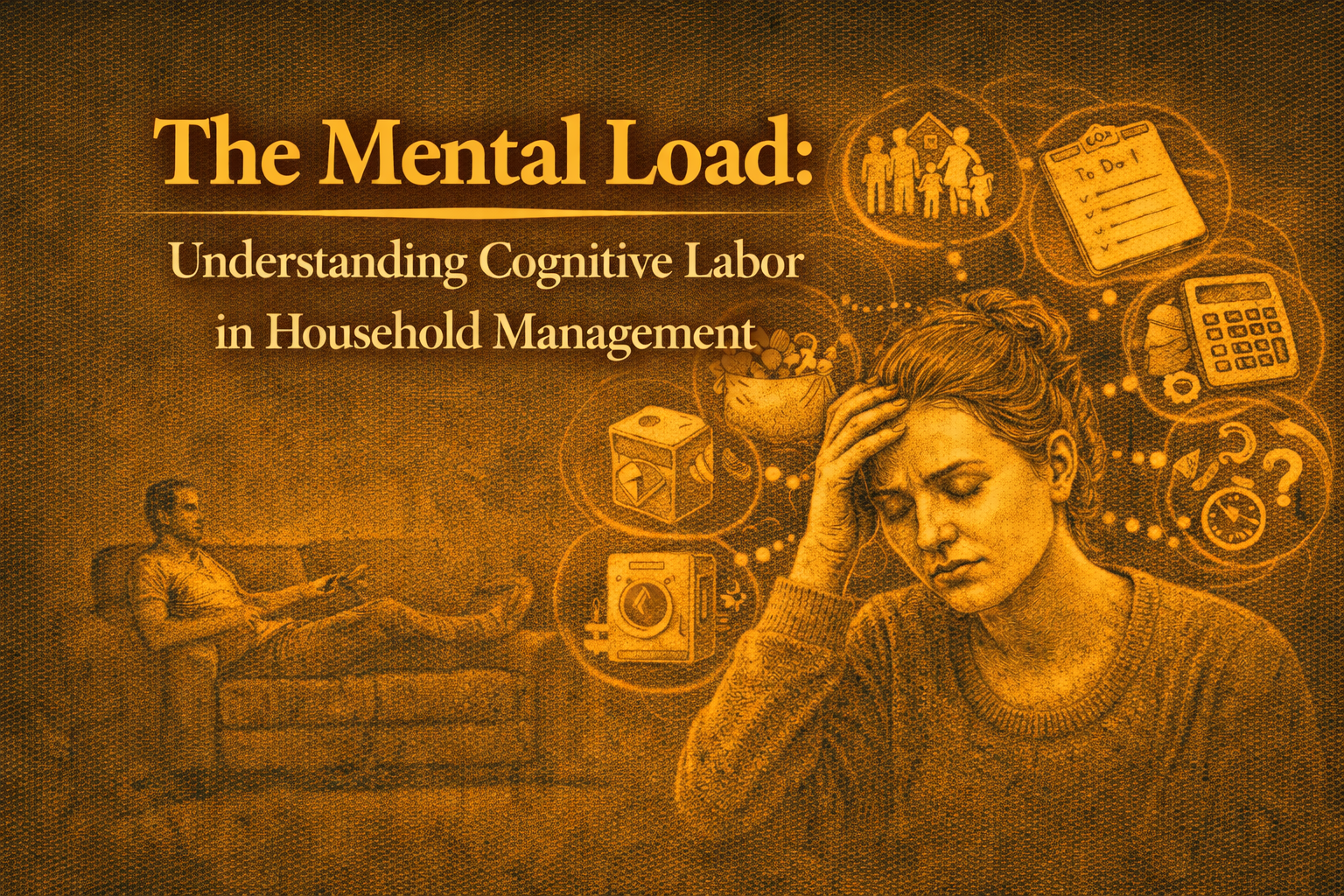
The Mental Load: Understanding Cognitive Labor in Household Management
Why “just tell me what to do” doesn’t solve the problem
The mental load is the invisible cognitive work of managing a household—not the tasks themselves, but the constant tracking, anticipating, planning, and remembering that makes tasks possible.
It’s the difference between doing the dishes and knowing the dishes need doing, buying more soap before it runs out, and noticing the dish rack is cracked and needs replacing.
It matters because it never stops.
Unlike physical chores, the mental load doesn’t end when you leave the kitchen.
It runs in the background of everything else you do.
This guide covers:
-
What the mental load actually is (and what it isn’t)
-
Why “just ask me” is a structural misunderstanding, not a solution
-
How the mental load operates as a system, not a list of tasks
-
What research shows about its distribution and cost
-
Why does it manifest differently depending on class, race, and relationship structure
-
What women are most commonly told that gets it wrong
-
What would actually need to change
I’ve tracked this in my own household across seven years, two careers, and two children.
Here’s everything you need to understand it.
What the Mental Load Actually Means

It’s not the act of cooking dinner.
It’s knowing what’s in the fridge, what needs to be used before it expires, whether your child has a food sensitivity that affects tonight’s meal, and whether tomorrow is a school day that requires a packed lunch.
This distinction matters because cognitive labour is invisible by design.
When the task is done, what’s visible is dinner on the table.
What’s invisible is the 40-decision chain that produced it.
Women often conflate the mental load with household chores themselves.
These overlap but are distinct.
A partner can share the physical work of laundry while the woman still tracks when it needs doing, which items need special care, whether the detergent is running low, and when to buy more.
The work looks shared.
The mental load stays concentrated.
The mental load is also distinct from emotional labour—though the two frequently co-occur.
Emotional labour is managing others’ emotional experiences.
The mental load is managing logistics.
The exhaustion women describe after “doing nothing all day” is often the cognitive residue of managing both simultaneously.
The term entered mainstream conversation in 2017 when French cartoonist Emma published You Should’ve Asked, a comic depicting how women function as household managers while partners function as helpers—present for execution, absent from anticipation.
Within months, it had been shared millions of times, not because it introduced a new concept, but because it named something millions of women had been living without language for.
What Seven Years of Tracking Taught Me
My husband is, by any reasonable measure, an involved partner.
He cooks several nights a week, handles all car maintenance, manages our finances, and is present and engaged with our children.
We divided tasks deliberately when we moved in together.
We revisited the division after each child.
We use a shared calendar, a shared grocery app, and have explicit conversations about household management at least quarterly.
And I still carry approximately 80% of the mental load.
I know this because I tracked it.
For six months across two different years, I logged every instance of cognitive household management—every task anticipated, every system monitored, every transition tracked, every appointment remembered before it appeared on the calendar.
The numbers were not close.
I made 340–380 household management decisions per month.
My husband made approximately 60–80, almost all in categories he “owned” (cars, finances, outdoor maintenance).
In every other category—children’s medical, school, social, emotional needs; food systems; home maintenance outside his domains; family scheduling; gift-giving and social obligations; clothing and supplies—I was the sole cognitive manager.
He wasn’t checked out.
He was helpful, responsive, and willing when asked.
But the asking itself was mine.
The monitoring was mine.
The anticipation was mine.
This is what seven years taught me:
Task-sharing doesn’t transfer the mental load.
Management transfer does.
And almost no one is doing the latter.
How the Mental Load Actually Works
The Anticipation Layer
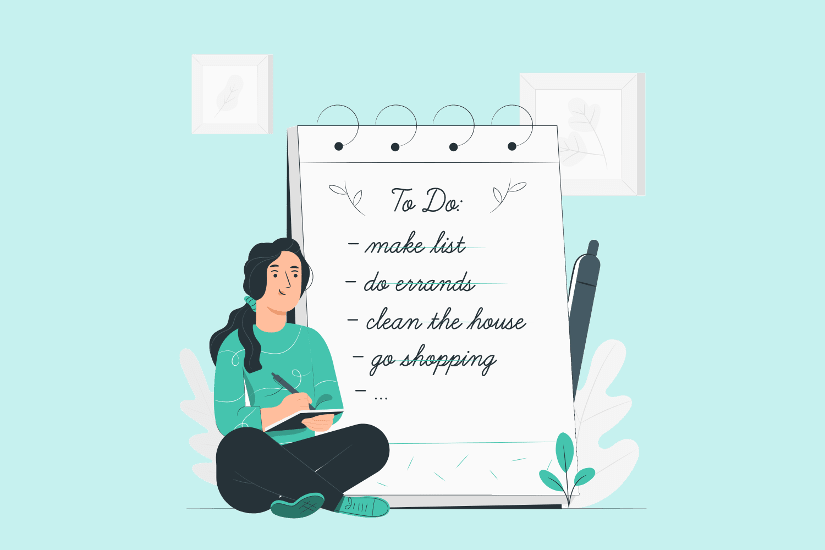
The mental load isn’t a collection of tasks.
It’s a management system.
Understanding the difference is what makes “just tell me what to do” such a precise misdiagnosis.
Most household tasks are visible only after someone has already done anticipation work.
“We’re out of milk” is a visible problem.
Knowing you’ll be out of milk by Thursday, before Thursday arrives, is anticipation.
Knowing this, because you track consumption patterns, family schedules, and grocery timing, is the mental load.
Anticipatory work is continuous and automatic for whoever carries the mental load.
It doesn’t require a trigger.
It runs as background monitoring.
For partners who don’t carry this layer, household problems become visible only when they’re already problems.
Which means they respond.
They don’t anticipate.
This creates an asymmetry that looks like inattentiveness but is actually structural.
One person is running the prevention systems.
The other is running response systems.
Both can be fully present and engaged.
Only one is managing.
The Tracking System
Households run on dozens of overlapping systems: food supply, medical schedules, school calendars, social obligations, clothing seasons, home maintenance cycles, and financial rhythms.
Someone has to hold the current state of each system in working memory.
Know that the dentist appointment is in three weeks, but needs to be confirmed on Tuesday.
Know that your child’s friend’s birthday is coming, and your child mentioned wanting to bring a gift.
Know that the library books are due Friday, and one is missing.
Tracking is the continuous update of that working memory.
It doesn’t require action—it requires attention.
Constant, background, interrupted-by-nothing attention.
Arlie Hochschild documented this in The Second Shift (1989):
Women working full-time professional jobs described a mental “second shift” that ran parallel to their paid work—not just household tasks in the evening, but household management throughout the day.
Thinking about dinner during a work meeting.
Texting the paediatrician during a lunch break.
Confirming the babysitter during a commute.
The mental load doesn’t clock out.
The Delegation Problem
This is the mechanism “just tell me what to do” misses.
When a partner says this, they’re offering to execute.
They’re not offering to anticipate, track, or manage.
So the person carrying the mental load must now:
-
Monitor the system (still theirs)
-
Identify when action is needed (still theirs)
-
Communicate that to a partner (now additional work)
-
Follow up if it doesn’t happen (still theirs)
-
Accept that the standard may differ (negotiation)
Delegating to an executor doesn’t reduce the mental load.
It adds a communication and monitoring layer to it.
Allison Daminger’s 2019 research in American Sociological Review documented this precisely.
She broke household cognitive labour into four stages:
-
anticipation
-
identification
-
decision
-
monitoring
In heterosexual couples, women dominated all four stages—but especially anticipation and monitoring, the least visible and most continuous.
When men participated, it was primarily in the decision stage, after women had already done the preceding cognitive work.
The division isn’t men refusing to help.
It’s men entering the process after the expensive work is already done.
The Standard Problem
Household management requires standards.
What “clean enough” means.
When is a paediatrician call necessary vs. watchful waiting?
How much lead time does a birthday party need?
Standards aren’t natural.
They’re learned, held, and enforced by whoever monitors them.
When the mental load is concentrated in one person, that person’s standards govern the household.
When a partner isn’t tracking, they’re also not holding standards.
So when they execute tasks, the execution may not match the standard—not because they’re incompetent, but because they haven’t been monitoring long enough to internalise what the standard is.
This produces a specific conflict.
The partner who carries the load experiences the other’s execution as inadequate.
The executing partner experiences the feedback as criticism or micromanagement.
Both interpretations are accurate.
Neither addresses the structure.
Why the Mental Load Is Concentrated in Women

The mental load doesn’t distribute randomly.
It follows a structural pattern that predates any individual household’s decisions.
The Default Manager Assumption
Households need a primary manager—someone whose job it is to know the current state of all systems.
In heterosexual relationships, this role defaults to women, regardless of employment status, earning level, or stated values.
Research from Takahashi & Gager (2019) in the Journal of Family Issues found that this default persists even when women out-earn their partners and both work equivalent hours.
It persists even when male partners identify as feminists and explicitly value equality.
The default isn’t a choice couples make.
It’s a pattern they inherit and often don’t examine until the cognitive cost becomes unsustainable.
The Visibility Differential
Cognitive labour is invisible.
Physical labour is not.
When a partner vacuums, the vacuuming is visible—and credible.
When a partner mentally tracks that the vacuum bag is nearly full, orders the replacement, schedules time to change it, and remembers to move the furniture first, none of that is visible.
This creates a systematic undervaluing.
Physical contributions to housework are seen, acknowledged, and appreciated.
Cognitive contributions aren’t.
So the partner doing more visible work experiences themselves as contributing significantly.
The partner doing more invisible work experiences themselves as unseen.
Both perceptions are accurate.
Neither is the full picture.
The Socialisation Gap
Girls are socialised into household monitoring earlier and more consistently than boys.
Noticing when supplies are low, anticipating guests’ needs, tracking family schedules—these are behaviours modelled and reinforced in girls throughout childhood.
This isn’t biological.
It’s learned.
But it means by the time two adults share a household, one typically has 15–20 years more practice at cognitive household management than the other.
This gap isn’t insurmountable.
But it doesn’t close through good intentions.
It closes through deliberate, sustained practice—which requires the person with less experience to carry systems they’re currently not tracking, and to tolerate the discomfort of learning while things go slightly wrong.
Most couples don’t get there because it’s easier for the person who already knows how to just do it.
How the Mental Load Looks Different Across Contexts
For Professional and High-Earning Women
In professional households, the mental load often stays invisible the longest because outsourcing is possible.
Hire a cleaner.
Use a meal service.
Pay for a household manager app.
These reduce physical labour.
They don’t reduce the cognitive labour of managing those services—scheduling, communicating standards, following up, rebooking when they cancel.
Someone still holds the system.
That person is still, almost always, the woman.
The penalty in professional households is time and cognitive bandwidth, not immediately economic.
It shows up as exhausted high earners who can’t understand why they feel so depleted—they’re “doing nothing” compared to what the cleaner does.
What they’re doing is managing everything the cleaner doesn’t touch.
For Hourly and Working-Class Women
Without the option to outsource, the mental load compounds directly into physical labour.
No cleaning service means the woman both tracks the cleaning and does it.
No meal service means she plans, shops, prepares, and monitors food systems alone.
No household management tools means the systems live entirely in her head—and can’t be delegated to an app, let alone a partner.
Class also shapes what “falling behind” costs.
A professional woman whose mental load causes her to miss a dentist appointment reschedules it.
A working-class woman who can’t afford the appointment, can’t take time off to attend it, or has no transportation to reach it faces compounding consequences.
The mental load doesn’t just feel heavier at lower income levels.
It is heavier.
The margin for error is smaller.
The cost of system failure is higher.
For Single Mothers
Without a partner, the question of distribution becomes moot.
The mental load is entirely hers.
What changes is the visibility.
Single mothers report that other people suddenly see their cognitive labour—because there’s no one else to attribute it to.
But the social support to relieve it rarely follows.
Research from Edin & Kefalas (2005) documents how single mothers develop extremely sophisticated household management systems out of necessity—detailed scheduling, tight resource tracking, precise anticipatory planning.
Skills that go entirely unrecognised as cognitive labour because they’re framed as individual competence rather than management work.
For Women of Colour
Racial dynamics layer onto the mental load in specific ways.
Black women face the “strong Black woman” stereotype—expected to manage more, acknowledge difficulty less, and require less support.
This expectation operates inside households, not just outside them.
Research from Woods-Giscombé (2010) on the “Superwoman Schema” documents how Black women internalise an obligation to appear capable, suppress emotional needs, and resist help, which makes acknowledging the mental load, let alone redistributing it, structurally harder.
The mental load is present.
The permission to name it as a burden is constrained.
What Women Are Commonly Told That’s Wrong
“Just ask for help, and he’ll do it.”
Why women believe this:
It sounds practical.
Explicit communication solves most partnership problems.
If he doesn’t know something needs doing, tell him.
Why it fails:
Asking for help positions the mental load as a task problem.
It isn’t.
It’s a management problem.
When you ask for help, you’re still the manager.
You identified the need, decided it required action, determined who should do it, communicated the request, and will monitor for completion.
Your partner executed one step.
You did the rest.
Eve Rodsky’s research for Fair Play (2019) found that women in heterosexual couples performed the “cognitive planning” component of household tasks 93% of the time, even when the physical execution was shared.
Asking for help doesn’t transfer the planning.
It just shares the labour.
What’s actually true:
Distribution of execution doesn’t redistribute the mental load.
Transfer of full ownership—anticipation, tracking, decision, monitoring—does.
These are different things.
Most couples are doing the first and calling it equity.
“Lower your standards, and you’ll be less stressed.”
Why women believe this:
It sounds like self-compassion.
If the standard is causing the stress, change the standard.
Why it fails:
This locates the problem in women’s perfectionism rather than in the structure of who holds the system.
Standards exist because households require them to function.
Medication needs to be tracked accurately, or children get wrong doses.
Food needs to be monitored, or people get sick.
School deadlines exist because schools enforce them.
The question isn’t whether standards are too high.
It’s who is responsible for meeting them.
When women “lower their standards,” what often happens is:
The standard drops, nothing fills the gap, and women absorb the consequences when systems fail—while partners remain unaware that a failure occurred.
What’s actually true:
The cognitive load of standards monitoring doesn’t decrease when standards are lowered.
It just produces worse outcomes when monitoring lapses.
The solution is transferring the standard to someone else, not abandoning it.
“You need to let him do it his way.”
Why women believe this:
There’s real truth buried here.
Micro-managing execution is counterproductive.
Partners need autonomy to develop competence.
Why it fails:
This addresses the wrong problem.
“His way” often means: without the anticipation work, without the tracking, without the standard—but with visible execution.
The toilet gets cleaned.
It gets cleaned wrong, inconsistently, or after it’s visibly overdue because no one is monitoring the cycle.
What gets framed as perfectionism is often the monitoring function, noticing that execution without management produces poor outcomes.
That’s an accurate observation, not control.
What’s actually true:
Ownership transfer requires transferring the management function, not just the task.
That means your partner anticipates when it needs doing, tracks the standard, decides when to act, and monitors completion—without prompting.
That’s different from “doing it his way.”
It’s doing the whole job, not just the visible part.
The Bottom Line on the Mental Load
The mental load is the cognitive management of household life—and it is structurally concentrated in women, across income levels, employment statuses, and stated relationship values.
Understanding this doesn’t make it lighter.
But it does clarify where the problem lives: not in communication failure, not in perfectionism, not in unwilling partners—in who holds the management function, and the structural defaults that determine that assignment before any couple makes a single decision.
“Just tell me what to do” is a genuine offer of help.
It misidentifies what help is needed.
The offer is: take my execution.
What the mental load requires is: take my management.
These are not the same thing, and conflating them is how well-intentioned couples stay unequal.
What changes this is ownership transfer—full, deliberate, monitored-by-no-one transfer of complete household domains from one person to another.
Not task-sharing.
Not asking.
Not helping.
I’ve been doing this work for seven years.
The transfer is possible.
It is not fast, and it is not comfortable while it’s happening.
But it’s the only version that actually moves the load.
Deepa
About the Author, Mrs Chandravanshi
Mrs Chandravanshi (Deepa Chandravanshi) analyses how marriage, motherhood, and workplace structures shape women’s timing, choices, and autonomy, and writes about the daily negotiations women make at home and work—where gradual self-reduction begins to feel normal.
| Platform | Description | Link |
|---|---|---|
| Substack | Newsletter essays and published writing | mrschandravanshi.substack.com |
| Medium | Long-form essays and analytical writing | medium.com/@mrschandravansh |
| Medium (Deepa Profile) | Long-form essays and analytical writing | medium.com/@DeepaChandravanshi |
| Medium Publication — Judgment Under Pressure | Publication on decision-making and systems thinking | medium.com/judgment-under-pressure |
| Medium Publication — The Honest Confusion | Articles explaining confusing school concepts | medium.com/the-honest-confusion |
| Medium Publication — संरचना | Long-form analytical essays in Hindi | medium.com/sanrachna-official |
| Chandravanshi.org | Author profile and articles | chandravanshi.org |
| Professional posts and articles | linkedin.com/in/deepachandravanshi |
|
| Pratilipi (Hindi) | Stories and essays | hindi.pratilipi.com/user/deepa-chandravanshi |
| Quora | Answers and discussions on investing and decision-making | quora.com/profile/Mrs-Chandravanshi |
| Posts, updates, and discussions | facebook.com/MrsChandravansh |
|
| Short video insights and reels | instagram.com/mrschandravansh |