Career Breaks for Women: Long-Term Salary Impact and Promotion Effects
Career Breaks and the Long-Term Salary Penalty Women Rarely See Coming
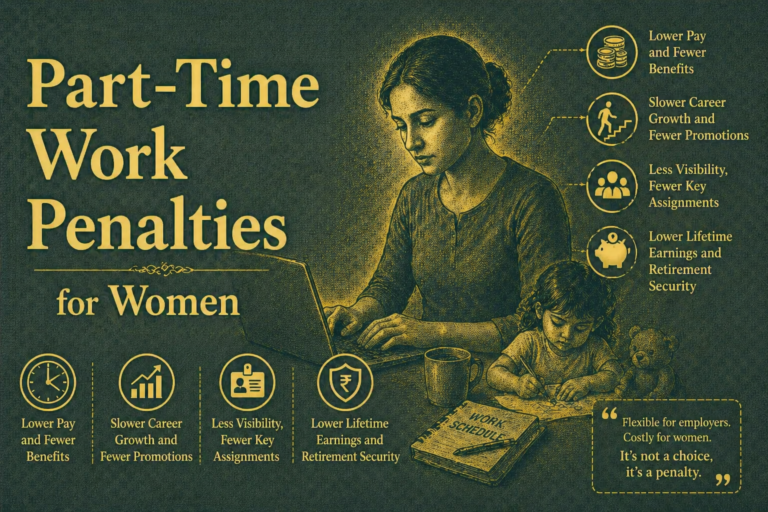
Career breaks taken for childbirth, caregiving, health, or family responsibilities create measurable long-term salary penalties for women across industries and income levels.
Research consistently shows that women who step away from full-time employment face:
- Lower re-entry salaries
- Delayed promotions
- Reduced lifetime earnings
- Professional network erosion
- Permanent career trajectory resets
The issue is not whether taking time away from work is morally right or wrong.
The issue is understanding what structurally happens afterward.
This guide examines:
- How career breaks create salary penalties
- Why the effects compound over decades
- What re-entry actually looks like
- What research across multiple studies shows
- Why common career advice fails women structurally
The central reality is uncomfortable:
Career breaks rarely function as temporary pauses.
Under current labour structures, they often become permanent economic resets.
What Career Breaks Actually Mean
A career break typically refers to workforce absence longer than standard parental leave, usually six months or more.
This includes:
- Extended leave after childbirth
- Elder care responsibilities
- Partner relocation
- Health recovery
- Education or retraining periods
- Leaving work because childcare costs exceed income
This distinction matters because employers treat extended breaks differently from ordinary leave.
Standard leave is expected.
Extended absence becomes a “gap.”
And gaps trigger assumptions about:
- Commitment
- Skill relevance
- Reliability
- Long-term availability
Women take significant career breaks at substantially higher rates than men.
That asymmetry explains why career interruption penalties disproportionately affect women over time.
How Career Breaks Create Salary Penalties
The Salary Reset Problem
Career breaks do not simply pause earnings.
They often reset compensation downward during re-entry.
Employers rarely negotiate from a woman’s pre-break trajectory.
Instead, negotiation begins from unemployment.
This changes bargaining power immediately.
A woman earning $145K before leaving may return to offers in the $80K-$100K range despite equivalent skills and experience.
The logic employers apply often sounds like this:
“You’ve been away from the workforce.”
“We need to assess current readiness.”
“There’s some risk involved.”
The salary reduction becomes framed as risk management.
But structurally, it functions as a discount applied to caregiving-related interruption.
The Skill Currency Assumption
Employers frequently justify reduced offers by claiming skills may have become outdated.
But in practice, many women maintain skills actively through:
- Freelancing
- Consulting
- Professional education
- Industry conferences
- Online certifications
The problem is not always actual skill decay.
The problem is perceived discontinuity.
Continuous organisational presence often matters more than objective competence.
This creates a hidden distinction:
- Skill maintenance helps performance
- Continuous employment protects valuation
Those are not the same thing.
The Promotion Clock Resets
Career breaks affect advancement as much as salary.
Women frequently return to:
- The same title
- Lower-visibility projects
- Reduced promotion velocity
- Re-established probationary perception
Previous tenure often loses practical value.
A woman with eight years of pre-break experience may return treated as though her advancement clock restarted from zero.
This compounds across decades because promotions generate:
- Larger salary jumps
- Equity access
- Leadership visibility
- Decision-making authority
Losing promotion velocity creates a widening structural gap over time.
Professional Network Decay
Professional networks weaken quickly during workforce absence.
This is rarely personal.
It is structural.
During multi-year breaks:
- Managers change companies
- Teams dissolve
- Internal sponsors disappear
- Organisational memory fades
Women often discover that former professional relationships no longer provide meaningful leverage during re-entry.
The result is that re-entry happens without:
- Strong referrals
- Internal advocates
- Recent collaborative visibility
Rebuilding networks takes years.
And the rebuilt network rarely carries the same influence as the original one.
Why the Penalty Compounds Over Decades
The largest misunderstanding about career breaks is assuming the damage is temporary.
The actual effect is compounding trajectory loss.
A simplified example:
Continuous Career Path
- Year 0: $145K
- Year 5: $190K
- Year 10: $250K
- Year 20: $400K+
Three-Year Career Break
- Years 0-3: Out of workforce
- Year 4 re-entry: $87K
- Year 10: Slower advancement
- Year 20: Still below no-break trajectory
The total difference across a career can exceed:
- $1M
- $2M
- Or more in lifetime earnings
Because the penalty affects:
- Salary baseline
- Promotion timing
- Equity participation
- Retirement contributions
- Social security accumulation
The loss compounds because future growth builds from a lower foundation permanently.
Why Career Break Penalties Persist Structurally
The “Ideal Worker” Model
Most corporate advancement systems were designed around a specific worker model:
- Continuous employment
- No caregiving interruptions
- Unlimited scheduling flexibility
- Full domestic support outside work
That model historically assumed male workers supported by unpaid female labour at home.
The labour market changed.
The advancement structure largely did not.
Promotion systems still reward:
- Continuous availability
- Long hours
- Constant visibility
- Uninterrupted tenure
Career breaks violate those assumptions.
The system therefore interprets interruption as reduced commitment instead of recognising caregiving as structurally necessary labour.
Why Employers Maintain the Structure
The current system benefits:
- Workers without caregiving interruptions
- Workers with domestic support
- High earners who outsource care
- Organisations purchasing experienced labour at discounted re-entry wages
Changing compensation structures would require:
- Salary protection
- Tenure portability
- Promotion flexibility
- Extended protected leave systems
Those changes are expensive and operationally disruptive.
Which is why most organisations avoid them.
How Career Break Penalties Differ Across Groups
Professional Women
White-collar women often experience:
- Reduced advancement velocity
- Loss of leadership track visibility
- Lower compensation growth
- Quiet exclusion from high-impact projects
The salary may continue rising slowly.
But peers without breaks accelerate much faster through promotion cycles.
Hourly and Service Workers
Hourly workers face harsher immediate consequences:
- Lower re-entry wages
- Reduced scheduling stability
- Loss of benefits
- Entry-level restart treatment
For many women, returning becomes economically irrational once childcare costs exceed reduced wages.
Women Returning After Long Breaks
Breaks longer than five years create severe penalties:
- Reduced interview callbacks
- Massive salary reductions
- “Junior role” reassignment despite senior experience
Long breaks often become permanent workforce exits because re-entry compensation no longer offsets caregiving and logistical costs.
Women of Colour
Women of colour frequently experience compounded penalties:
- Career break penalty
- Existing racial wage gaps
- Bias around competence and commitment
The result is:
- Longer unemployment periods
- Steeper salary reductions
- More severe under-placement
Common Advice Women Receive That Fails Structurally
“Keep Your Skills Current”
This helps with interview credibility.
It does not eliminate the salary penalty.
The core issue is not usually technical competence.
It is how employers interpret career interruption itself.
“Use Return-to-Work Programs”
Returnships help women access employment again.
But many:
- Reduce seniority
- Reset promotion timelines
- Offer below-market compensation
They improve access.
They rarely restore lost trajectory.
“Be Transparent About Caregiving”
Transparency often increases perceived risk.
Employers may quietly assume:
- Future interruptions are likely
- Caregiving remains priority
- Long-term availability is uncertain
This changes compensation behaviour even when interviewers remain outwardly supportive.
“Strong Performance Will Close the Gap”
Strong performance helps women progress from their new baseline.
It rarely restores the original trajectory.
A woman climbing from $87K to $150K post-break may still remain dramatically behind the no-break path that would have reached $280K+ over the same period.
What Research Across Two Decades Shows
Longitudinal research consistently finds:
- Women returning after breaks earn significantly less long-term
- The penalty grows with break length
- Skills maintenance only marginally reduces penalties
- Professional networks weaken rapidly during absence
- The effects persist for decades
The findings repeat across:
- Labour economics
- Sociology
- Organisational behaviour studies
- Work-family conflict research
The evidence base is extensive.
The structural response remains limited.
What This Means Practically
At the Individual Level
Women considering career breaks should understand they are making a structural trade, not simply “taking time off.”
Potential losses include:
- Lifetime earnings
- Promotion speed
- Professional leverage
- Retirement accumulation
- Leadership positioning
Potential gains may include:
- Caregiving capacity
- Health recovery
- Reduced immediate stress
- Family stability
- Time with children during formative years
The point is not to morally rank those choices.
The point is to understand the cost structure honestly before deciding.
At the Organisational Level
Real structural support would require:
- Salary protection after leave
- Tenure continuity
- Objective skill evaluation
- Network preservation systems
- Equivalent-level re-entry pathways
Most organisations currently offer symbolic flexibility rather than structural redesign.
At the Policy Level
The strongest interventions would include:
- Extended paid parental leave
- Affordable universal childcare
- Career break protections
- Salary history restrictions
- Portable tenure frameworks
Without structural reform, individual women continue absorbing the financial penalty privately.
Frequently Asked Questions
How long does a break need to be before penalties begin?
Research suggests measurable penalties begin around:
- 12-18 months for moderate effects
- 2+ years for severe compounding effects
Does freelancing during the break prevent the penalty?
No.
It may improve interview success slightly but does not eliminate structural salary reductions tied to workforce absence.
Do men face the same penalties?
Men experience smaller penalties overall.
Women’s breaks are more strongly associated with caregiving assumptions and reduced commitment perceptions.
Can strong post-return performance erase the gap?
Usually not completely.
Women often advance successfully after re-entry while still remaining permanently below their no-break trajectory.
What is the average long-term financial impact?
For many professional women, total lifetime earnings losses may reach:
- $1M
- $2M+
Depending on:
- Industry
- Break length
- Promotion structure
- Compensation model
Final Perspective
Career breaks create long-term salary penalties because modern advancement systems still reward uninterrupted employment patterns designed around workers without caregiving interruptions.
The problem is not individual weakness.
It is structural valuation.
Women who take career breaks are not simply “pausing” careers under current systems.
They are often accepting:
- Reduced bargaining power
- Lower salary baselines
- Slower promotion timelines
- Permanent earnings compression
Some women still choose the break consciously and do not regret it.
But meaningful choice requires accurate information.
And accurate information means recognising that career breaks are rarely temporary economically, even when they are temporary chronologically.
Until organisations and policy structures redesign advancement around caregiving reality instead of uninterrupted employment assumptions, women will continue carrying the cost individually.
Not because they failed professionally.
Because the structure prices interruption as reduced value.