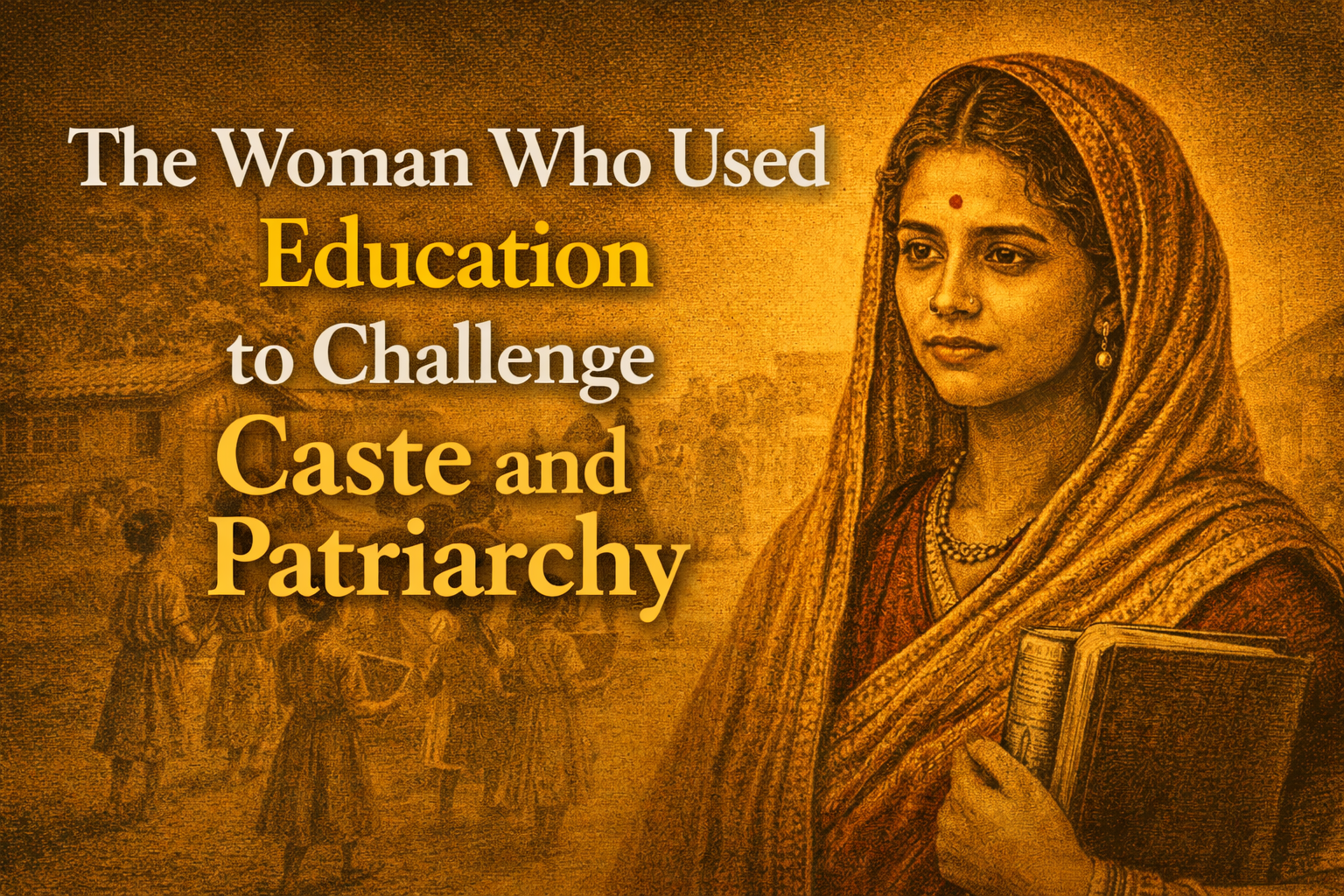
Savitribai Phule: The Woman Who Used Education to Challenge Caste and Patriarchy
How opening schools for girls quietly disrupted the social order of 19th-century India.
In 1848, a young woman walked through the streets of Pune carrying a second sari in her bag — not for warmth, but because she needed something clean to change into after neighbours threw dung and mud at her on the way to school. That woman was Savitribai Phule. She was 17 years old. She was a teacher. And she had just opened India’s first school for girls.
Savitribai Phule was not a reformer who wrote pamphlets from a safe distance. She worked where the resistance was loudest — inside homes ruled by caste and gender, inside a social order that treated a woman’s literacy as a threat. What she built across Maharashtra between 1848 and her death in 1897 was not just a school system. It was a direct challenge to who deserved to think, learn, and be seen.
This article covers who Savitribai Phule was, what she specifically built and why it mattered, where her work connects to the deeper structures of caste and patriarchy in 19th-century India, and why her legacy is still actively contested today.
Read Savitribai Phule in Hindi
Table of Contents
- Who Was Savitribai Phule?
- How Opening a School Became an Act of Social Disruption
- What the Work Actually Looked Like: Education, Shelter, and Survival
- The Poetry Nobody Mentions First
- How Her Work Challenged Caste — Not Just Gender
- The Final Years: Famine, Plague, and Service Until Death
- Where Her Legacy Stands Today
- Frequently Asked Questions
Who Was Savitribai Phule?
Savitribai Phule was born on January 3, 1831, in Naigaon village in Satara district, Maharashtra. She came from the Mali community — a lower-caste farming background that placed her outside the Brahminical social hierarchy that governed access to education, religious ritual, and public life in 19th-century India.
She was married at nine years old to Jyotirao Phule, who was twelve. The pairing was unusual for reasons beyond age: Jyotirao came from a family with some exposure to progressive ideas, and he took her education seriously from the beginning of their marriage. He taught her to read and write at home — an act that was itself transgressive in a social context where female literacy was actively discouraged among most communities.
She went on to complete two teacher-training programs: one at a Normal School in Pune and one at an institution run by Ms. Farar in Ahmednagar. By 17, she had the training. On January 1, 1848, she and Jyotirao opened their first school for girls at Bhide Wada in Pune, with nine students and two teachers: Savitribai and Sagunabai Kshirsagar.
India’s first female teacher had arrived. And almost nobody made it easy for her.
How Opening a School Became an Act of Social Disruption
The resistance Savitribai faced was not incidental. It was the point. The social order she was disrupting had a clear logic: caste restricted knowledge, and gender restricted mobility. Upper-caste Brahmin orthodoxy held that literacy for women — particularly lower-caste women — violated the natural hierarchy that organised Hindu society. A literate Dalit woman was not just an unusual sight. She was a structural problem.
Neighbours threw stones, garbage, and dung. Religious conservatives accused her of corrupting social order. Local officials were pressured to shut the school down. Savitribai’s response was to carry an extra sari, change when she arrived, and continue teaching.
The school at Bhide Wada was not a one-off experiment. It was the first of eighteen. Between 1848 and the early 1850s, Savitribai and Jyotirao Phule established eighteen schools across Pune and surrounding areas — all of them open to girls, all of them open to lower-caste students, all of them a direct challenge to the premise that education was a Brahmin entitlement.
This was not a coincidence. The Phules were building a system. Savitribai managed the day-to-day of the schools, trained teachers, and kept enrollment growing. The British colonial administration, which had complicated relationships with Indian social reform, occasionally acknowledged the work — a government inspector visited the Phule schools in 1852 and offered a favourable report. The endorsement gave the schools some official cover, but the social pressure never fully stopped.
The schools did something else that mattered. They taught in Marathi — the vernacular language — not in Sanskrit, which was the preserve of Brahmin clergy and scholars. Choosing the everyday language was a political act. It said that knowledge was not sacred property. It could belong to anyone who could speak and read.
A concise list of the major contributions of Savitribai Phule
-
Opened the first school for girls in India (Pune, 1848)
-
Became India’s first female teacher
-
Established multiple schools for girls in Pune
-
Co-founded 18 schools across Maharashtra with Jyotirao Phule
-
Promoted education for girls and marginalised communities
-
Worked for the education of lower-caste and oppressed communities
-
Promoted education for girls from marginalised and lower-caste communities
-
Fought against caste discrimination in education
-
Advocated for women’s education and social equality
-
Promoted education through vernacular languages
-
Organised education campaigns for marginalised communities
-
Worked against child marriage
-
Opposed child marriage
-
Opposed the practice of Sati
-
Advocated for widow remarriage
-
Encouraged widow remarriage
-
Provided shelter for pregnant widows
-
Supported widows and pregnant rape survivors
-
Opened a care home for widows (Balhatya Pratibandhak Griha)
-
Started Balhatya Pratibandhak Griha (home to prevent female infanticide)
-
Helped widows deliver children safely and opposed infanticide
-
Promoted women’s dignity and rights in society
-
Worked for women’s dignity and social independence
-
Encouraged women’s participation in public life
-
Organised Mahila Seva Mandal for women’s awareness
-
Started Mahila Seva Mandal to promote women’s awareness and rights
-
Worked to end untouchability practices
-
Fought against untouchability and caste hierarchy
-
Organised protests against untouchability
-
Encouraged inter-caste social equality
-
Promoted inter-caste equality and social justice
-
Promoted human dignity and social equality through education
-
Encouraged self-respect and dignity among oppressed communities
-
Promoted scientific thinking and rational social reform
-
Worked for the dignity of farmers and labouring communities
-
Helped run Satyashodhak Samaj activities with Jyotirao Phule
-
Contributed to the Satyashodhak Samaj movement
-
Worked with Jyotirao Phule in social reform movements
-
Led social reform work after Jyotirao Phule’s death
-
Became the leader of Satyashodhak Samaj after Jyotirao Phule’s death
-
Wrote poetry and social reform literature
-
Wrote poetry promoting social reform (Kavya Phule, 1854)
-
Published the poetry book “Kavyaphule” (1854)
-
Published the poetry collection “Kavya Phule” (1854)
-
Authored “Bavan Kashi Subodh Ratnakar”
-
Published “Bavan Kashi Subodh Ratnakar” (1892)
-
Provided food and shelter to famine victims (1876–77)
-
Served people during the 1897 plague epidemic
-
Established care for plague victims
-
Set up treatment camps during the bubonic plague epidemic (1897)
-
Provided care to plague victims during the 1897 plague epidemic
-
Died while serving plague patients
-
Died while nursing plague patients — a martyr to public service
-
Pioneer of the women’s liberation movement in India
-
Challenged Brahminical patriarchy and orthodox Hindu practices
-
Inspired the modern Dalit feminist movement
What the Work Actually Looked Like: Education, Shelter, and Survival
Savitribai’s reform work was not limited to classrooms. The schools addressed literacy. Everything around the schools addressed survival.
In 1853, Savitribai and Jyotirao opened the Balhatya Pratibandhak Griha — a name that translates roughly as “the home to prevent the killing of children.” The name tells you what the institution was built to address. In 19th-century Maharashtra, widows who became pregnant — often survivors of rape, sometimes abandoned by families after a husband’s death — faced a brutal set of choices. Infanticide was common. Social rejection was total. The Balhatya Pratibandhak Griha provided a place for pregnant widows to deliver safely, regardless of caste or background.
Savitribai herself adopted a child born at the home — Yashwant, the son of a Brahmin widow — and raised him as her own. He later became a doctor. The adoption was a direct, personal rejection of caste-based ideas of purity and belonging.
The work on widows was connected to a larger campaign. Savitribai and Jyotirao actively opposed child marriage, the practice of Sati (in which widows were burned on their husbands’ funeral pyres), and the social prohibition on widow remarriage. They organised the Mahila Seva Mandal — a collective for women’s awareness and rights — and conducted community meetings where widows and lower-caste women could gather, speak, and receive support. These gatherings were not passive information sessions. They were designed to move women from private suffering into public voice — a deliberate effort to encourage women’s participation in social and civic life at a time when their presence in any public forum was considered inappropriate. In a social context where a widow’s public presence was itself considered a transgression, convening such gatherings was a calculated act of defiance.
The Mahila Seva Mandal also carried an explicit message about dignity. Savitribai consistently argued that women — regardless of caste or marital status — deserved to be treated as full human beings, not as dependents defined by their relationship to men. That argument was not abstract. It was built into the structure of every institution she ran: the schools that told lower-caste girls their minds were worth developing, the care home that told abandoned widows their lives had value, the community meetings that told women their opinions deserved to be heard.
The Satyashodhak Samaj, which Jyotirao founded in 1873, provided an organised framework for much of this work. The Samaj’s philosophy was explicitly rationalist: it rejected superstition, priestly intermediaries, and ritual practices that it argued were used to keep lower-caste communities in a state of fear and dependence. It promoted scientific thinking and rational inquiry as tools of social liberation — the argument being that caste hierarchy was sustained not only by economic and legal force but by manufactured religious authority that rational education could dismantle. Savitribai absorbed and advanced this rationalist position throughout her life. Her poetry, her schools, and her public speeches all returned to the same premise: that the oppressed communities of Maharashtra deserved to think clearly, question openly, and reach their own conclusions. Savitribai was not a peripheral supporter of the Samaj. She ran Satyashodhak Samaj wedding ceremonies after Jyotirao’s death in 1890 — ceremonies conducted without Brahmin priests, using Marathi vows, open to inter-caste couples. She became the de facto leader of the movement during the final years of her life.
The Poetry Nobody Mentions First
Savitribai Phule was also a poet. The poetry tends to get mentioned after the schools and the social work, almost as a footnote. That ordering understates what the poetry actually did.
Kavya Phule, published in 1854, was her first poetry collection. She was twenty-three years old. The poems are written in Marathi, addressed directly to women and lower-caste communities, and carry an explicit argument: that ignorance is not a spiritual condition, it is an imposed condition. One of the most cited passages from the collection makes the case plainly — go, get yourselves educated, the poem says, because without learning, you are treated as beasts of burden.
This was not a metaphor for its own sake. The poetry was pedagogical. It was designed to reach readers and listeners who might not respond to abstract arguments about rights but could hear the same argument in verse form, in their own language, at a community gathering. The poems were part of the same infrastructure as the schools.
Her second major work, Bavan Kashi Subodh Ratnakar, was published in 1892 — thirty-eight years after Kavya Phule — and shows a poet who had been living inside the reform movement for decades. The latter collection is denser, more concerned with history and the structure of caste oppression, and reflects the influence of the Satyashodhak Samaj’s sustained intellectual work.
Taken together, the two collections represent something unusual in 19th-century Indian literature: a lower-caste woman’s direct address to other lower-caste women and men, written in a language they could access, making arguments they could use.
How Her Work Challenged Caste — Not Just Gender
It is easy to frame Savitribai Phule’s work primarily as women’s rights work — and it was that, in a fundamental sense. But reducing it to gender reform alone misses the structure of what she was actually fighting.
The exclusion of girls from education in 19th-century Maharashtra was not identical across communities. Upper-caste Hindu families had reasons rooted in purity norms and purdah-like practices. Lower-caste and Dalit communities faced a different and more total exclusion: the claim that they were constitutionally unfit for learning, that their bodies and minds were inherently inferior, that their role in the social order was to serve, not to think.
The Phule schools were explicitly and consistently open to students from lower castes, Dalit communities, and other marginalised groups. This was not an accident of policy. The Phules understood that gender and caste were interlocking systems. A school that educated upper-caste girls but continued to treat lower-caste children as unworthy of education would be addressing half the problem. They built for both.
Reaching those communities required active outreach, not just open doors. Savitribai and her colleagues went into neighbourhoods — particularly those populated by Mahar, Mang, and other lower-caste and untouchable communities — to encourage families to send their children to school. The campaigns were direct and personal: explaining why education mattered, countering the fatalism that generations of exclusion had produced, and insisting that literacy was a right, not a privilege. This was education campaigning in the most literal sense — going where the students were, rather than waiting for them to arrive.
Woven through all of this was a message about self-respect. The Satyashodhak Samaj’s philosophy, which Savitribai practised and extended, argued that the first damage caste inflicted was psychological — that oppressed communities had been taught to see their own degradation as natural and deserved. Restoring dignity and self-respect among those communities was not a secondary goal. It was the precondition for everything else. A person who believed they were inherently inferior would not send their daughter to school, would not stand up against untouchability, would not challenge a priest’s authority. Savitribai’s work — the schools, the poetry, the community meetings, the public ceremonies — was consistently directed at that psychological foundation.
Savitribai’s personal confrontation with untouchability was direct. She organised protests against the practice, insisted on inter-caste social equality in the institutions she ran, and worked alongside families from communities that Brahminical society placed at the absolute bottom of the hierarchy. The Balhatya Pratibandhak Griha, for instance, was explicitly caste-blind — a pregnant Brahmin widow received the same care as a Dalit woman in the same situation. That equivalence was itself a political statement.
The Satyashodhak Samaj formalised this dual critique. The Samaj argued that Brahminical authority — religious, social, and intellectual — was the common root of both caste and gender oppression. Savitribai’s work in the Samaj and her leadership of it after Jyotirao’s death placed her at the centre of a movement that was making a structural argument, not just appealing for individual acts of compassion.
The Final Years: Famine, Plague, and Service Until Death
Between 1876 and 1877, Maharashtra was struck by severe famine. The Phules organised relief work — food distribution, shelter, and direct support for the farming and labouring communities who bore the heaviest burden of the crisis. Cultivators, agricultural workers, and those without land or reserves had no buffer against crop failure. The Phules’ relief efforts were targeted at exactly those groups — the same communities the Satyashodhak Samaj had been arguing deserved dignity and justice in ordinary times. The work during the famine shows the practical reach of that agenda: the reform movement was not only ideological but operational, capable of mobilising resources when the need was immediate and physical.
In 1897, the bubonic plague swept through Pune. Savitribai and her son Yashwant — the Brahmin widow’s son she had adopted — opened a clinic in Halkarwadi to treat plague victims. Savitribai herself went to patients’ homes to carry those who were sick and dying to the clinic. She contracted the plague while carrying a sick child. She died on March 10, 1897.
She was sixty-six years old. She died doing the same thing she had done for fifty years: physically placing herself where the need was greatest, regardless of the social cost.
Where Her Legacy Stands Today
India officially recognises Savitribai Phule as a pioneer of women’s education and social reform. Her image appears on postage stamps. January 3rd — her birthday — is observed as Balika Din in Maharashtra. Pune University was renamed Savitribai Phule Pune University in 2014.
The official recognition is real and also partial. The Dalit feminist movement in India claims her as a foundational figure — specifically because her work addressed caste and gender together, not separately. Scholars in this tradition argue that mainstream commemorations often dilute the caste-critique dimension of her work, presenting her as a generic pioneer of women’s education without acknowledging that the women she was fighting for were specifically lower-caste and Dalit women, and that the men she was fighting against were specifically upper-caste men defending a system of Brahminical authority.
That debate is ongoing. It is also, in its way, evidence that her work touched something real and structural — something that has not been fully resolved by the passage of 175 years.
Frequently Asked Questions
Who was Savitribai Phule, and why is she significant?
Savitribai Phule (1831–1897) was a Maharashtrian social reformer, poet, and educator who opened India’s first school for girls in Pune in 1848 and became the country’s first female teacher. Her significance lies in the dual nature of her work: she challenged both gender discrimination and caste hierarchy simultaneously at a time when each alone was considered radical. She worked not just through institutional reform but through direct personal service — teaching under threat, sheltering abandoned widows, and dying while treating plague patients.
When did Savitribai Phule open the first school for girls?
On January 1, 1848, at Bhide Wada in Pune, Savitribai and Jyotirao Phule opened the first school for girls in India. Savitribai and her colleague Sagunabai Kshirsagar were the teachers. The school began with nine students. Over the following years, Savitribai and Jyotirao expanded to eighteen schools across Maharashtra.
What was the Balhatya Pratibandhak Griha?
The Balhatya Pratibandhak Griha was a home established by Savitribai and Jyotirao Phule in 1853 to support pregnant widows — including rape survivors — who had nowhere safe to give birth. The home was caste-blind: women from all communities received care. Savitribai adopted a child born at the home, Yashwant, the son of a Brahmin widow, and raised him as her own son. The institution was a direct response to the social practice of infanticide and the abandonment of widows who became pregnant.
What is the difference between Savitribai Phule’s work and the standard 19th-century women’s reform?
Most 19th-century women’s reform in India focused on upper-caste women — widow remarriage campaigns, opposition to Sati, arguments for female education — while leaving the caste hierarchy intact. Savitribai Phule’s work was different because it explicitly and consistently included lower-caste and Dalit women. The schools she ran were open regardless of caste. The Satyashodhak Samaj, which she helped lead, argued that caste authority and gender oppression were the same problem, not two separate problems. This integrated critique is why the Dalit feminist movement today treats her as a foundational figure rather than just a women’s rights pioneer.
What poetry did Savitribai Phule write?
She published two major collections. Kavya Phule appeared in 1854, when she was twenty-three — a collection of poems addressed directly to women and lower-caste communities, arguing in Marathi verse that ignorance is imposed, not inherent, and that education is the path out of it. Bavan Kashi Subodh Ratnakar was published in 1892 and reflects four decades of engagement with the Satyashodhak Samaj’s intellectual work on caste and social justice. Both collections were written in Marathi — a deliberate choice that made the work accessible to people excluded from Sanskrit-based learning.
How did Savitribai Phule die?
Savitribai Phule died on March 10, 1897, from the bubonic plague. During the 1897 plague epidemic in Pune, she and her son Yashwant opened a clinic to treat plague victims. She personally carried sick patients to the clinic, contracted the plague herself while transporting a sick child, and died shortly after. She was sixty-six years old. The manner of her death was consistent with the manner of her life: direct, physical engagement with the people most at risk, regardless of the personal cost.
Why is Savitribai Phule considered a pioneer of the Dalit feminist movement?
Because she located the roots of women’s oppression in caste hierarchy, not only in gender hierarchy. Her schools served Dalit and lower-caste girls specifically. Her organisations challenged untouchability as inseparable from gender injustice. Her personal life — adopting a Brahmin widow’s child, leading Satyashodhak Samaj ceremonies without Brahmin priests — was a series of direct rejections of caste-based purity norms. Dalit feminist scholars argue that this structural integration of caste and gender critique makes her distinct from most reformers of her era, and makes her legacy more relevant to contemporary conversations about intersectional oppression in India.
What This Changes
If you have thought of Savitribai Phule primarily as an early educator, that framing is accurate but incomplete. The more precise reading: she was a strategist who understood that literacy, shelter, and social equality were parts of a single system — and that attacking one without the others would leave the structure intact. The school was the visible part. The homes for widows, the plague clinic, the caste-blind marriage ceremonies, the Marathi poetry addressed directly to the people who needed it most — those were the parts of the system that made the school durable.
The historical significance of her work does not depend on romanticisation. She walked through the garbage every morning. She taught through direct community opposition. She died carrying a sick child. The record is specific enough that it does not need embellishment. What it needs is accurate framing: not a gentle pioneer of women’s education, but a woman who spent fifty years dismantling, from the inside, the social logic that said certain people do not deserve to learn.
The primary historical record on Savitribai Phule’s life and work draws on Marathi sources, including the Phule collected writings and the records of the Satyashodhak Samaj. Scholarly work by Dr Y.D. Phadke and more recent Dalit feminist historians — particularly those engaged with the Maharashtra-based social reform tradition — provide the most complete contextual reading.