
How Political Opinions Form Inside Family WhatsApp Groups
How Political Opinions Form Inside Family WhatsApp Groups
The group doesn’t ask you what you think. It tells you.
The mechanism runs the same way every time. A message arrives in a group of 47 people. Someone reacts before others have opened it. By the time the fifth person responds, the frame is already set. What follows is not a debate. It is confirmation. The political opinion that forms inside a family WhatsApp group is not built on information. It is built from social weight — who sent it, who agreed, and how many people reacted before you arrived.

How the Group Actually Works
The family group is not a news channel. It does not function like one, even when it carries news.

Every message that enters the group arrives wearing the identity of the sender. When Dhruv’s chacha in Lucknow forwards a political video, the video does not land as a claim to be evaluated. It lands as a signal from a person Dhruv already has a relationship with — a relationship built over decades, across weddings and funerals and phone calls during festivals. The claim inside the video inherits that trust. The viewer is not reading the message. They are reading the sender.
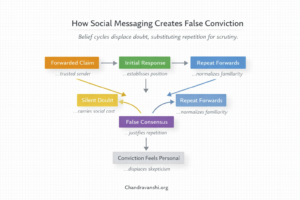
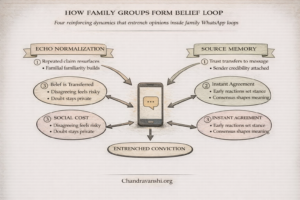
This is the first mechanism: source substitution. The credibility of the person replaces the credibility of the content. A forwarded message from a trusted uncle carries more epistemic weight than a headline from a channel the reader has been watching for years. The channel speaks to the family. The uncle speaks with them.
What Forwarding Actually Does
Deepa opens the group. Five people have already reacted. She reads the reactions before she watches the video.
This is not unusual behaviour. It is the default behaviour, and it changes what the video means before she has seen a single frame. The reactions are not responses to the content. They are social coordinates. They tell her where the group already stands. By the time she presses play, she is not evaluating the video. She is deciding whether to align with the group or separate from it.
Forwarding amplifies this further. A message forwarded across three groups by four different relatives is not becoming more credible through repetition. But it feels that way from inside. The fourth encounter with the same claim does not register as repetition. It registers as convergence — multiple independent sources arriving at the same conclusion. The brain treats volume as verification. It is not. It is one message that has travelled.
The “Forwarded many times” label is the only honest signal in this system. Most people do not read it as a warning. They read it as evidence of importance.
The Social Cost of the Private Doubt

Navya had a question forming. Something in the numbers felt wrong. She put the phone face down.
The family group is not a space where doubt travels easily. A correction inside the group does not land as a correction. It lands as a challenge to the person who shared the message — and through that person, to everyone who agreed with them. The social cost is specific: the next wedding, the next family call, the next time someone asks her parents how she is doing. These are not abstract stakes. They are the actual infrastructure of her life.
So the doubt stays private. The agreement stays public. And the group accumulates a consensus that nobody inside it fully holds — but that everyone performs, because the performance is the price of membership.
This is the mechanism that produces the false consensus: not agreement, but the absence of visible disagreement. Over weeks and months, the silence of private doubt reads as collective belief. The group does not know it is performing. It believes it is expressing.
Why Repetition Becomes Belief
The same political claim reaches Dhruv six times across three weeks. It arrives from his chacha, then from a cousin, then from his father, who reads it aloud over chai, then from two separate forwards in two different groups.
After the sixth encounter, Dhruv is not asking whether it is true. He is asking why he hadn’t known it earlier.
This shift — from evaluation to acceptance — does not require any single moment of persuasion. It requires only repetition across trusted sources over sufficient time. The brain’s credibility filter is not calibrated for volume. It is calibrated for novelty. A claim encountered once is new information. A claim encountered six times from six different trusted people feels like established fact. The filter was never designed for a system that can replicate one message across 47 people in twenty minutes.
This mechanism does not favour any particular politics. It runs identically across every ideological direction. The group that leans one way will deepen that lean. The group that leans another way will deepen that instead. The forwarding does the deepening. The existing lean determines the direction.
What the Opinion Feels Like From Inside
By the end of the month, Dhruv holds a clearer political position than he held at the start. He has not read the new analysis. He has not followed new sources. He has mostly read the family group.
The opinion feels like his own. That is the precise detail worth examining. It arrived without a visible author. It came wearing the faces of people he already trusted, carried by conversations that felt like family — not like political instruction. There was no moment when someone told him what to think. There were only dozens of small moments where the group showed him what it already thought, and the social mathematics of belonging did the rest.
Navya still carries her private doubt. She still does not post it. She watches the group the way you watch a current from the bank — knowing its direction, not certain she wants to enter it, not certain what is on the other side.
The newspaper in the corner has not been read in three days. The TV remote is where it always is. The Android phone buzzes again.
Someone has forwarded something new. Five people have already reacted.
How This System Produces Political Opinion
- Source substitution: the sender’s credibility replaces the content’s credibility
- Reaction framing: group position is read before the content is evaluated
- Volume as verification: repetition across trusted sources registers as independent confirmation
- False consensus: private doubt suppressed, public agreement performed
- Directionless amplification: the mechanism runs equally in every political direction — it deepens whatever lean already exists
Frequently Asked Questions
How do family WhatsApp groups shape political opinions differently from news channels?
News channels speak to the viewer. The family group speaks through people the viewer already trusts. A forwarded message from a relative carries the relationship history of that person — decades of trust that the content inherits automatically. A TV headline carries only the credibility of the channel. This is why the group produces faster and deeper belief change than broadcast media, even when the underlying content is the same.
Why doesn’t disagreement correct misinformation inside family groups?
The social cost of correction is too high and too personal. Correcting a forwarded message is experienced as a challenge to the person who shared it — not as a factual intervention. These are people the reader sees at weddings, whose opinion of the reader’s family matters, whose relationship cannot be ended the way a social media follow can be. The correction is technically possible. The social consequence makes it functionally unavailable for most people.
Does this mechanism work the same way across all political beliefs?
Yes. The mechanism is directionally neutral. It amplifies whatever the group already leans toward — left, right, religious, secular, regional. The forwarding infrastructure does not have an ideology. It has a direction, and that direction is set by the existing composition of the group. A group that leans one way will deepen that lean through exactly the same process as a group leaning another.
What makes repeated forwarded messages feel like independent confirmation?
The brain’s credibility filter is calibrated for novelty, not volume. When the same claim arrives from six different trusted people across three weeks, it does not feel like one message repeated. It feels like six people independently arriving at the same conclusion. The distributed nature of the arrival disguises the single origin of the claim. Volume reads as convergence. Convergence reads as truth.
When does someone recognise that their opinion was shaped by the group rather than formed independently?
Rarely, and usually only after a significant distance from the group — physical, temporal, or social. From inside the process, the opinion feels self-generated because no single moment of instruction is identifiable. The mechanism is distributed across hundreds of small moments. The accumulation is invisible while it is happening.
The opinion that forms inside the family group is not false by definition. It is not formed by the process most people believe they are using.