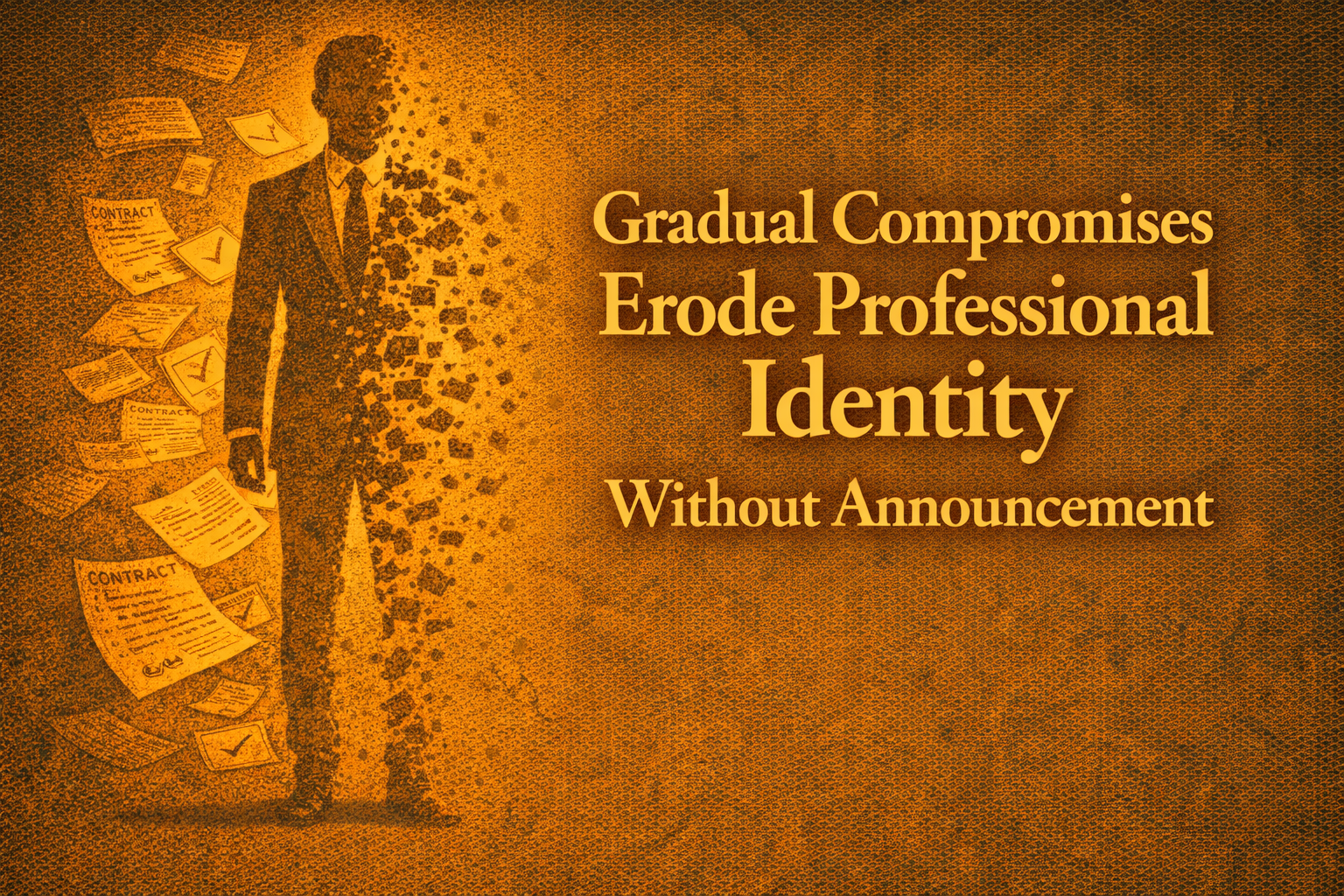
How Gradual Compromises Erode Professional Identity Without Announcement
Why careers rarely collapse suddenly—and why gradual drift is harder to see
Professional identity doesn’t collapse in a single moment.
It erodes through decisions small enough to feel manageable and frequent enough to become invisible.
Nobody announces the day they stopped being the professional they intended to become.
There’s no meeting where someone decides to trade integrity for convenience or values for approval.
The erosion happens in increments—each one defensible in isolation, each one slightly repositioning the baseline against which the next decision is measured.
Six years into a career feels different from twelve.
Not because of a single turning point.
Because of accumulated small adjustments that compound into a substantially different professional posture than the one you started with.
That’s the mechanism worth understanding.
What Professional Identity Actually Contains
Before examining how erosion happens, clarity on what’s eroding matters.
Professional identity is not a job title, industry, or credentials.
Those are labels attached to identity.
The identity itself is the set of standards, values, and behavioural commitments that determine how you work—what you’ll do, what you won’t, where you draw lines, and why.
It includes competence standards: the quality threshold below which you won’t submit work, the preparation level you consider adequate, and the intellectual rigour you apply to problems you’re paid to solve.
It includes relational standards: how you treat colleagues with less power, whether you take credit accurately, how you handle disagreement, and whether you protect people who report to you when it costs you something.
It includes value commitments: what you refuse to do regardless of financial incentive, which instructions you push back on, and whose interests you weigh when interests conflict.
These aren’t abstract.
They’re behavioural.
They show up in specific decisions made under specific pressures.
And they’re what gradual compromise erodes—not the labels, but the behavioural commitments underneath them.
The Erosion Mechanism: How Compromise Compounds
The First Compromise and Its Baseline Shift

Initial compromises rarely feel like compromises.
They feel like pragmatism, context-sensitivity, or mature judgment.
The junior analyst who rounds up a projection slightly because the client seems to want optimism.
The manager who doesn’t challenge a hire she knows is underqualified because the VP championed it.
The consultant who softens a finding that would embarrass a senior partner.
Each decision has a rationale that sounds reasonable in the moment.
What each decision also does is create a new reference point.
The next time a similar situation arises, the previous compromise becomes the baseline.
The question isn’t “should I compromise from my original standard?”
It’s “Should I compromise from where I already am?”
The psychological distance required for the second compromise is shorter than for the first.
The third shorter than the second.
Ann Tenbrunsel and David Messick (2004) described this process as ethical fading in Business Ethics Quarterly.
Over time, the moral dimension disappears from decisions that once clearly involved ethical judgment.
Decisions that once felt moral become categorised as:
-
business strategy
-
practical judgment
-
professional realism
The ethical framing fades because the baseline moved.
The Sycophancy Gradient
Professional environments reward certain behaviours more than they should.
Agreeing with authority generates approval.
Disagreeing generates friction.
Over time, employees who generate more approval than friction advance faster than those who generate more friction than approval—regardless of whether the friction was substantively correct.
That selection pressure is consistent and cumulative.
An employee who learns that pushing back on a senior stakeholder’s flawed assumption produces visible displeasure begins calculating when disagreement is worth it.
Initially, they push back on important issues.
Minor ones pass.
Reasonable judgment.
Over eighteen months, the threshold for “important enough to push back on” quietly rises.
Issues that would have triggered disagreement in month three pass in month twenty-one.
By year four, the employee who entered the organisation with strong, independent analytical instincts has become reliably validating of authority positions.
The transition happened through hundreds of threshold adjustments.
None of them felt like capitulation.
Dr Jennifer Chatman’s research (UC Berkeley Haas School of Business) found that employees in high-cohesion teams became less willing to introduce disconfirming information over time, even when they privately believed it mattered.
The social cost of disrupting cohesion gradually silenced independent judgment.
Quality Threshold Compression
Competence standards erode through workload pressure, deadlines, and normalised adequacy.
The first time a project is submitted below the professional’s actual standard, it registers as a compromise.
The reason is situational:
-
impossible timeline
-
inadequate resources
-
overwhelming pressure
If that situation repeats without consequence—if the work is accepted, approved, and unremarked—the standard adjusts.
What was previously a compromise becomes the operating level.
The professional doesn’t consciously decide to lower their standards.
The standards migrate toward the consistently delivered level.
Clients approve work because they compare it to competitors.
Managers approve output because it clears their threshold.
The gap between delivered quality and potential quality becomes invisible to everyone except the professional experiencing it.
Over time, the professional loses access to her higher standard.
Not because she forgot it.
Because she stopped practising it.
Where Professional Identity Erosion Accelerates
Performance Theatre Organisations

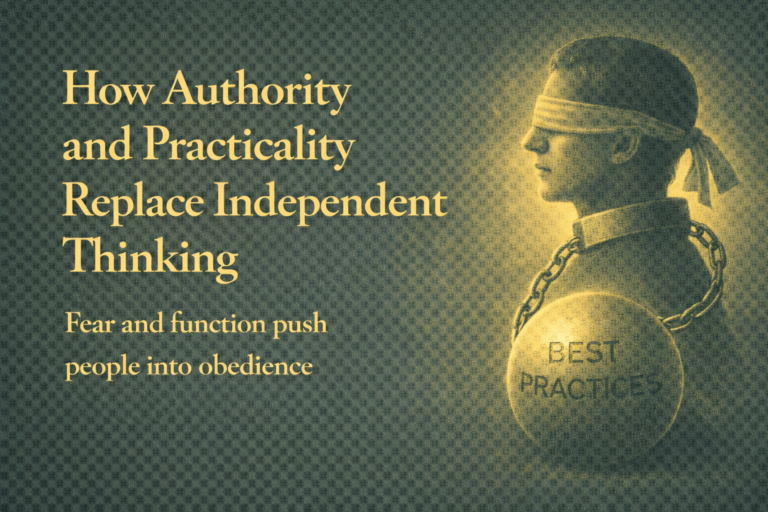
Metrics that are easy to manipulate replace metrics that are hard to game.
Presentations matter more than underlying work.
Relationships with decision-makers outweigh decision quality.
Professionals entering these environments face a clear signal:
The behaviours that produce rewards are not the behaviours that define their professional standards.
Over time, one of two outcomes occurs:
-
The professional leaves
-
The professional adapts
Adaptation rarely feels like betrayal.
It feels like learning how things actually work.
But that reframing is exactly how professional identity erosion justifies itself internally.
High-Stakes Relationship Dependence
Professional identity is vulnerable when a single relationship controls disproportionate outcomes.
Examples include:
-
a client representing 60% of revenue
-
a sponsor determining promotion
-
a partner controlling strategic approval
Dependence creates accommodation pressure.
The professional with concentrated dependency faces a different calculation than someone with diversified relationships.
Maintaining standards risks losing the relationship.
Losing the relationship carries catastrophic consequences.
Small accommodations accumulate to preserve the relationship.
Over time, independent judgment gets filtered.
The professional learns what the stakeholder wants to hear—and delivers it reliably.
Professor Heidi Gardner (Harvard Business School) found that partners with highly concentrated client portfolios were less likely to deliver difficult findings to those clients over time.
The pressure wasn’t dishonesty.
It was a structural incentive.
The Promotion Threshold
Career advancement introduces a specific erosion window: the period just before promotion decisions.
During this window, the professional optimises behaviour toward evaluator preferences.
If those preferences align with professional standards, no problem.
If they prioritise:
-
political skill
-
visibility management
-
stakeholder accommodation
The professional experiences pressure to move behaviour toward those signals.
Often, the adjustment feels temporary.
“Once I get promoted, I’ll return to my real standards.”
Instead, the adapted behaviour becomes the operating standard.
Because:
-
The next promotion creates another optimisation window
-
The rewarded behaviour becomes the perceived path to success
The temporary compromise becomes a structural change.
Why Professionals Don’t Notice the Drift
The Retrospective Justification System
Human cognition is extremely effective at justifying past behaviour.
Each compromise gets reframed into a coherent narrative.
Examples include:
-
Political accommodation becomes a strategic judgment,
-
softened findings become actionable communication
-
Silence becomes stakeholder awareness
These aren’t lies.
They’re motivated reasoning.
The justifications maintain a consistent professional self-image.
But they also hide the accumulated direction of change.
Daniel Kahneman’s work on cognitive bias—particularly in Thinking, Fast and Slow (2011)—explains how System 1 thinking constructs coherent self-narratives even from inconsistent behaviour.
The professional experiencing erosion doesn’t feel unethical.
She feels more mature and sophisticated.
Peer Reference Group Drift
Professional identity calibrates partly against peer standards.
Early in careers, peers often share similar values.
Over time, peer groups shift.
Professionals who maintain strict standards may leave environments where those standards create friction.
Those who remain become the new reference group.
By year eight, the professional’s current behaviour appears normal relative to current peers.
Compared to year-one peers, it might represent major drift.
But the comparison is never made.
Normalisation becomes socially reinforced.
Detecting Professional Identity Drift
Longitudinal Comparison
The most reliable detection method is historical comparison.
Not memory—memory has already been justified.
Actual records.
Examples include:
-
early-career emails pushing back on clients
-
documentation of decisions that generated friction
-
writing reflecting earlier standards
Comparing these records to current behaviour reveals movement that point-in-time reflection misses.
Friction Frequency Tracking
Independent judgment generates friction.
Examples include:
-
rejected work
-
stakeholder disagreement
-
delayed approvals
-
uncomfortable meetings
If friction frequency drops to zero in areas where independent judgment should generate disagreement, the cause may not be improved diplomacy.
It may be reduced independence.
Zero friction in substantive matters rarely indicates mastery.
It often indicates accommodation.
The Reversal Test
Ask a simple question:
If a respected colleague behaved this way, would I think less of them?
The difference between how we judge ourselves and others exposes hidden rationalisations.
Standards applied to others haven’t been filtered through justification.
They remain clearer.
If a colleague’s compromise would disappoint you—but your own feels reasonable—that gap deserves examination.
What Recovery Requires
Recognising erosion is uncomfortable.
Acting on that recognition is more so.
Recovery does not require dramatic confrontation.
It requires rebuilding standards through small behavioural commitments.
Start with low-cost decisions.
Gradually restore standards where they drifted.
The first pushback after long accommodation is harder than the first pushback ever was.
Relationships built on accommodation will generate friction as accommodation decreases.
Organisations that benefited from compliance may resist the change.
The discomfort is informative.
It measures the gap between your current professional identity and the one you began with.
Recovery also requires acknowledging that past compromises were real compromises—not merely sophisticated judgment.
That admission is psychologically costly.
But it is also the price of maintaining professional identity across a career.
Final Understanding
Professional identity erosion happens without announcement because the mechanism operates below conscious decision thresholds.
Each compromise is defensible.
Each baseline shift is small.
Each justification feels reasonable.
The accumulation isn’t.
What years of incremental accommodation produce isn’t a professional who made one bad decision.
It’s a professional who made hundreds of reasonable decisions that collectively moved her away from her original standards.
Detecting that movement requires tools that bypass self-justification:
-
longitudinal documentation
-
friction frequency awareness
-
external reference standards
Reversing it requires accepting discomfort, friction, and occasionally misalignment with the environment around you.
Those small moments—where no one would notice the difference—are exactly where professional identity is maintained or lost.
They rarely announce themselves as identity-defining.
They are defining precisely because they don’t.
Mr Chandravanshi
About the Author, Mr Chandravanshi
Writing on judgment under uncertainty, markets, and human decision errors. Author of multiple long-form nonfiction works on Amazon.
| Platform | Description | Link |
|---|---|---|
| Substack | Newsletter essays and published writing | digimanako.substack.com |
| Medium | Long-form essays and analytical writing | medium.com/@digimanako |
| Medium Publication — Judgment Under Pressure | Publication on decision-making and systems thinking | medium.com/judgment-under-pressure |
| Medium Publication — The Honest Confusion | Articles explaining confusing school concepts | medium.com/the-honest-confusion |
| Medium Publication — संरचना | Long-form analytical essays in Hindi | medium.com/sanrachna-official |
| Beehiiv | Archive of the “Judgment Under Pressure” newsletter | judgmentunderpressure.beehiiv.com |
| Amazon | Books and author profile | amazon.com/stores/Mr-Chandravanshi |
| Chandravanshi.org | Author profile and articles | chandravanshi.org/en/author/MrChandravansh |
| Professional posts and articles | linkedin.com/in/digimanakoo |
|
| Pratilipi (English) | English stories and essays | english.pratilipi.com/user/nishant-chandravanshi |
| Quora | Answers and discussions on investing and decision-making | quora.com/profile/Mr-Chandravanshi-3 |
| Posts, updates, and discussions | facebook.com/MrChandravansh |
|
| Short video insights and reels | instagram.com/digimanako |
|
| Dev.to | Technical essays and developer analysis | dev.to/chandravanshi |
| Blogger | In-depth essays and analysis | judgmentunderpressure.blogspot.com |