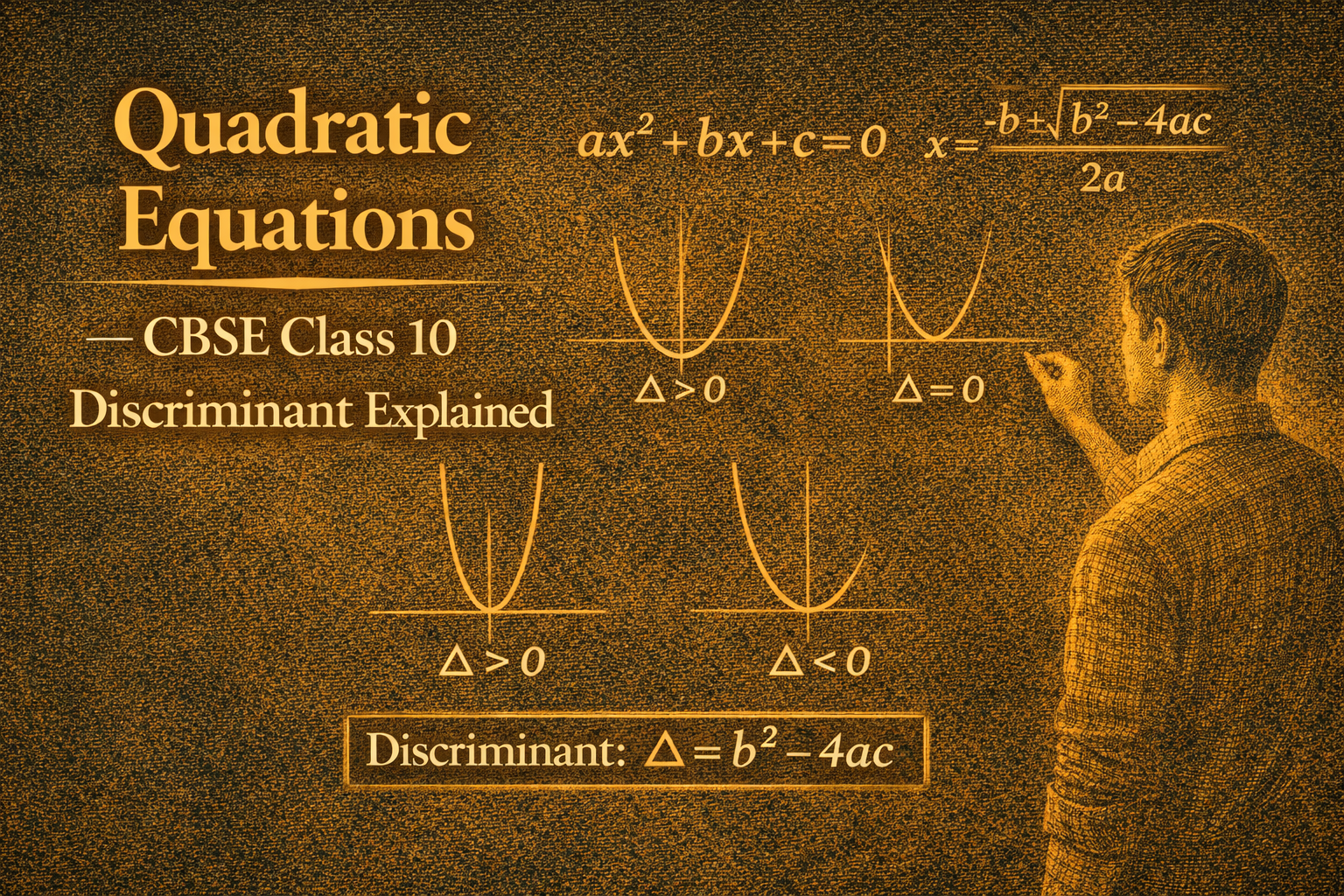
Quadratic Equations — CBSE Class 10 Discriminant Explained Clearly
The discriminant (b² − 4ac) predicts the nature of roots before solving. Learn how it determines real and distinct solutions.
By Dhruv Chandravanshi | Class 10 Mathematics | CBSE
Have You Ever Wondered How a Mathematician Knows Whether an Equation Has Answers — Before Actually Solving It?
In this article, you will learn:
-
What a quadratic equation actually is — in plain language, before the algebra appears
-
What the discriminant does — and why it is a prediction tool, not a solving tool
-
What b² − 4ac tells you about roots — and why three outcomes are possible
-
What CBSE Class 10 expects in discriminant questions — and the single most common error that costs students marks
By the end, you will understand that the discriminant is not a step inside the quadratic formula.
It is a separate tool that answers a different question:
Not what the roots are, but how many roots exist and what kind they are.
A Garden Planning Problem
Arjun is helping his father plan a rectangular vegetable garden behind their house in Patna.
His father wants the garden to have an area of exactly 24 square metres.
He also wants the length to be 5 metres more than the width.
Arjun opens his notebook.
Let the width be x metres.
Then the length becomes (x + 5) metres.
Area = length × width
x(x + 5) = 24
x² + 5x = 24
x² + 5x − 24 = 0
Arjun pauses.
This equation contains x².
It is not a simple linear equation anymore.
Before solving it, he wants to know something important:
Does this equation actually have a real answer?
If not, the garden his father described cannot exist.
Before solving the equation, mathematicians often check something first.
A single expression that predicts the type of solution.
That expression is called the discriminant.
Why Quadratic Equations Are Different
Quadratic equations behave differently from linear equations.
A linear equation such as:
2x + 3 = 7
always has exactly one solution.
But quadratic equations are different.
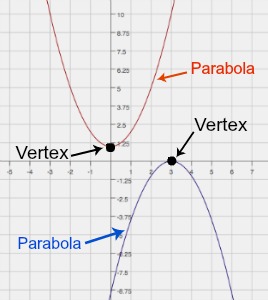
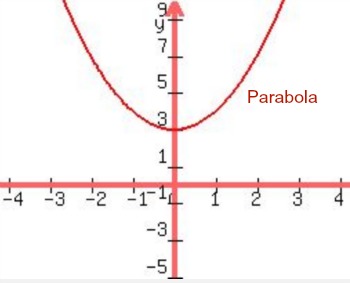
Their graph forms a parabola, a U-shaped curve.
This curve can interact with the x-axis in three ways:
-
It cuts the axis at two points → two different real roots
-
It touches the axis at one point → one repeated root
-
It never touches the axis → no real roots
So before solving the equation, mathematicians often ask:
Which of these three situations applies?
That answer comes from the expression under the square root in the quadratic formula.

The Discriminant
Mathematicians call the key expression the discriminant.
It comes from the quadratic formula.
Quadratic formula:
x = (−b ± √(b² − 4ac)) ÷ 2a
The expression inside the square root is:
D = b² − 4ac
This expression alone tells us the nature of the roots.
It helps distinguish between different possible solutions.
That is why it is called the discriminant.
How the Discriminant Works
Follow these steps carefully.
Step 1 — Write the Equation in Standard Form
Every quadratic must be written as:
ax² + bx + c = 0
Step 2 — Identify a, b, and c
a → coefficient of x²
b → coefficient of x
c → constant term
Step 3 — Calculate the Discriminant
D = b² − 4ac
Step 4 — Interpret the Value of D
Three possibilities exist.
If D > 0
-
Two distinct real roots exist
-
The parabola crosses the x-axis at two points
If D = 0
-
Two equal real roots exist
-
The parabola touches the x-axis at one point
Root value:
x = −b ÷ 2a
If D < 0
-
No real roots exist
-
The parabola does not intersect the x-axis
Applying the Discriminant to Arjun’s Garden
Equation:
x² + 5x − 24 = 0
Identify coefficients:
a = 1
b = 5
c = −24
Calculate D:
D = 5² − 4 × 1 × (−24)
D = 25 + 96
D = 121
Since:
D > 0
The equation has two distinct real roots.
The garden dimensions are therefore possible.
Now we solve using the quadratic formula:
x = (−5 ± √121) ÷ 2
x = (−5 ± 11) ÷ 2
x₁ = 3
x₂ = −8
Width cannot be negative.
So:
Width = 3 m
Length = 8 m
Area = 24 m² ✔
Understanding the Quadratic Formula
Quadratic formula:
x = (−b ± √D) ÷ 2a
This produces two roots:
x₁ = (−b + √D) ÷ 2a
x₂ = (−b − √D) ÷ 2a
Now observe what happens with different values of D:
-
D > 0 → square root exists → two different answers
-
D = 0 → square root becomes zero → same answer twice
-
D < 0 → square root of negative → no real solution
Worked Examples
Example 1 — Two Distinct Roots
Equation:
2x² − 7x + 3 = 0
a = 2
b = −7
c = 3
D = (−7)² − 4 × 2 × 3
D = 49 − 24
D = 25
Since D > 0, two real roots exist.
Example 2 — Equal Roots
Equation:
x² − 6x + 9 = 0
D = (−6)² − 4 × 1 × 9
D = 36 − 36
D = 0
So the equation has equal roots.
Root:
x = −b ÷ 2a
x = 6 ÷ 2
x = 3
Example 3 — No Real Roots
Equation:
x² + x + 1 = 0
D = 1² − 4 × 1 × 1
D = −3
Since D < 0, there are no real roots.
Visual Meaning of the Discriminant
The discriminant also explains the graph of the quadratic.
-
D > 0 → parabola intersects x-axis twice
-
D = 0 → parabola touches the x-axis once
-
D < 0 → parabola does not intersect the x-axis


Common Mistakes Students Make
Mistake 1 — Miscalculating 4ac
Students sometimes treat 4ac as separate numbers.
Remember:
4ac = 4 × a × c
Calculate the entire product first.
Mistake 2 — Confusing D = 0 with No Roots
Correct rule:
D = 0 → one repeated real root
D < 0 → no real roots
Mistake 3 — Forgetting Standard Form
Always convert the equation to:
ax² + bx + c = 0
before identifying a, b, and c.
Important Rules for CBSE Exams
| Value of D | Nature of Roots |
|---|---|
| D > 0 (perfect square) | Two distinct rational roots |
| D > 0 (not a perfect square) | Two distinct irrational roots |
| D = 0 | Two equal real roots |
| D < 0 | No real roots |
Types of Questions CBSE Asks
Common exam patterns include:
-
Find the discriminant and state the nature of the roots
-
Find the value of k for equal roots (set D = 0)
-
Find the value of k for real roots (D ≥ 0)
-
Find the value of k for distinct roots (D > 0)
Real-World Applications
Projectile Motion
Height equations in physics often form quadratic equations.
The discriminant helps determine whether an object reaches a certain height.
Geometry Problems
Rectangles, areas, and dimensions frequently produce quadratic equations.
The discriminant checks whether the dimensions are geometrically possible.
Engineering and Physics
Quadratic equations appear in:
-
Motion equations
-
Structural calculations
-
Optimisation problems
The discriminant predicts whether solutions exist.
Key Idea in Simple Words
A quadratic equation can have:
-
two real roots
-
one repeated root
-
no real roots
The discriminant D = b² − 4ac tells us which situation occurs.
It allows mathematicians to predict the nature of roots before solving the equation.
Practice Questions
-
Find the discriminant of 3x² − 5x + 2 = 0 and state the nature of its roots.
-
For what value of k does kx² + 6x + 1 = 0 have equal roots?
-
Show that x² + 5x + 7 = 0 has no real roots.
-
A rectangular park has a perimeter of 46 m and an area of 120 m². Form a quadratic equation and test if the park is possible.
-
If α and β are roots of 2x² − 5x + 3 = 0, find α + β and αβ.
Frequently Asked Questions
Why is it called the discriminant?
Because it distinguishes between different types of roots.
Does the discriminant solve the equation?
No. It only tells the nature of roots.
Why can a quadratic have only two roots?
A polynomial of degree 2 always has two roots in the complex number system.
What does D = 0 mean geometrically?
The parabola touches the x-axis exactly once.
Are equations with D < 0 unsolvable?
They have no real roots, but they do have complex roots studied in higher classes.
Related Topics
-
Factorisation of Quadratic Equations
-
Completing the Square Method
-
Relationship Between Zeros and Coefficients
This article follows the CBSE Class 10 Mathematics syllabus (Chapter 4 — Quadratic Equations) and aligns with NCERT Class 10 Mathematics concepts. All worked examples are mathematically verifiable and designed to reflect common CBSE examination patterns.
