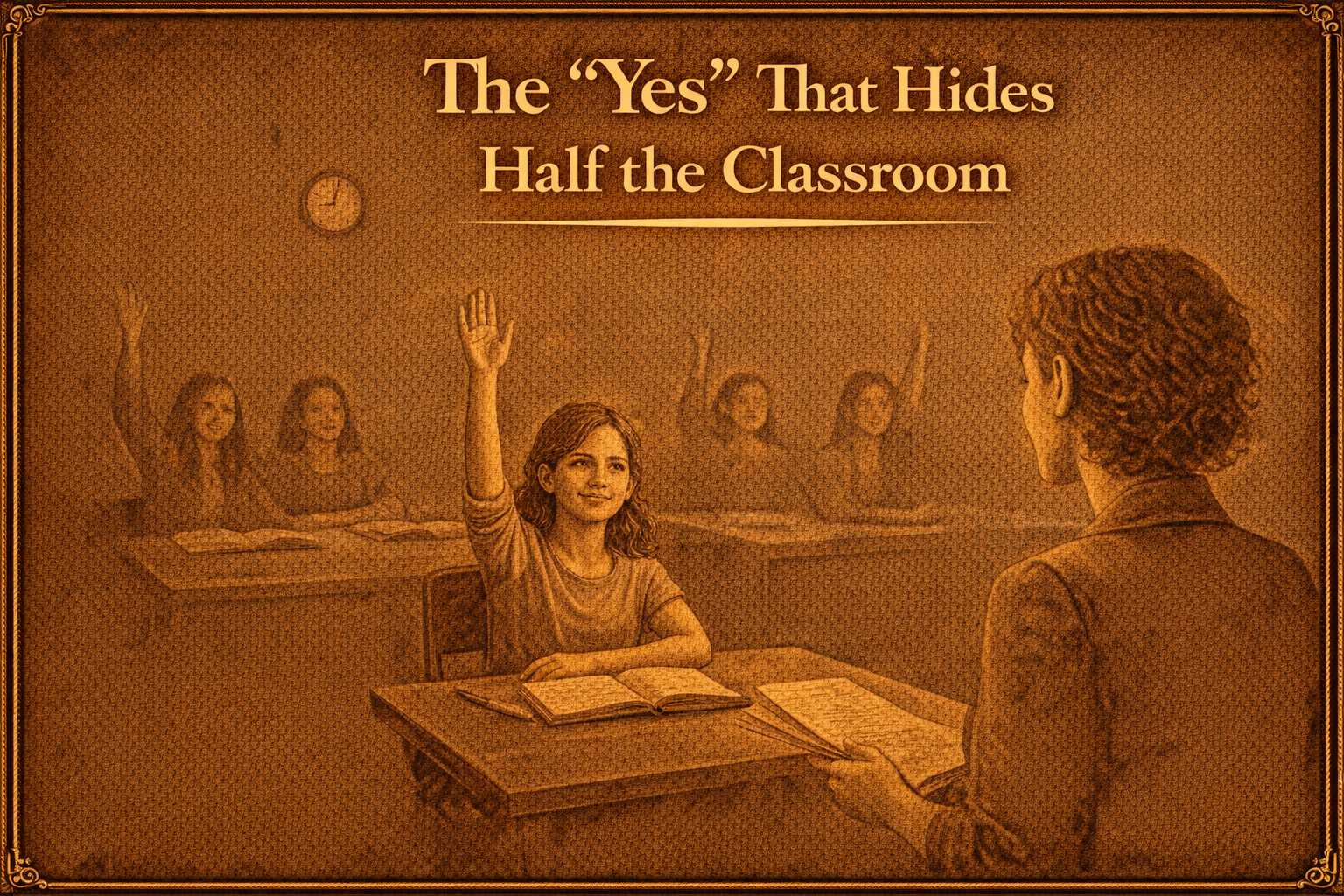
The “Yes” That Hides Half the Classroom
Why students say they understand—even when they don’t
You’ve seen this moment.
The teacher turns from the board. “Clear?”
The entire class nods together. The teacher turns back and continues.
You already know what just happened. Some students didn’t understand—and still nodded.
The usual explanation comes quickly: they’re shy, not confident, afraid to ask.
That explanation sounds right. It’s also incomplete.
Until you see the real mechanism, no solution will work.
Navya’s Nod
In a Class 9 classroom, Navya has a half-written page in front of her.
A formula she copied—but cannot explain. A word circled, with nothing written next to it. Three boys in the back row were distracted when that part was taught.
The teacher turns.
“Clear?”
The girl next to her nods. The boys nod. The room moves as one.
Navya nods too.
In that exact second, she knows she understood nothing.
And still, she nods.
This is not laziness.
This is a calculation.
Two Different Questions
Here’s what most people miss.
The teacher asked: “Did you understand?”
But inside the classroom’s social logic, what was actually heard was:
“Is anyone willing, right now, to make themselves visible and say they are behind?”
These are not the same question.
And they don’t produce the same answer.
When Navya nods, she isn’t thinking about the subject. She’s thinking about what happens next:
- Twelve people turning to look
- A half-second pause from the teacher
- A signal to the room about who didn’t get it
Her confusion is real—but it is private.
Raising her hand makes it public.
And public confusion, in a room full of peers, feels more expensive than the confusion itself.
The Asymmetric Cost Problem
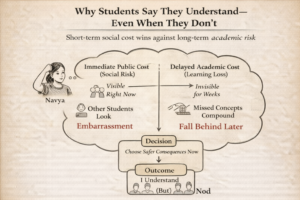
This is the core idea.
Raising a hand has an immediate cost. It arrives in the next five seconds—visibility, reaction, attention.
Not raising a hand has a delayed cost. It arrives weeks later—in an exam or the next chapter.
When an immediate, certain cost competes with a delayed, uncertain one, the immediate cost wins.
Every time.
This pattern is known as asymmetric cost.
Navya’s nod is not a mistake.
It is the expected outcome of this structure.
How the Loop Builds
- Step 1: The social cost of asking appears instantly
- Step 2: The academic cost of silence appears later
- Step 3: The mind chooses what feels safer now
- Step 4: No record is created—the system shows everything is “fine”
- Step 5: The next chapter builds on a gap that was never visible
One nod becomes two. Then five. Then ten.
The gap grows quietly.
Nothing in the system flags it.
Where the Real Problem Is
Most adults think the solution is confidence.
“Students should ask more.”
But confidence isn’t the constraint.
Navya already knows asking is allowed.
The real issue is this: the check itself is broken.
The Measurement Failure
When a teacher asks, “Clear?” and the whole class answers together, only one thing becomes visible:
the group’s answer.
But inside that answer are two realities:
- Students who understood
- Students who didn’t, but followed the group
The teacher sees one signal.
The classroom contains two different truths.
This is not a student problem.
This is a measurement design problem.
The tool being used cannot detect what it is supposed to detect.
What Actually Changes the Outcome
Change the way understanding is checked.
- Ask one student to explain
- Give a short written response
- Use pair problem-solving
- Have a student demonstrate the process
These remove the group from the moment.
The student either knows—or doesn’t.
And that becomes visible without forcing anyone to stand apart socially.
Navya doesn’t need more courage.
She needs a system where silence is no longer the safer choice.
Common Misreadings
“Students don’t ask because they don’t care.”
Interest and social risk are separate. A student can care deeply—and still stay silent.
“A kind teacher solves this.”
Teacher attitude helps, but the structure remains. Visibility pressure doesn’t disappear.
“This is only a problem for shy students.”
No. Even confident students run the same calculation. Only the threshold changes.
If You Remember Only This
In 5 lines:
Navya nods because speaking has an immediate social cost. Staying silent has a delayed academic cost. Immediate costs dominate decisions. The teacher’s question captures the group—not individuals. Individual gaps stay hidden.
In 3 lines:
The nod is rational. The check is flawed. Change the check, and behaviour changes.
In 1 line:
The nod is not the problem—it is evidence that the system cannot see what matters.
Practice Questions
- Give one example of asymmetric cost outside a classroom
- Why is Navya’s nod rational, not dishonest?
- What changes when checking is done individually?
- Why does timing (immediate vs delayed cost) matter so much?
FAQ
Is this only an Indian classroom problem?
No. Wherever groups answer together, and visibility carries social risk, the same pattern appears.
If students know asking is okay, why don’t they ask?
Because knowing something is allowed and paying its immediate cost are different experiences.
What can teachers do differently?
Stop relying on group checks. Use individual or small-group verification methods.
Where else does this concept apply?
Anywhere decisions involve immediate vs delayed consequences—health, money, habits. The immediate cost usually dominates.
Final thought:
If the nod is rational within the system,
Then the real question isn’t why students behave this way—
It’s who is responsible for changing the system that produces it.