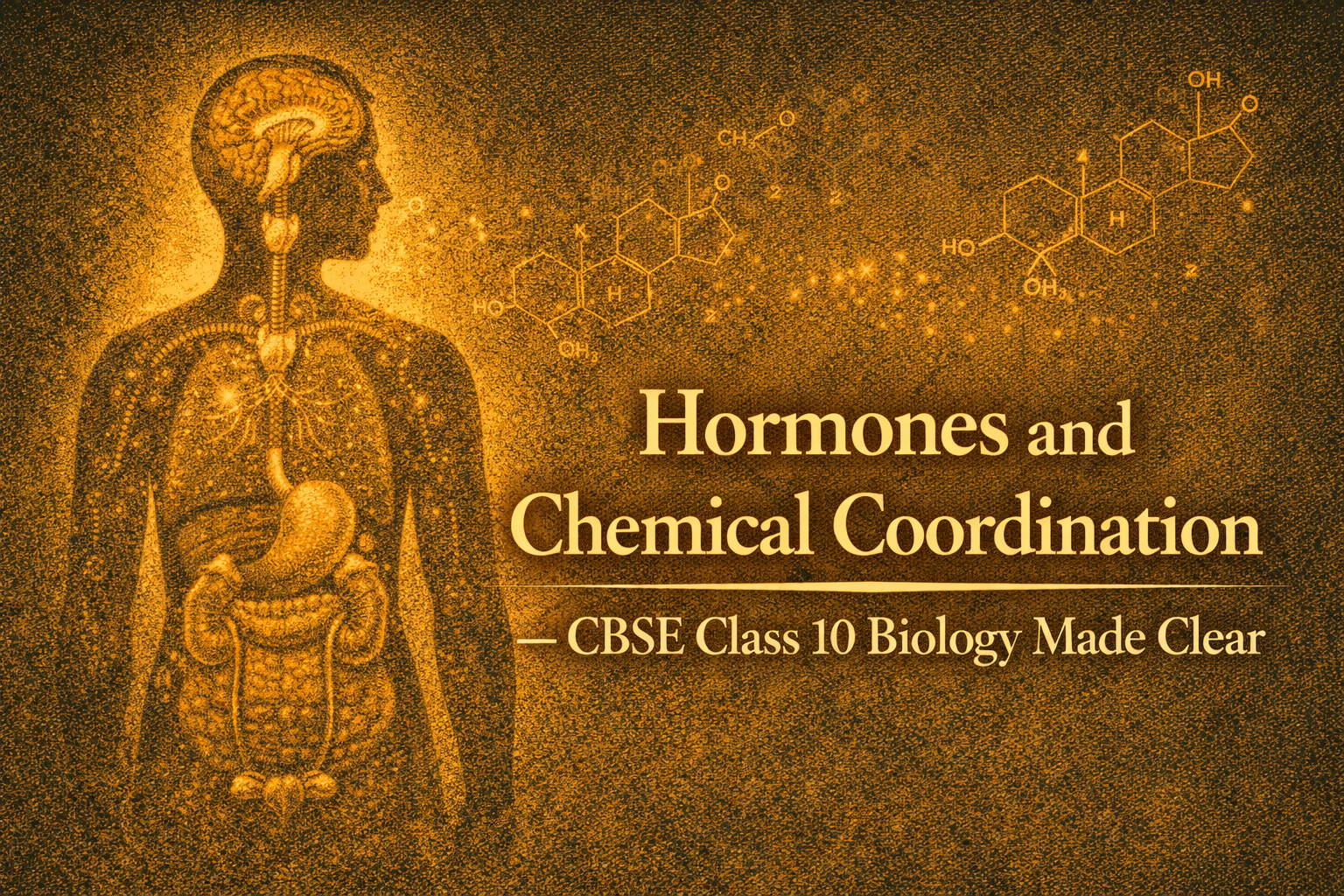
Hormones and Chemical Coordination — CBSE Class 10 Biology Made Clear
The nervous system acts quickly. Hormones act gradually but deeply. Learn how both systems regulate the human body.
By Navya Chandravanshi | Class 10 Science | CBSE
Have You Ever Wondered Why Your Heart Pounds Before an Exam — Even Before It Has Started?
In this article, you will learn:
-
What hormones are and why your body needs a slow chemical system alongside a fast electrical one
-
Which glands produce which hormones — and what each one actually does
-
Why are the endocrine system and nervous system two different solutions to the same problem
-
What CBSE Class 10 expects you to write — and the specific mistakes most students make in this chapter
By the end, you will understand that your body runs two coordination systems simultaneously — one for emergencies, one for everything else.
Hormones are the everything-else system.
And they are doing far more than most students realise.
A Morning Before the Board Exam
It is the morning of Meena’s Class 10 board exam.
She has studied. Her notes are ready. Her pencil case is packed. But when she wakes up at 6 a.m., something is already happening inside her body — without her permission.
Her heart is beating faster than usual. Her palms are slightly damp. Her stomach feels tight. She has not run anywhere. She has not lifted anything heavy. She is just lying in bed, thinking about the exam.
By the time she reaches the examination hall, her mouth is dry. Her breathing is quicker. Her body is wide awake — more awake than she asked it to be.
Her brain had sent no direct instruction to her heart. Her brain had sent no message to her palms.
Something else had. Something travelling not as an electrical signal through nerves — but as a chemical, moving silently through her blood.
That chemical had a name.


What Was Happening Inside Meena’s Body
Think about what Meena’s body was doing.
Her brain had recognised a threat — not a physical one, but a future one. The exam. The result. The pressure. And her brain responded the way it has responded to threats for millions of years: it prepared her body to perform.
But here is the thing.
Her nervous system is fast — electrical signals travel in milliseconds. That system handles immediate responses. Touch a hot tawa — pull your hand back.
That is the nervous system.
What Meena needed was different.
She needed a slower, deeper, body-wide preparation.
Not a single muscle reacting — every organ becoming ready at the same time.
Her heart, lungs, blood vessels, and sweat glands all adjusted together.
The nervous system alone cannot coordinate that many organs simultaneously.
So the body uses a different method.
It releases a chemical messenger into the bloodstream.
The blood carries it everywhere — to every organ, tissue, and cell.
This system is slower than nerve signals.
But it reaches everywhere.
And it lasts longer.
Meena’s body had just demonstrated why the chemical coordination system exists alongside the nervous system — not instead of it.
The Endocrine System and Hormones
Scientists gave this chemical communication system a name.
It is called the endocrine system.
The organs that produce these chemicals are known as endocrine glands or ductless glands because they release their chemicals directly into the bloodstream rather than through ducts.
The chemicals themselves are called hormones.
Hormones are chemical messengers produced by endocrine glands and released directly into the blood.
They travel to target organs and regulate functions such as:
-
Growth
-
Metabolism
-
Reproduction
-
Stress response
-
Blood sugar levels
The chemical moving through Meena’s bloodstream that morning — the one making her heart race and her palms sweat — is called adrenaline.
It is produced by the adrenal glands, which sit just above the kidneys.
Adrenaline is one of the most studied hormones because its effects are so immediate and visible.
How Chemical Coordination Works
The endocrine system works through a clear sequence of steps.
Step 1 — A Stimulus Appears
A change or stimulus is detected by the body.
In Meena’s case, the stimulus was anticipated stress from the exam.
Step 2 — The Brain Signals a Gland
The brain communicates with endocrine glands — often through the hypothalamus and pituitary gland.
Sometimes the signal comes directly from changes in blood chemistry.
Step 3 — Hormone Release
The gland releases a hormone into the bloodstream.
The hormone travels dissolved in blood plasma and circulates throughout the body.
Step 4 — Only Target Cells Respond
Each hormone has a specific molecular structure.
Only cells with matching receptors respond to it.
Other cells ignore it completely.
This is why adrenaline speeds up the heart but does not affect your fingernails.
Step 5 — Target Organs Change Behaviour
The target organ adjusts its activity.
It might:
-
Speed up
-
Slow down
-
Produce another chemical
-
Begin growth
-
Stop a process
Hormonal responses take longer than nerve impulses but affect many organs at once.
Step 6 — Feedback Control
Once the body returns to balance, hormone levels drop.
Production slows or stops automatically.
This self-regulation system is called feedback control.
Major Endocrine Glands You Must Know
The list may look long, but each gland has a clear function.
Pituitary Gland
Location: Base of the brain
Often called the master gland because it controls many other endocrine glands.
Main hormone: Growth Hormone (GH)
Functions:
-
Controls body growth
-
Regulates other endocrine glands
Too little GH in childhood leads to stunted growth.
Too much causes gigantism.
Thyroid Gland
Location: Front of the neck around the windpipe.
Produces thyroxine, which regulates metabolism — the rate at which the body uses energy.
Thyroxine requires iodine.
Without iodine, the thyroid enlarges and causes goitre.
This is why iodised salt is widely used.


Adrenal Glands
Location: On top of each kidney.
Main hormone: Adrenaline
Function:
Prepares the body for emergencies through the fight-or-flight response.
Effects include:
-
Faster heartbeat
-
Faster breathing
-
More blood to muscles
-
Reduced digestion
Your body reacts the same way to exams, fear, or danger.
It cannot tell the difference.
Pancreas
Location: Behind the stomach.
The pancreas is unique because it is both:
-
Exocrine (digestive enzymes through ducts)
-
Endocrine (hormones released into the blood)
Its endocrine cells produce two hormones:
Insulin
-
Lowers blood sugar
-
Helps cells absorb glucose
Glucagon
-
Raises blood sugar
-
Releases stored glucose from the liver
Together, they maintain stable blood sugar.
If insulin production fails, the result is diabetes mellitus.
Reproductive Glands
Testes
Produce testosterone.
Functions:
-
Male secondary sexual characteristics
-
Voice deepening
-
Facial hair
-
Sperm production
Ovaries
Produce oestrogeno.
Functions:
-
Female secondary sexual characteristics
-
Breast development
-
Regulation of the menstrual cycle
Hormone production increases dramatically during puberty.


Real-World Examples
Iodised Salt and Goitre Prevention
Before iodised salt became common in India, goitre was widespread in inland regions.
Iodine is necessary for the thyroid gland to produce thyroxine.
Adding iodine to salt became one of the most successful public health measures.
Insulin and Diabetes
In Type 1 diabetes, the immune system destroys insulin-producing cells in the pancreas.
Without insulin, glucose cannot enter body cells.
Before insulin therapy was discovered in 1921, Type 1 diabetes was usually fatal.
Today, insulin injections allow patients to live normal lives.
Meena’s Exam Morning
Everything Meena felt — the racing heart, dry mouth, tight stomach — was adrenaline doing its job.
Her body was prepared for action.
Her digestion slowed.
Her heart pumped faster.
Her muscles received more blood.
The only mismatch was the situation.
The body prepared for danger — but the challenge was only an exam.
Common Mistakes Students Make
Many students believe hormones and nerves do the same job.
In reality:
-
Nervous system: fast, electrical, short-term
-
Endocrine system: slower, chemical, long-lasting
The body needs both systems.
Another mistake:
Students often think the pancreas is only a digestive organ.
Actually, it has two roles:
-
Digestive enzyme production
-
Hormone production (insulin and glucagon)
CBSE questions often test this dual function.
A third misconception:
Some students believe hormones affect every cell equally.
In fact, hormones only affect cells that have the correct receptors.
Cells without the receptor do not respond.
Essential Table for CBSE Exams
| Gland | Hormone | Function |
|---|---|---|
| Pituitary | Growth Hormone | Controls growth, regulates other glands |
| Thyroid | Thyroxine | Controls metabolic rate |
| Adrenal | Adrenaline | Emergency response |
| Pancreas | Insulin | Lowers blood sugar |
| Pancreas | Glucagon | Raises blood sugar |
| Testes | Testosterone | Male secondary sexual characteristics |
| Ovaries | Oestrogen | Female reproductive development |
Nervous System vs Endocrine System
| Feature | Nervous System | Endocrine System |
|---|---|---|
| Messenger | Electrical impulse | Chemical hormone |
| Speed | Very fast | Slower |
| Duration | Short | Long |
| Range | Specific nerve pathway | Body-wide through the blood |
| Control | Voluntary and involuntary | Involuntary |
The Core Idea in Simple Words
The human body uses two coordination systems.
The nervous system sends fast electrical signals.
The endocrine system sends slower chemical messages called hormones through the bloodstream.
Each gland produces hormones with specific functions.
When hormone levels become too high or too low, feedback control restores balance.
Together, these systems regulate nearly every process in the human body.
Practice Questions
-
What is a hormone? How is chemical coordination different from nervous coordination?
-
Name the gland that produces adrenaline and explain two effects of adrenaline.
-
What happens when the pancreas does not produce enough insulin?
-
Why is iodine necessary for the thyroid gland?
-
Draw a labelled diagram of the human endocrine system.
Frequently Asked Questions
What is the difference between endocrine and exocrine glands?
Endocrine glands release hormones directly into the bloodstream. Exocrine glands release substances through ducts.
Why is the pituitary called the master gland?
It produces hormones that control other endocrine glands.
Can stress make you physically ill?
Yes. Long-term stress raises hormone levels like cortisol, which can affect immunity, digestion, and blood pressure.
Is insulin a hormone or a protein?
Both. Insulin is a protein hormone made of amino acids.
What is the difference between Type 1 and Type 2 diabetes?
Type 1 occurs when the pancreas produces no insulin. Type 2 occurs when the body becomes resistant to insulin.
Related Topics for Students
-
Nervous System and Reflex Actions
-
Life Processes and Digestion
-
Human Reproduction
This article follows the CBSE Class 10 Science syllabus (Control and Coordination — Chapter 7) and is consistent with NCERT Class 10 Science content.
Navya
About the author Navya Chandravanshi
I write about living systems — from constitutions to chromosomes — uncovering the patterns that make them coherent.
| Platform | Description | Link |
|---|---|---|
| Substack | Newsletter essays and published writing | navyachandravanshi.substack.com |
| Medium | Long-form essays and analytical writing | medium.com/@navyachandravanshi |
| Medium Publication — Judgment Under Pressure | Publication on decision-making and systems thinking | medium.com/judgment-under-pressure |
| Medium Publication — The Honest Confusion | Articles explaining confusing school concepts | medium.com/the-honest-confusion |
| Medium Publication — संरचना | Long-form analytical essays in Hindi | medium.com/sanrachna-official |
| Chandravanshi.org | Author profile and articles | chandravanshi.org/en/author/navyatimes |
| Professional posts and articles | linkedin.com/in/navya-chandravanshi |
|
| Posts, updates, and discussions | facebook.com/TimesNavya |
|
| Short video insights and reels | instagram.com/navya_times |
