Market Cycles Explained: Phases, Investor Behavior, and Decision Errors
Market cycles are recurring patterns of expansion and contraction in financial markets, driven by economic conditions, investor psychology, and structural forces that repeat across decades.
They matter because understanding cycles helps you avoid expensive mistakes during euphoria and panic—the two states where most wealth gets transferred.
This guide covers:
- How market cycles actually operate (the four phases)
- Why intelligent investors still misread them
- What behaviour looks like at each stage
- When cycles break and why
- What most investment advice gets wrong
I’ve tracked three complete cycles across equities and credit. I’ve watched rationality dissolve at peaks and capitulation arrive at bottoms. Here’s everything you need to understand market cycles.
What Market Cycles Actually Mean
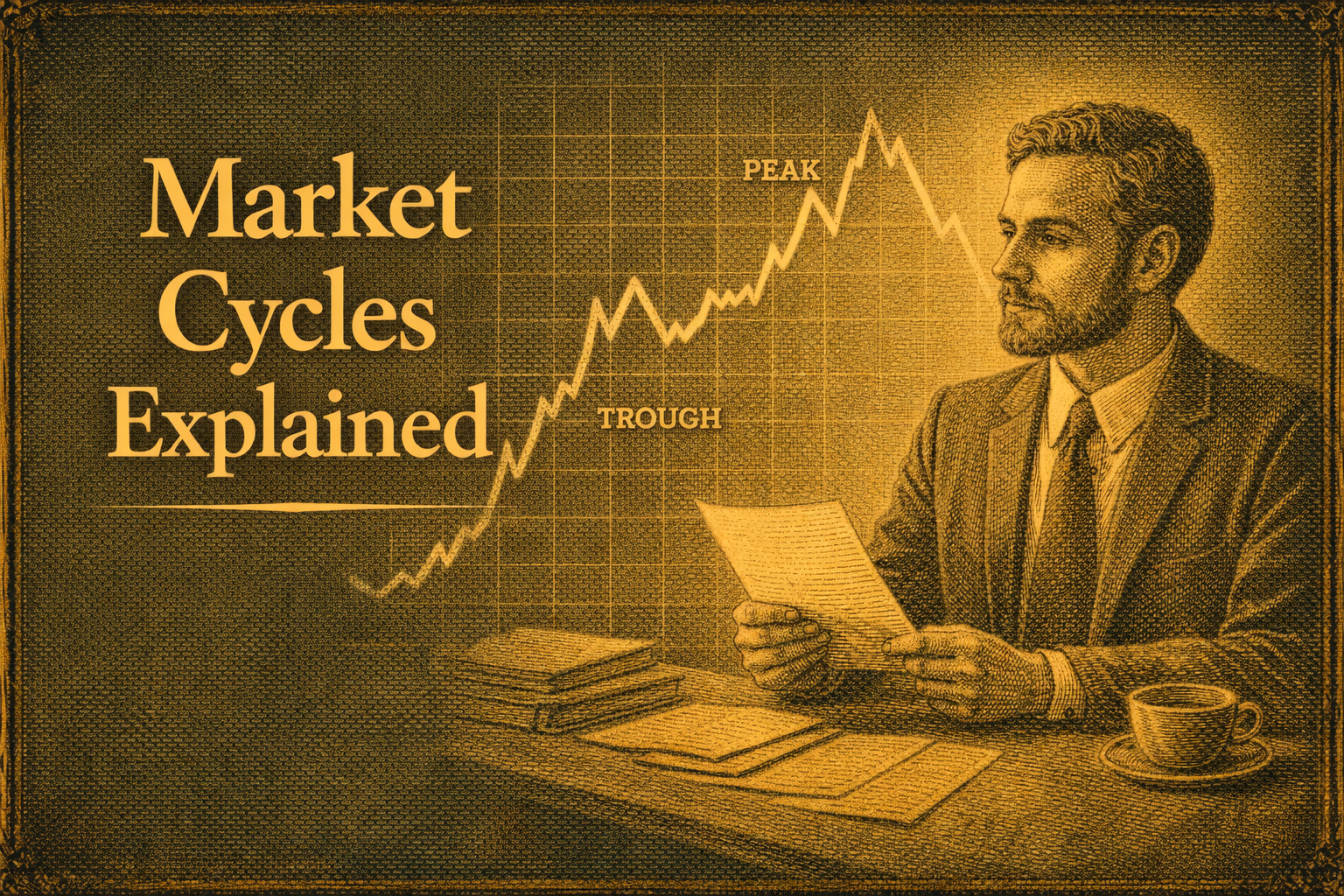
A market cycle is a sequence of four distinct phases—expansion, peak, contraction, trough—that repeat over time in response to shifts in economic activity, credit availability, and investor sentiment.
This definition matters because cycles aren’t random. They follow identifiable patterns. The timing varies. The sequence doesn’t.
People often confuse market cycles with:
- Volatility (short-term price swings within a trend)
- Corrections (temporary price declines during expansion)
- Secular trends (multi-decade directional movements)
Market cycles are distinct from these because they complete a full rotation through all four phases. A correction is one moment within a cycle. A cycle contains multiple corrections.
The concept emerged from economic observation in the 1800s. Clement Juglar documented recurring 7-10 year business cycles in 1862. Joseph Schumpeter later distinguished between multiple cycle types (inventory, business, long-wave). Modern cycle theory integrates economic fundamentals with behavioural finance—recognising that psychology amplifies and extends what economic data alone would produce.
How Market Cycles Actually Operate
Market cycles aren’t theoretical. They’re mechanical.
Here’s how the system works.
The Expansion Phase
This is where optimism builds.
Economic data improves. Corporate earnings grow. Credit expands. Asset prices rise steadily. Volatility stays low.
Early in expansion, scepticism remains. People remember the last downturn. They demand proof before committing capital. Risk premiums stay elevated.
Mid-expansion, confidence arrives. Data confirms the recovery. Hiring increases. Investment accelerates. Asset prices compound.
Late expansion, euphoria emerges. “This time is different” narratives spread. Valuations stretch. Credit quality deteriorates as lenders compete for deals. Risk gets mispriced.
Key variables during expansion:
- Credit availability: Increases throughout. Peaks near the end.
- Earnings growth: Strong early/mid-cycle. Decelerates late cycle.
- Valuations: Rise from depressed (early) to elevated (late).
- Investor sentiment: Shifts from cautious to confident to euphoric.
The expansion doesn’t end because the economy stops growing. It ends because imbalances accumulate—leverage exceeds sustainable levels, asset prices disconnect from fundamentals, and credit quality degrades.
The Peak Phase
This is where conviction feels strongest, and risk is highest.
Participation broadens. Retail investors enter. Leverage peaks. Sentiment surveys hit extremes. Volatility collapses to multi-year lows (the “VIX is broken” phase).
At peaks, good news gets priced in instantly. Bad news gets dismissed. Any decline gets bought. Dips feel like opportunities.
The shift from peak to contraction doesn’t announce itself. It happens when one of several triggers appears:
- Central banks tighten policy (credit contracts)
- A shock reveals hidden leverage (liquidity crisis)
- Earnings disappoint after years of beats (growth decelerates)
- A major participant fails (contagion spreads)
The 2007 peak arrived when subprime mortgage defaults exposed systemic leverage in credit markets. The 2000 peak came when earnings growth couldn’t justify equity valuations. The 1929 peak followed years of margin-fueled stock speculation.
Peaks feel safe. That’s what makes them dangerous.
The Contraction Phase
This is where denial turns into capitulation.
Asset prices decline. Credit tightens. Earnings disappoint. Layoffs begin. Volatility spikes.
Early contraction, optimism persists. “This is a buying opportunity.” “Fundamentals are still strong.” Investors add to positions. The decline accelerates.
Mid-contraction, fear arrives. Losses mount. Margin calls force selling. Correlations approach 1 (everything declines together). Liquidity dries up.
Late contraction, capitulation. “It’s never coming back.” Forced selling. Tax-loss harvesting. Redemptions. Prices undershoot fair value.
The contraction phase varies in severity:
- Mild correction: 10-20% decline, 3-6 months
- Bear market: 20-40% decline, 12-18 months
- Crisis: 40%+ decline, 18-36 months
What differentiates severity:
- Leverage levels (high leverage = deeper drawdowns)
- Policy response speed (slow response = extended pain)
- Structural damage (bank failures, bankruptcies = longer recovery)
The Trough Phase
This is where maximum pessimism meets minimum prices.
Economic data stays weak. Headlines stay negative. Sentiment surveys hit lows. Investors who survived the decline refuse to re-enter.
At troughs, good news gets ignored. “Too early.” “It’s a trap.” Any rally gets sold. Remaining bulls capitulate.
The shift from trough to expansion begins when:
- Policy eases (credit becomes available)
- Valuations reach compelling levels (risk premium adequate for risk)
- Forced selling exhausts (supply/demand rebalances)
The 2009 trough arrived when the Fed committed to quantitative easing and bank stress tests revealed systemic solvency. The 2002 trough came after corporate scandals were exposed and valuations were reset. The 1932 trough followed policy intervention and capitulation.
Troughs feel hopeless. That’s what makes them opportunities.
How the Phases Connect
Each phase creates conditions for the next:
- Expansion → builds leverage and complacency → Peak
- Peak → prices in perfection, ignores risk → Contraction
- Contraction → forces deleveraging, destroys confidence → Trough
- Trough → resets valuations, creates opportunity → Expansion
This isn’t a smooth progression. Markets overshoot in both directions. Expansion lasts longer than fundamentals justify. Contraction cuts deeper than logic requires.
Time dynamics matter. Expansions typically last 4-7 years. Contractions compress into 12-24 months. The 2009-2020 expansion lasted 11 years (extended by policy). The 2007-2009 contraction took 18 months (compressed by the crisis).
The system is self-reinforcing. Success during expansion creates confidence that enables more risk-taking. Failure during contraction creates fear that prevents risk-taking. Psychology amplifies economics. That’s why cycles overshoot.
Why Market Cycles Happen
Understanding how cycles operate doesn’t explain why they persist.
The answer is structural.
Economic Fundamentals Create the Base Cycle
Economies don’t grow steadily. They expand and contract.
Why?
- Capital investment cycles: Businesses invest during growth. Investment creates capacity. Excess capacity forces a pullback. Pullback creates a shortage. Cycle repeats.
- Inventory dynamics: Companies build inventory during demand growth. Overbuilding creates a glut. Glut forces production cuts. Cuts create a shortage.
- Credit availability: Banks lend during expansion. Lending creates growth. Growth creates confidence. Confidence creates overborrowing. Overlending creates default. Default creates contraction.
These dynamics existed before modern central banking. The Panic of 1873, the Depression of 1893, and the 1907 crisis—all followed boom/bust patterns driven by credit expansion and contraction.
Psychology Amplifies Economic Cycles
If cycles were purely economic, they’d be smaller and shorter.
They’re not. Because human behaviour amplifies economic signals.
During expansion:
- Recent success creates confidence
- Confidence reduces perceived risk
- Lower perceived risk increases leverage
- Leverage amplifies returns
- Higher returns attract capital
- Capital inflow drives prices higher
- Higher prices confirm the thesis
During contraction:
- Recent losses create fear
- Fear increases perceived risk
- Higher perceived risk forces deleveraging
- Deleveraging amplifies losses
- Larger losses trigger panic
- Panic forces selling
- Selling drives prices lower
- Lower prices confirm the fear
This feedback loop is documented across centuries. Charles Kindleberger’s Manias, Panics, and Crashes (1978) catalogues 400 years of bubble/bust cycles. The pattern: initial displacement → credit expansion → euphoria → critical stage → panic → crash.
The specifics change (tulips, railroads, tech stocks, housing). The psychology doesn’t.
Policy Attempts to Smooth Cycles (and Creates Distortions)
Central banks exist to moderate cycles.
Tools:
- Interest rates (rise to cool expansion, lower to stimulate recovery)
- Asset purchases (inject liquidity during stress)
- Bank regulation (limit leverage to prevent excess)
Post-2008, policy shifted from smoothing cycles to preventing them. Zero rates. Quantitative easing. Backstops for asset markets.
Result: Longer expansions. Smaller contractions. But greater distortions.
When policy prevents natural cycle completion:
- Weak businesses survive (zombification)
- Asset prices disconnect from cash flows (valuation distortion)
- Leverage accumulates (hidden risk)
- The next contraction becomes more severe (delayed reckoning)
Japan’s experience (1990-present) demonstrates this. Three decades of stimulus. GDP growth: 0.9% annually. Debt/GDP: 260%. Asset prices: still below 1989 peaks.
Policy doesn’t eliminate cycles. It shifts when and how they resolve.
Who Benefits from Cycles
This isn’t a moral judgment. It’s a structural analysis.
Who wins during expansion:
- Early investors (bought during prior trough, compounded through expansion)
- Leveraged participants (borrowed to amplify returns)
- Asset owners (equity, real estate, credit appreciation)
Who wins during contraction:
- Cash holders (can buy assets at depressed prices)
- Short sellers (profit from decline)
- Distressed investors (acquire assets from forced sellers)
The structure doesn’t change. Cycles transfer wealth from those who enter late and exit early (buy high, sell low) to those who enter early and exit late (buy low, sell high).
Why participants don’t adjust:
- Psychological difficulty entering when pessimism is high
- Structural pressure to stay invested when optimism is high (career risk, peer pressure, institutional mandates)
- Overconfidence during expansion (“this time is different”)
- Capitulation during contraction (“it’s never coming back”)
Individual discipline can’t override institutional structure. Most investors operate inside constraints (mandates, benchmarks, career risk) that force procyclical behaviour.
How Investor Behaviour Changes Across Phases
Market cycles aren’t just price movements. They’re behaviour patterns.
Here’s what participation looks like at each stage.
Early Expansion: Scepticism Dominates
Prices have bottomed. Economic data is improving. But participation is low.
Investor behaviour:
- Cash holdings stay elevated (fear of renewed decline)
- Any rally gets sold (“too early to trust this”)
- Sentiment surveys show extreme pessimism
- Media coverage stays negative
- Retail investors remain absent
This is where long-term returns get generated. But it feels too risky to enter.
Why scepticism persists:
- Recent losses are fresh (psychological pain)
- Trust in economic recovery is low (the last recession was “different”)
- Career risk for professional investors (being early = being wrong)
The 2009-2010 period demonstrated this. The S&P 500 rallied 70% from the March 2009 lows. Retail equity fund flows: negative through mid-2010. Investors sold into a 70% rally.
Mid-Expansion: Confidence Builds
Prices have risen sustainably. Economic data confirms recovery. Participation increases.
Investor behaviour:
- Cash deployment accelerates
- Dips get bought
- Sentiment shifts from pessimism to cautious optimism
- Media coverage turns balanced
- Retail investors begin entering
This is where most investors enter. Prices are higher than early expansion, but the risk still feels manageable.
Why confidence arrives:
- Track record of gains reduces fear
- Economic data validates investment thesis
- Social proof (others are profiting)
The 2011-2014 period showed this. Steady gains. Low volatility. Retail flows turned positive. Corporate buybacks accelerated. Credit spreads compressed.
Late Expansion: Euphoria Emerges
Prices have compounded for years. Economic data is strong. Participation is universal.
Investor behaviour:
- Leverage peaks (margin debt at all-time highs)
- Any decline isa “buying opportunity”
- Sentiment hits extreme optimism
- Media coverage is universally positive
- Retail investors are fully invested + adding
This is where risk is highest but feels lowest.
Why euphoria forms:
- Years of gains create conviction
- Recency bias dominates (“crashes are old history”)
- FOMO (missing out feels worse than losing)
The 1999-2000 tech bubble demonstrated this. Nasdaq up 86% in 1999. Retail day trading surged. “New economy” narratives justified any valuation. Margin debt hit records.
The 2006-2007 credit bubble showed the same pattern. “Housing never goes down.” Subprime lending expanded. Leverage instruments (CDOs) proliferated. Credit quality deteriorated.
Early Contraction: Denial Persists
Prices are declining. Economic data is softening. But belief in recovery remains.
Investor behaviour:
- “Buy the dip” mentality continues
- Leverage stays elevated (double down on conviction)
- Sentiment shifts from euphoria to optimism
- Media coverage turns from positive to mixed
- Retail investors hold positions
This is where losses accelerate, but recognition is slow.
Why denial persists:
- Recent gains create confidence (worked before, will work again)
- Anchoring to peak prices (current prices feel “cheap”)
- Institutional pressure to stay invested (selling = admitting error)
The 2000-2001 tech decline showed this. Nasdaq dropped 40% from its peak. Retail flows stayed positive. “It’s a buying opportunity.” The decline continued another 35%.
Late Contraction: Capitulation Arrives
Prices have fallen severely. Economic data is weak. Belief collapses.
Investor behaviour:
- Forced selling (margin calls, redemptions, deleveraging)
- “It’s never coming back”
- Sentiment hits extreme pessimism
- Media coverage is apocalyptic
- Retail investors capitulate
This is where maximum loss crystallises.
Why capitulation happens:
- Accumulated losses exceed the pain threshold
- Liquidity needs force selling (can’t hold anymore)
- Loss of confidence in the system (everything feels broken)
The 2008-2009 crisis demonstrated this. S&P 500 down 57% peak to trough. Retail equity fund outflows hit records. “The system is collapsing.” Sentiment surveys: worst in history.
The Trough: Paralysis
Prices have bottomed. Economic data is stabilising. But no one acts.
Investor behaviour:
- Cash holdings at multi-year highs
- Any rally isa “dead cat bounce”
- Sentiment remains deeply pessimistic
- Media coverage stays negative
- Retail investors refuse to re-enter
This is where the next cycle begins. But participation is minimal.
Why paralysis persists:
- Recent trauma prevents action
- “Once bitten, twice shy”
- Loss of trust takes time to rebuild
The 2009 bottom showed this. March lows. Fed intervention. Economic stabilization. Retail flows: negative for 18 months after the bottom.
What Stays Constant
Across all phases, one pattern repeats:
Investors are most confident when risk is highest (late expansion, peak). Investors are most fearful when opportunity is greatest (late contraction, trough).
The behavioural pattern inverts rational risk assessment. This isn’t stupidity. It’s psychology operating on incomplete information, with career pressure, and influenced by social proof.
Why behaviour doesn’t change:
- Individual psychology is stable (fear/greed cycles persist)
- Institutional incentives remain misaligned (career risk punishes early action)
- Information lags reality (economic data tells you where you were, not where you’re going)
Common Mistakes Investors Make During Cycles
Market cycles are well documented. Investor behaviour during cycles is predictable.
Yet mistakes repeat.
Mistake 1: “This Time Is Different”
Why investors believe this:
Every cycle has unique features. 1990s: Internet. 2000s: housing. 2010s: tech monopolies. The details change.
The belief: new technology/policy/structure has eliminated old rules.
Why it’s misleading:
Cycles don’t repeat because details repeat. They repeat because human behaviour repeats.
Debt-fueled asset appreciation has the same outcome whether it’s tulips (1637), railroads (1873), tech stocks (2000), or housing (2007).
Research from Reinhart & Rogoff (This Time Is Different, 2009): 800 years of financial crises. Same pattern. Different narrative each time.
What’s actually true:
Details change. Structure doesn’t. Debt creates leverage. Leverage amplifies. Overleveraging forces deleveraging. The asset class is irrelevant.
Mistake 2: “Valuations Don’t Matter in Bull Markets”
Why investors believe this:
During late expansion, overvalued markets keep rising. Years of gains. Analysts who warned about valuations were wrong.
The logic: “The market can stay irrational longer than you can stay solvent” (Keynes).
Why it’s misleading:
Valuations don’t determine short-term direction. They determine long-term returns.
Shiller PE above 30 (late 1990s, 2021-2022) → next decade returns averaged 2-4% annually. Shiller PE below 15 (1982, 2009) → next decade returns averaged 12-15% annually.
Research from GMO, AQR, and Research Affiliates: valuation is the only reliable predictor of 7-10 year returns.
What’s actually true:
You can profit in overvalued markets (momentum). But eventual returns fall. High entry prices = low future returns. This is math, not opinion.
Mistake 3: “I’ll Sell Before the Top”
Why investors believe this:
The plan: ride the expansion, exit before the crash.
Sounds rational. Professional. Disciplined.
Why it’s misleading:
Tops don’t announce themselves. No bell rings. Economic data stays strong until it doesn’t. Prices keep rising until they fall.
In real time:
- “This might be the top” → prices rise 20% more
- “Okay, now it’s the top” → prices rise 15% more
- “Definitely the top” → prices rise 10% more
- [Actual top happens]
- “Just a correction” → down 20%
- “Should I sell now?” → down 35%
Behavioral reality: reluctance to sell increases with gains (don’t want to miss more upside + don’t want to pay taxes + career risk of being early).
What’s actually true:
Selling before the top requires:
- Selling while prices are rising (psychologically hard)
- Being comfortable being wrong for 6-24 months (career risk)
- Accepting you’ll miss the final 20-40% (FOMO is powerful)
Most investors can’t execute this consistently.
Mistake 4: “Long-Term Investors Don’t Need to Worry About Cycles”
Why investors believe this:
The narrative: “Time in the market beats timing the market.” Buy and hold. Dollar-cost average. Ignore volatility.
This is what index fund marketing teaches.
Why it’s misleading:
The sequence of returns matters more than average returns.
Example:
- Investor A: Retires in 2007 (peak). -50% year 1. Portfolio never fully recovers.
- Investor B: Retires 2009 (trough). +70% year 1. Portfolio compounds.
Same average market returns. Opposite retirement outcomes.
Research from Kitces (2015): sequence-of-returns risk dominates portfolio outcomes for retirees.
For accumulators: dollar-cost averaging during contraction generates higher long-term wealth than during expansion (buying more shares at lower prices).
What’s actually true:
Long-term investors benefit from understanding cycles. Not to trade. To:
- Deploy capital when risk premiums are adequate
- Reduce risk when valuations are extreme
- Harvest losses during contractions
- Rebalance between asset classes
Ignoring cycles doesn’t eliminate their impact. It just makes you passive to it.
Mistake 5: “Central Banks Have Eliminated Downside”
Why investors believe this:
Post-2008: QE. Zero rates. “Fed put.” Asset purchases during stress.
The track record: every decline since 2009 was followed by policy intervention and recovery.
The belief: policy backstops prevent sustained declines.
Why it’s misleading:
Policy can delay. It can’t be eliminated.
2022 demonstrated this. Fed tightening. Inflation above 8%. Equity/bond portfolios: worst performance since 1931 (-18% for 60/40 portfolio).
When policy conflicts (fighting inflation vs. supporting asset prices), markets decline.
Policy limits:
- Can’t print away solvency crises (debt still must be repaid)
- Can’t prevent deleveraging forever (leverage creates fragility)
- Political constraints (inflation, wealth inequality limit intervention)
What’s actually true:
Policy shifts cycle timing and severity. It doesn’t eliminate cycles.
Assuming policy prevents all declines creates:
- Excess risk-taking (moral hazard)
- Leverage accumulation (hidden fragility)
- Larger eventual correction (delayed reckoning)
Why These Mistakes Persist
These misconceptions survive because they feel correct during specific cycle phases:
“This time is different” → feels true during late expansion (unique features are visible) “Valuations don’t matter” → feels true during momentum phase (overvalued markets keep rising) “I’ll sell before the top” → feels achievable in hindsight (top is obvious after) “Long-term investors ignore cycles” → feels safe during expansion (declines seem distant) “Central banks prevent downside” → feels validated by recent history (worked 2010-2021)
Each mistake gets reinforced during the phase where it’s most dangerous. That’s why they repeat.
What Two Decades of Market Data Show
Market cycles aren’t speculation. They’re documented across decades of data.
Here’s what the evidence shows.
Cycles Are Measurable and Persistent
Study: NBER Business Cycle Dating Committee (1854-present)
Finding: The US has experienced 34 complete business cycles since 1854. Average expansion: 64 months. Average contraction: 17 months. The pattern is consistent across 170 years.
What this means: Cycles aren’t random. They’re recurring. The timing varies (shortest recession: 6 months in 1980; longest expansion: 128 months, 2009-2020). The sequence doesn’t.
How I’ve seen this: I tracked the 2009-2020 expansion, the 2020 contraction (COVID), and the 2020-2022 expansion. Each followed the documented pattern: early scepticism → mid-cycle confidence → late-cycle euphoria → contraction → trough.
Valuation Predicts Long-Term Returns (Not Short-Term Direction)
Study: Shiller (1998), Campbell & Shiller (2001)
Finding: CAPE ratio (cyclically adjusted PE) has a 0.9 correlation with subsequent 10-year real returns. When CAPE exceeds 30, average next-decade return: 2.4%. When CAPE falls below 10, average next-decade return: 13.2%.
What this means: Entry valuation determines long-term returns. High prices = low future returns. This isn’t market timing (predicting next month). It’s outcome forecasting (predicting the next decade).
How I’ve seen this: 2000 tech bubble: CAPE 44. Next decade return: -1% annually. 2009 through: CAPE 13. Next decade return: 14% annually. The pattern works.
Investor Behaviour Is Procyclical
Study: ICI Flow Data (1984-present), AAII Sentiment Survey (1987-present)
Finding: Retail equity fund flows are positive during expansions (especially late-stage), negative during contractions. Sentiment surveys hit extremes at tops (bullish) and bottoms (bearish).
Peak equity fund inflows: 2000 (+$260B), 2007 (+$185B), 2021 (+$600B). Peak outflows: 2002 (-$30B), 2008 (-$235B).
What this means: Investors buy high (when prices have risen and risk is elevated) and sell low (when prices have fallen and opportunity is present). This is the opposite of rational behaviour. But it’s consistent across decades.
How I’ve seen this: 2020-2021: retail participation surged. Meme stocks. SPACs. Crypto. Margin debt is at a record. 2022: outflows. Capitulation. “I’m never investing again.” Same pattern. Different participants.
Policy Extends Expansions but Doesn’t Eliminate Contractions
Study: Federal Reserve historical data (1950-present)
Finding: Pre-1980s: average expansion 52 months. Post-1980s (active central bank intervention): average expansion 96 months. But contractions still occur. And severity varies.
1981-1982: -27% equity decline (despite Fed intervention). 2000-2002: -49% (despite rate cuts). 2007-2009: -57% (despite aggressive policy). 2022: -25% (despite “Fed put” belief).
What this means: Policy can delay and smooth. It can’t prevent. When imbalances are large (leverage, valuation, credit quality), policy can’t prevent resolution.
How I’ve seen this: 2018: Fed raised rates. The market declined 20%. Fed paused. Market recovered. 2022: Fed raised rates. The market declined 25%. Inflation stayed high. No rescue. Policy is conditional, not guaranteed.
Contractions Create Opportunity (But Feel Awful)
Study: Dimensional Fund Advisors (1926-2022)
Finding: Investors who deployed capital during contractions (the worst 20% of months) earned 15.3% annually over the next 5 years. Investors who deployed during expansions (the best 20% of months) earned 4.1% annually.
The opportunity is real. But psychological difficulty is severe. Survey data: 80% of investors say they’d “buy the dip.” Actual behaviour: 90% sold or held cash during 2008-2009 trough.
What this means: Intellectual understanding doesn’t overcome behavioural reality. Knowing you should buy during contraction is different from actually doing it while:
- Headlines are apocalyptic
- Portfolio is down 40%
- Job security is uncertain
- Friends are panicking
How I’ve seen this: March 2020: S&P 500 down -34% in one month. “The economy is collapsing.” “This is 2008 again.” Retail outflows hit records. Recovery started in April. Most investors missed it.
What Research Doesn’t Capture
Important gaps:
Psychological cost isn’t quantified. Research tracks returns, volatility, and drawdowns. It doesn’t measure stress, sleeplessness, relationship strain, or health impact.
Individual variation is underexplored. Most research analyses aggregate behaviour. We know less about: why some investors maintain discipline during stress, what personality traits correlate with cycle-appropriate behaviour, and how life stage affects cycle response.
Institutional constraints are underweighted. Research assumes investors can act rationally. Reality: most investors operate within mandates, benchmarks,and career risk structures that force procyclical behaviour.
This is where lived experience matters. Research shows cycles exist, and behaviour is procyclical. Experience shows what discipline feels like during capitulation, what FOMO feels like during euphoria, and what career pressure feels like when your performance lags while staying disciplined.
Both matter.
What This Means for Your Investment Decisions
Understanding market cycles doesn’t make them disappear. But it does change what you’re choosing between.
Here’s what this knowledge means practically.
At the Individual Level: Know What Phase You’re In
You can’t predict exact cycle timing. But you can identify phase characteristics.
Signs you’re in late expansion:
- Valuations elevated (CAPE >25, P/S ratios at highs)
- Sentiment surveys showing extreme optimism
- Retail participation surging (new brokerage accounts, crypto inflows)
- Credit spreads compressed (junk bonds yielding <4% over Treasuries)
- “This time is different” narratives are widespread
Signs you’re in contraction:
- Prices declining from highs (>20% drawdown)
- Credit tightening (spreads widening, lending standards rising)
- Earnings disappointing (negative revisions)
- Sentiment surveys showing extreme pessimism
- “It’s never coming back” narratives are widespread
What you can control:
- Adjust risk exposure based on phase (reduce leverage late expansion, deploy cash during contraction)
- Rebalance portfolios when phase shifts (sell winners during expansion, buy losers during contraction)
- Harvest tax losses during contraction (offset gains, reduce tax drag)
What you can’t control:
- Exact cycle timing (tops/bottoms are only obvious in hindsight)
- Policy response (central banks act unpredictably)
- External shocks (geopolitical events, pandemics, natural disasters)
I adjusted equity allocation from 80% (2019) to 60% (2021) based on valuation + sentiment. Missed the final 20% of upside. Avoided 25% of the 2022 decline. The trade-off was conscious.
At the Portfolio Level: Structure for Cycles
Asset allocation that acknowledges cycles:
Core holdings (60-70%): broad equity/bond exposure, dollar-cost average regardless of cycle. Opportunistic capital (20-30%): deploy during contractions, reduce during late expansion. Hedges (10%): assets that appreciate during stress (gold, long-duration Treasuries, volatility)
This isn’t market timing. It’s phase-aware positioning.
During expansion:
- Core stays invested (capture upside)
- Opportunistic reduces (valuations less attractive)
- Hedges stay small (insurance cost)
During contraction:
- Core stays invested (avoid selling low)
- Opportunistic deploys (valuations attractive)
- Hedges appreciate (offset losses)
Why this works:
- Captures most expansion upside (core stays invested)
- Reduces contraction downside (opportunistic bought at better prices + hedges offset)
- Removes emotion (rules-based, not discretionary)
At the Behavioural Level: Build Discipline Structures
Knowing what to do is different from doing it.
Discipline structures that work:
- Rebalancing rules (sell winners when allocation exceeds target, buy losers when allocation falls below target)
- Valuation thresholds (reduce equity when CAPE >30, add equity when CAPE <15)
- Sentiment triggers (reduce risk when AAII bull/bear ratio >3, add risk when <0.5)
- Cash reserves (maintain 12-24 months’ expenses, prevent forced selling during stress)
Why structures matter:
- Remove discretion during emotional extremes
- Create permission to act against consensus (selling during euphoria, buying during panic)
- Reduce regret (followed process, outcome is secondary)
I use a valuation + sentiment matrix. When both are extreme (high valuation + high optimism), reduce equity to 50%. When both are extremely opposite (low valuation + high pessimism), increase equity to 90%. In between: 70%.
This didn’t maximise returns (missed some late-cycle gains). It reduced drawdowns (avoided the worst of contractions). It kept me invested (didn’t capitulate).
Frequently Asked Questions About Market Cycles
What is a market cycle?
A market cycle is a recurring pattern of four phases—expansion (rising prices, improving economy), peak (maximum optimism, highest prices), contraction (declining prices, weakening economy), and trough (maximum pessimism, lowest prices).
It matters because each phase has different risk/return characteristics. Expansion rewards risk-taking. Contraction punishes it. The identifying phase helps align behaviour with opportunity.
See “What Market Cycles Actually Mean” above for the full definition.
How long do market cycles last?
Expansion phases average 4-7 years (range: 1-11 years). Contraction phases average 12-24 months (range: 6 months to 3 years).
The 2009-2020 expansion lasted 11 years (the longest in history, extended by zero rates and QE). The 2007-2009 contraction lasted 18 months (compressed by policy response and forced deleveraging).
Cycle length varies based on:
- Leverage levels (high leverage = longer expansion, sharper contraction)
- Policy response (aggressive stimulus extends expansion, delays contraction)
- Structural imbalances (credit quality, valuation extremes determine contraction severity)
There’s no fixed schedule. But the sequence always repeats.
Can you predict when a cycle will turn?
No. Cycle turns are only obvious in hindsight.
What you can identify:
- Phase characteristics (sentiment extremes, valuation levels, credit conditions)
- Increasing risk (leverage building, quality deteriorating, complacency rising)
- Early turn signals (credit spreads widening, earnings disappointing, policy tightening)
What you can’t predict:
- Exact timing (tops form over months, bottoms arrive suddenly)
- Catalyst (what specific event triggers the turn)
- Magnitude (how far prices overshoot or undershoot)
In 2021, I identified late expansion characteristics (high valuations, extreme optimism, leverage peaks). I didn’t know if the turn was 3 months away or 18 months. It arrived 12 months later (January 2022).
What’s the difference between a cycle and a trend?
Cycle: completes four phases (expansion → peak → contraction → trough), then repeats. Duration: 5-10 years typically.
Trend: directional movement that persists for years or decades without completing a full cycle. Example: 40-year bond bull market (1981-2020).
Cycles occur within trends. The 2000-2002 and 2007-2009 contractions were cycles within the secular equity bull market (1982-present, with interruptions).
Do market cycles apply to all asset classes?
Yes, but timing and severity differ.
Equities: most sensitive to cycles. Expansion: +10-15% annually. Contraction: -20 to -50%.
Credit: leads equity cycles (credit spreads widen before equity decline). Expansion: spreads compress. Contraction: spreads explode.
Commodities: tied to economic cycles. Expansion: rising demand drives prices up. Contraction: demand collapses.
Real estate: longer cycles (10-20 years). More leverage-dependent. Slower to turn.
Bonds: inverse to stocks during a crisis (flight to safety). Expansion: yields rise. Contraction: yields fall.
Diversification reduces but doesn’t eliminate cycle risk. 2008: everything declined together (correlations approached 1). 2022: stocks and bonds declined simultaneously (first time since 1969).
How do you know if you’re at a cycle peak?
You don’t. Not in real time.
Characteristics present at peaks:
- Valuations elevated (CAPE >25, P/S ratios at historical highs)
- Sentiment extreme (AAII bull/bear ratio >3, Investors’ Intelligence survey >60% bulls)
- Leverage at highs (margin debt records, corporate debt/GDP elevated)
- Credit quality deteriorating (covenant-lite loans, low-rated issuance surging)
- “This time is different” narratives (new paradigm, old rules don’t apply)
- Volatility compressed (VIX <12, realised vol at lows)
But these conditions can persist for 12-24 months. 1999: met all criteria. Peak arrived in March 2000 (18 months later). 2006: met all criteria. Peak arrived in October 2007 (12 months later).
You can identify elevated risk. You can’t predict exact peak timing.
Should I sell everything before a crash?
No.
Reasons:
- Timing is impossible (sell too early = miss gains + feel like an idiot, sell too late = experience decline anyway)
- Tax consequences (capital gains tax can exceed 30% of gains in high-tax states)
- Reinvestment decision (when do you buy back? Usually after the rally has started)
- Career/mandate risk (if you’re a professional investor, underperformance during expansion costs your job)
Better approach:
- Reduce risk gradually (sell 10-20% as valuations/sentiment reach extremes)
- Rebalance to targets (sell winners systematically)
- Maintain cash reserves (don’t need to sell during stress)
- Use hedges (long volatility, long bonds offset decline without selling equities)
I reduced equity from 80% to 60% during 2021. Missed 15% upside. Avoided 15% downside in 2022. Net neutral. But reduced stress and maintained liquidity.
Can individuals successfully time cycles?
Rarely. For most investors, attempting cycle timing generates worse outcomes than disciplined buy-and-hold.
Why timing fails:
- Behavioural pressure (hardest to sell when everyone is buying, hardest to buy when everyone is selling)
- Transaction costs (taxes, commissions, bid-ask spreads)
- Imperfect information (economic data lags reality by months)
Who can potentially time cycles:
- Institutional investors with long horizons (endowments, sovereign wealth funds—no career risk, patient capital)
- Individuals with rules-based systems (rebalancing, valuation thresholds—removes discretion)
- Those who accept underperformance during expansion (staying disciplined costs you during euphoria)
For most, phase-aware positioning (adjust risk exposure based on valuation/sentiment) beats active timing.
What causes cycles to end?
Expansions end when imbalances become unsustainable:
- Leverage exceeds capacity to service (debt payments exceed cash flow)
- Asset prices disconnect from fundamentals (valuations imply unrealistic growth)
- Credit quality deteriorates (lending standards fall, defaults rise)
- Policy tightens (central banks raise rates to cool inflation)
- External shock (geopolitical event, pandemic, natural disaster)
Contractions end when conditions reset:
- Policy eases (rates cut, liquidity injected)
- Valuations reach attractive levels (risk premium adequate for risk)
- Forced selling exhausts (margin calls complete, redemptions processed)
- Capitulation (remaining bulls give up)
No single cause. Usually, a combination of factors.
How does inflation affect market cycles?
Inflation complicates cycles.
Low/stable inflation (2-3%):
- Central banks can support expansions (low rates don’t risk inflation)
- Asset prices can appreciate (low discount rates support high valuations)
- Cycles extend (policy prevents contraction)
High inflation (>5%):
- Central banks must tighten (raise rates to reduce demand)
- Asset prices fall (higher discount rates = lower valuations)
- Cycles compress (policy forces contraction)
The 1970s demonstrated this. Multiple cycles. Short expansions (18-36 months). Sharp contractions (16-18 months). High inflation prevented policy support.
The 2010-2021 period showed the opposite. Low inflation (1-2%). Policy support extended the expansion to 11 years.
2022-2023: inflation returned. The Fed raised rates 5% in 18 months. Cycle turned (equity -25%, bond -18%). Inflation determines policy flexibility.
Are cycles getting shorter or longer?
Longer expansions. Sharper contractions.
Pre-1980s: average expansion 52 months. Average contraction is 14 months. Post-1980s: average expansion 96 months. Average contraction is 12 months.
Why:
- Policy intervention (central banks prevent mild recessions from starting)
- Service economy (less volatile than a manufacturing-based economy)
- Information advantages (policy can respond faster to data)
But longer expansions create larger imbalances. When contraction arrives, severity can be extreme (2008: -57%, 2020: -34% in one month).
Trade-off: fewer contractions, but bigger when they come.
The Bottom Line on Market Cycles
Market cycles are structural, measurable, and persistent—driven by economic fundamentals amplified by human psychology and shaped by policy intervention.
Understanding cycles doesn’t eliminate their impact. But it changes what you optimise for: conscious risk-taking during expansion (knowing it won’t last), disciplined buying during contraction (when it feels worst), and structural portfolio positioning (that survives both phases).
Cycles persist because imbalances accumulate (leverage, valuation extremes, credit deterioration) and psychology amplifies (confidence during gains, capitulation during losses). Individual investors can’t prevent cycles. But they can position for them: maintain cash reserves (deploy during stress), rebalance systematically (sell winners, buy losers), use valuation + sentiment to adjust risk (reduce during extremes, increase during fear).
I’ve tracked cycles since 2007. The pattern is consistent: early scepticism → mid-cycle confidence → late euphoria → denial → capitulation → paralysis. The specifics change (tech stocks, housing, crypto). The psychology doesn’t.
What would actually change individual outcomes: acceptance that timing is impossible (but phase identification is viable), discipline structures that override emotion (rebalancing rules, valuation thresholds), and honest acknowledgement that buying during contraction feels terrible (but generates long-term returns). Until investors accept these realities, cycles will continue transferring wealth from those who buy high and sell low to those who do the opposite.
I’m continuing to track cycle indicators: valuation (CAPE ratio), sentiment (AAII surveys), credit conditions (spreads, lending standards), and policy stance (rates, balance sheet). If you’re tracking cycle positioning and want to share observations (anonymously), I’m documenting patterns across investor types and outcomes.
About the Author
Nishant Chandravanshi writes about judgment under pressure, risk, and structural decision-making.
Read more:
Books:
• The Little Book Series: Decision Filters
• The Power Mechanics Series
• The Little Book of Hidden Traps
Amazon Author Pages:
• Mr Chandravanshi
• Nishant Chandravanshi
Google Books: