Margin of Safety: Definition, Calculation Methods, and Limitations
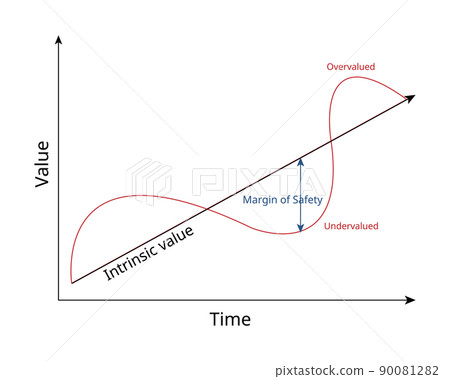
Margin of safety is the difference between an asset’s intrinsic value and its market price, or the cushion between expected performance and the breakeven point.
It matters because it quantifies risk tolerance—the buffer that protects against estimation errors, unforeseen events, and adverse outcomes.

This guide covers:
- How to calculate the margin of safety (multiple methods for investing and business)
- When it works as a risk filter and when it fails
- What creates false precision and how to avoid it
- Limitations most frameworks ignore
- Real applications across investing, business planning, and engineering
- What research shows about its effectiveness
I’ve spent 15 years applying margin of safety principles in investment analysis and business planning—both as a protective framework and observing where it breaks down. This article integrates practical application with research on risk management, behavioural finance, and decision-making under uncertainty.
What follows is pattern documentation, not investment advice.
What Margin of Safety Actually Means
Margin of safety is a buffer concept—the distance between where you are and where things break.
In investing, it’s the gap between what something is worth (intrinsic value) and what you pay (market price). Benjamin Graham, who coined the term in The Intelligent Investor (1949), defined it as “the difference between the percentage rate of earnings on the stock at the price you pay for it and the rate of interest on bonds.”
In business operations, it’s the cushion between actual sales and breakeven sales—how far revenue can fall before losses begin.
In engineering, it’s the ratio between a structure’s load capacity and the expected maximum load—how much stress it can handle beyond normal conditions.
Why this definition matters:
Margin of safety isn’t a prediction. It’s not a forecast of future returns. It’s a measure of how wrong you can be and still avoid permanent loss.
This distinction matters because people often confuse the margin of safety (risk buffer) with the margin of profit (return expectation). One is defensive. The other is offensive.
Common confusion:
Investors often conflate “buying with a margin of safety” with “buying a bargain.” A stock trading at 50% of its intrinsic value has a 50% margin of safety. A stock trading at 50% off its 52-week high has a price decline, not necessarily a margin of safety.
The margin depends on the gap between value and price. The discount depends on the gap between the current price and the past price. These are different measurements.
Boundary clarity:
Margin of safety is distinct from diversification. Diversification spreads risk across positions. Margin of safety reduces risk within each position. Both matter, but they operate differently.
It’s also distinct from position sizing. Position sizing controls how much capital you risk per decision. Margin of safety controls how much error each decision can absorb. One limits exposure. The other limits fragility.
Historical context:
Graham developed a margin of safety during the Great Depression, when asset prices collapsed, and previously “sound” investments evaporated. The concept emerged from observing that even careful analysis fails, so you need a cushion for when your estimates prove wrong.
The framework wasn’t about finding bargains. It was about surviving mistakes.
How Margin of Safety Actually Works
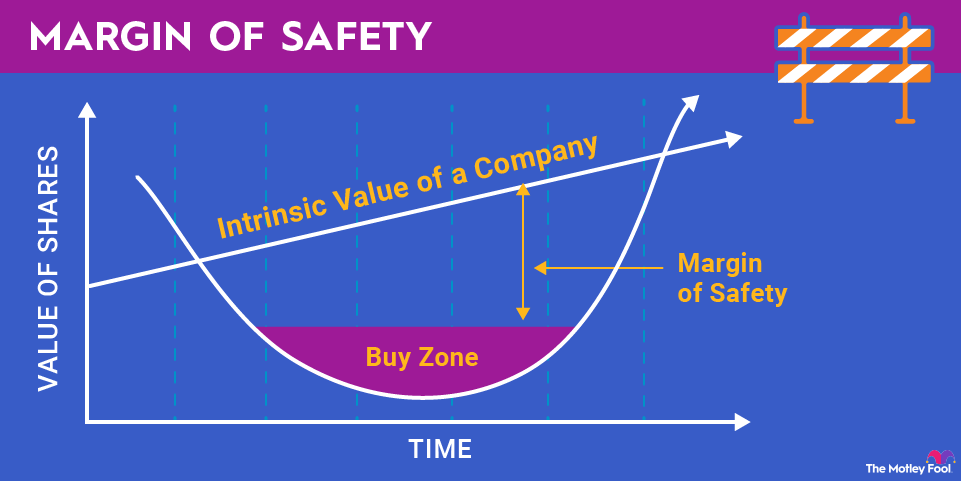
Margin of safety operates as a filter, not a generator of returns.
Here’s the mechanism.
The Core Logic
Value estimation creates a range, not a point.
When you estimate intrinsic value, you’re not identifying a precise number. You’re establishing a range of plausible values based on assumptions about future cash flows, growth rates, discount rates, and competitive dynamics.
Example: You might estimate a company’s intrinsic value at $80-120 per share, with $100 as your central estimate. That $40 range reflects genuine uncertainty—not sloppy analysis.
Margin of safety accounts for this uncertainty.
If the stock trades at $90, you have no margin of safety—even though it’s below your $100 estimate. Why? Because $90 falls within your uncertainty range. You could easily be wrong about value, and $90 could equal or exceed true worth.
But if the stock trades at $50, you have a 50% margin of safety relative to your $100 estimate. Even if you’re wrong and the true value is only $70, you still bought at a discount.
The margin absorbs error.
How It Creates Asymmetry
Margin of safety changes the risk/reward profile.
Without a margin of safety:
- Buy at $100 (estimated value)
- If correct → earn market return
- If wrong by 20% (value actually $80) → lose 20%
- If wrong by 40% (value actually $60) → lose 40%
With 50% margin of safety:
- Buy at $50 (estimated value $100)
- If correct → earn 100% return as price approaches value
- If wrong by 20% (value actually $80) → still earn 60% return
- If wrong by 40% (value actually $60) → still earn 20% return
The margin creates upside when you’re right and protection when you’re wrong. That asymmetry matters more than the absolute return potential.
What Changes the Outcome
Not all margins of safety offer equal protection. Several variables determine effectiveness:
- Quality of value estimation
If your intrinsic value estimate is systematically wrong (consistently overestimating), a margin of safety won’t protect you. You’re measuring the buffer against an incorrect baseline.
Example: During the dot-com bubble, many investors estimated internet company values using flawed assumptions about future profitability. A 50% margin of safety against those estimates still led to losses when the assumptions proved unrealistic.
- Stability of business fundamentals
Margin of safety works best for businesses with predictable economics. When fundamentals shift rapidly (technological disruption, regulatory change, competitive collapse), yesterday’s margin of safety becomes today’s full price.
Example: A newspaper with a 60% margin of safety in 2005 offered no protection against the structural decline of print advertising. The intrinsic value itself was falling faster than the market price.
- Time horizon
Margin of safety provides more protection over longer time horizons. Short-term price movements can violate margins before value recognition occurs. But over 3-5 years, price tends to converge toward value for liquid securities.
- Market regime
During periods of forced selling (2008-09, March 2020), securities can trade below intrinsic value for extended periods. Margin of safety protects you from overpaying, but it doesn’t prevent temporary mark-to-market losses.
Why It Persists (And Why It’s Hard to Exploit)
Margin of safety opportunities exist because of structural market dynamics:
Information asymmetry: Not all investors analyse every security deeply. Many follow momentum, sentiment, or technical patterns—creating occasional mispricings.
Time horizon mismatch: Most capital operates on short time horizons (quarterly performance measurement). This creates opportunities for patient capital willing to wait for value recognition.
Behavioural patterns: Investors systematically overreact to negative news and underreact to positive developments—especially in out-of-favour sectors.
But exploitation is difficult because:
You need the skill to estimate value accurately. Most investors overestimate their analytical ability.
You need emotional discipline to buy when assets feel dangerous (which is usually when margins exist).
You need capital available when opportunities appear (margins of safety cluster during market dislocations).
You need time for value recognition (which may take years).
These requirements mean the margin of safety remains effective for disciplined practitioners while staying elusive for most investors.
Margin of Safety Calculation Methods
Margin of safety has different calculation approaches depending on the domain and purpose.
Here’s how each works.
Investment Analysis: Price vs. Intrinsic Value
Formula:
Margin of Safety (%) = [(Intrinsic Value – Market Price) / Intrinsic Value] × 100
Process:
- Estimate intrinsic value using discounted cash flow (DCF), comparable company analysis, asset-based valuation, or earnings multiples
- Compare to market price (current trading price for public securities, offer price for private transactions)
- Calculate the gap as a percentage of the intrinsic value
Example:
Company XYZ:
- Estimated intrinsic value: $100 per share (based on DCF of future cash flows)
- Current market price: $65 per share
- Margin of safety: [($100 – $65) / $100] × 100 = 35%
Interpretation: You could be wrong about intrinsic value by 35% and still not overpay. If the true value is only $70 (30% error), you still bought at $65.
Variation: Using Earnings Yield
Graham’s original formulation compared earnings yield to bond rates:
Margin of Safety = Earnings Yield – Bond Yield
Where Earnings Yield = (Earnings per Share / Price per Share) × 100
Example:
- Stock earns $8 per share, trades at $50 → 16% earnings yield
- 10-year Treasury yields 4%
- Margin of safety: 16% – 4% = 12 percentage points
This measures how much the earnings yield exceeds the risk-free rate—your compensation for equity risk.
Business Operations: Sales vs. Breakeven

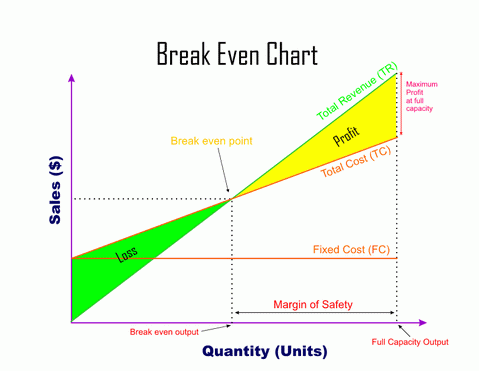
Formula:
Margin of Safety (Units) = Actual Sales – Breakeven Sales
Margin of Safety (%) = [(Actual Sales – Breakeven Sales) / Actual Sales] × 100
Process:
- Calculate breakeven point: Fixed Costs / (Price per Unit – Variable Cost per Unit)
- Compare to actual or projected sales
- Calculate the cushion in units or percentage terms
Example:
Manufacturing business:
- Fixed costs: $500,000 per year
- Variable cost per unit: $30
- Selling price per unit: $50
- Current sales: 40,000 units per year
Breakeven = $500,000 / ($50 – $30) = 25,000 units
Margin of Safety = 40,000 – 25,000 = 15,000 units
Margin of Safety (%) = [(40,000 – 25,000) / 40,000] × 100 = 37.5%
Interpretation: Sales can drop 37.5% before the business becomes unprofitable. This measures operating risk—how fragile the business is to revenue declines.
Engineering: Load Capacity vs. Expected Load

Formula:
Factor of Safety = Maximum Load Capacity / Expected Maximum Load
Process:
- Determine rated capacity (maximum load structure can handle before failure)
- Estimate expected maximum load (highest anticipated stress during normal operation)
- Calculate the ratio (typically expressed as a factor of safety, e.g., 2.0, 3.0, 4.0)
Example:
Bridge design:
- Rated capacity: 10,000 pounds per square foot
- Expected maximum load: 2,500 pounds per square foot
- Factor of safety: 10,000 / 2,500 = 4.0
Interpretation: The structure can handle 4 times the expected maximum load. This accounts for material defects, measurement errors, unexpected stress concentrations, and aging/weathering.
Key difference from investment margin:
Engineering margins are standardised by industry (building codes, safety regulations). Investment margins are judgment calls with no standard threshold.
Limitations of Each Method
Investment calculation limitations:
Intrinsic value estimation is subjective. Two competent analysts can produce widely different estimates for the same company. This means the margin of safety is only as reliable as your valuation model.
Business operations limitations:
Fixed cost/variable cost classification isn’t always clean. Many costs are semi-variable. And breakeven analysis assumes linear cost behaviour, which breaks at extreme volumes.
Engineering limitations:
The factor of safety protects against known failure modes. It doesn’t protect against unrecognised risks (design flaws, unknown material properties, novel stress patterns).
Applications Across Domains
Margin of safety manifests differently depending on context and constraints.
Here’s what that looks like.
In Value Investing
Value investors use the margin of safety as a primary risk filter.
The approach: Only buy securities when the market price is significantly below the estimated intrinsic value—typically 30-50% below, though thresholds vary by investor and opportunity.
How it operates:
You analyse a company deeply, estimate its intrinsic value through cash flow modelling, and compare that estimate to the market price. If the gap is substantial, you buy. If not, you wait.
What this protects against:
- Valuation errors: Your DCF model might overestimate growth or underestimate risk. The margin absorbs this error.
- Unforeseen problems: Management missteps, competitive threats, and regulatory changes that weren’t visible during analysis.
- Market volatility: Short-term price movements that would otherwise generate losses.
What it doesn’t protect against:
- Value destruction: If the business deteriorates faster than expected (structural decline, disruption), the margin of safety can’t save you.
- Value traps: Companies that appear cheap but deserve to trade at low multiples because economics are permanently impaired.
- Opportunity cost: While waiting for a sufficient margin of safety, you miss investments that appreciate without ever offering large discounts.
Research evidence:
Studies show value strategies (low P/E, low P/B, high dividend yield) outperform growth strategies over long periods, with lower volatility. Fama & French (1992) documented the “value premium”—cheap stocks outperform expensive stocks by ~4-5% annually.
But this premium is not consistent year-to-year. Value can underperform for extended periods (2010-2019 was brutal for value investors).
In Business Planning
Operating managers use the margin of safety to assess financial fragility.
How it operates:
You calculate how far sales can fall before reaching breakeven. This reveals operating leverage—businesses with high fixed costs have low margins of safety (vulnerable to revenue declines).
Example comparison:
Company A (Asset-light services):
- Fixed costs: $200K
- Variable costs: 80% of revenue
- Breakeven: $1M revenue
- Actual revenue: $2M
- Margin of safety: 50%
Company B (Capital-intensive manufacturing):
- Fixed costs: $800K
- Variable costs: 20% of revenue
- Breakeven: $1M revenue
- Actual revenue: $2M
- Margin of safety: 50%
Both have identical margin of safety percentages, but Company B is more operationally leveraged. A 50% revenue drop takes both to breakeven, but Company B has much higher financial risk because its fixed cost base is larger.
What this reveals:
High margin of safety = resilient to downturns, but limited operating leverage (profits don’t scale dramatically with revenue growth)
Low margin of safety = fragile to downturns, but high operating leverage (profits scale quickly if revenue grows)
In Engineering & Safety-Critical Systems
Engineers embed a margin of safety through redundancy and overbuilding.
How it operates:
You design systems to withstand loads far exceeding expected maximums. Buildings must handle 4-5x expected wind loads. Aircraft components must survive 1.5-2x maximum expected stress.
Why higher margins here:
- Consequences of failure: Structural collapse, loss of life, catastrophic system failure
- Unknown unknowns: Material defects, construction errors, unanticipated stress patterns
- Ageing and degradation: Structures weaken over time; the initial margin erodes
Trade-offs:
Higher margins increase cost and weight. A bridge built to 10x the expected load would be prohibitively expensive and heavy. So margins balance safety against practical constraints.
Regulated industries (aerospace, construction, medicine) have mandated minimum margins. Investment and business planning do not—margins are judgment calls.
What Stays Constant
Across all applications, the margin of safety serves the same function:
Risk reduction through buffers.
You accept that estimates are imperfect, that unforeseen problems emerge, and that reality often disappoints expectations. So you build cushions that absorb error.
The specific calculation changes. The underlying philosophy doesn’t.
Limitations & Edge Cases
Margin of safety is a filter, not a guarantee. It works under specific conditions and breaks under others.
Here are the boundaries.
When Value Estimation Is Systematically Wrong
The problem:
Margin of safety protects against estimation error—but only if errors are random and unbiased. If your valuation methodology consistently overestimates value, the margin doesn’t protect you.
Where this shows up:
- Growth company valuation: Estimating terminal values 10-15 years out involves enormous uncertainty. Small changes in assumptions (long-term growth rate, fade period, terminal multiple) produce huge valuation swings. A 50% margin of safety against a flawed DCF is worthless.
- Cyclical businesses: If you estimate value at peak earnings, you’ll consistently overvalue cyclical companies. The margin of safety evaporates when earnings normalise.
- Disruption-prone industries: Your value estimate assumes business continuity. But technological or competitive disruption can render historical earnings irrelevant. Newspapers, taxis, retail—margins of safety didn’t protect investors from structural decline.
Detection signal:
If you consistently buy assets with “large margins of safety” and they continue declining, your valuation process is biased. The market isn’t persistently wrong—your estimates are.
When Markets Stay Irrational Longer Than You Stay Solvent
The problem:
Margin of safety assumes eventual price convergence to value. But “eventual” can be years—or never.
Where this shows up:
- Forced selling: If you face redemptions, margin calls, or funding constraints, you may have to sell before value recognition occurs.
- Career risk: Professional investors face quarterly performance measurement. A three-year wait for value recognition can end your career even if you’re ultimately right.
- Permanent mispricings: Some securities trade at persistent discounts for structural reasons (illiquidity, governance concerns, tax disadvantages). The discount is part of the equilibrium, not a temporary anomaly.
Example:
Closed-end funds often trade at 5-15% discounts to net asset value (NAV). This looks like a margin of safety—you’re buying $1 of assets for $0.85. But the discount persists because:
- Management fees erode NAV over time
- Illiquidity penalty (can’t redeem at NAV like open-end funds)
- Governance issues (boards controlled by management)
The discount isn’t temporary mispricing—it’s a structural feature.
When the Margin Is Too Small to Matter
The problem:
A 10-15% margin of safety is barely distinguishable from noise. Valuation uncertainty easily exceeds this range.
Where this shows up:
Ben Graham suggested a minimum of 30-33% margins for equity investments (buying at 2/3 of intrinsic value or less). Modern value investors often require 40-50% for illiquid or complex situations.
Below these thresholds, the margin doesn’t meaningfully protect against estimation error or adverse developments.
Why do people violate this?
Discipline breaks when opportunities are scarce. After years without finding deeply discounted securities, investors lower their standards—accepting 15-20% margins when they should wait for larger discounts.
This is when the margin of safety fails most often—not because the concept is flawed, but because it’s applied with insufficient rigour.
When Business Quality Is Low
The problem:
Margin of safety can’t compensate for deteriorating fundamentals.
Where this shows up:
Value traps: Companies that appear cheap (low P/E, low P/B) but deserve low valuations because:
- Declining competitive position
- Obsolete business models
- Poor capital allocation
- Unsustainable economics
Example: Many retail stocks traded at 30-50% discounts to book value throughout the 2010s. These appeared to offer large margins of safety. But book value was overstated (real estate worth less than carrying value), and ongoing losses destroyed remaining equity. The margin of safety was illusory.
Research evidence:
Piotroski (2000) showed that within value stocks (high book-to-market), financial strength distinguishes winners from losers. “Strong” value stocks (measured by profitability, cash flow, and improving fundamentals) outperformed by 23% annually. “Weak” value stocks underperformed.
Margin of safety works for decent businesses temporarily mispriced. It fails for bad businesses permanently cheap.
What People Get Wrong About Margin of Safety
Margin of safety is widely discussed but frequently misapplied.
Here are the most common misconceptions.
Misconception 1: “Any discount to intrinsic value creates a margin of safety”
Why people believe this:
The formula suggests that any gap between value and price constitutes a margin of safety. If intrinsic value is $100 and price is $95, you have a 5% margin.
This sounds mathematically correct.
Why it’s misleading:
Valuation uncertainty typically exceeds small discounts. If your intrinsic value estimate could reasonably range from $90-110, buying at $95 offers no real margin of safety. You’re within the uncertainty band.
Margin of safety only exists when the discount exceeds your estimation error. For most equity analysis, this requires 30%+ discounts.
What’s actually true:
Graham recommended buying at 2/3 of intrinsic value or less (33% margin minimum) for equity investments. For bonds secured by assets, he suggested 50% margins.
Modern practitioners often require 40-50% margins for complex businesses or illiquid securities, where valuation uncertainty is higher.
The required margin scales with uncertainty. Low-uncertainty situations (stable cash flows, simple business models) can work with 20-30% margins. High-uncertainty situations need 50%+ margins.
Misconception 2: “Margin of safety guarantees you won’t lose money”
Why people believe this:
The concept sounds protective—a “safety” margin that prevents losses.
Why it’s misleading:
Margin of safety reduces risk; it doesn’t eliminate it.
You can still lose money if:
- Your intrinsic value estimate was too optimistic (even with a margin)
- Business fundamentals deteriorate after purchase
- You’re forced to sell before value recognition (liquidity constraints)
- The market discount persists or widens
Example:
In 2007, many bank stocks traded at 30-40% discounts to tangible book value—apparent margins of safety. But book value itself was overstated (bad loans not written down). When the financial crisis hit, intrinsic value collapsed. The margin of safety didn’t protect investors because the baseline value estimate was wrong.
What’s actually true:
Margin of safety improves your odds of avoiding loss and increases potential upside. But it’s probabilistic, not deterministic.
Think of it as risk reduction, not risk elimination. Over a portfolio of positions with genuine margins of safety, you should experience better outcomes than buying at or above intrinsic value. But individual positions can still lose money.
Misconception 3: “Margin of safety means buying low P/E stocks”
Why people believe this:
Low P/E stocks are often cited as value investments with margins of safety. If the market multiple is 20x earnings and you buy at 10x earnings, you have a margin of safety—right?
Why it’s misleading:
P/E ratio is not an intrinsic value. It’s a price metric relative to current earnings.
A stock trading at 10x earnings might have:
- Actual intrinsic value of 8x earnings (value trap—deserves low multiple)
- Actual intrinsic value of 15x earnings (true margin of safety exists)
You can’t know which without analysing the business. The low P/E alone doesn’t create a margin of safety.
What’s actually true:
Low valuation multiples (P/E, P/B, EV/EBITDA) are screens that identify potential candidates for further analysis. They’re starting points, not conclusions.
After screening for low multiples, you must:
- Estimate intrinsic value through cash flow analysis
- Assess business quality (sustainable competitive position?)
- Understand why the market is pricing it cheaply
Only after that work can you determine if a genuine margin of safety exists.
Many low P/E stocks are cheap for good reason—no margin of safety exists because intrinsic value is also low.
When Margin of Safety Works and When It Fails
Margin of safety isn’t universally applicable. Its effectiveness depends on context.
Here’s how to read those conditions.
When It Works Best
Stable, predictable cash flows:
Margin of safety is most reliable when business economics are stable and cash flows are predictable. Utilities, regulated monopolies, consumer staples—these allow higher-confidence value estimates.
Lower valuation uncertainty means smaller margins still provide meaningful protection.
Temporary adversity, not structural decline:
If a quality business faces temporary problems (one-time loss, management transition, negative news cycle), the margin of safety protects you while the market overreacts.
The key: fundamentals remain intact; only sentiment has shifted.
Liquid securities with mean reversion:
For publicly traded securities, prices tend to converge toward value over 3-5 years. Patient capital can wait for this reversion.
Illiquid securities (private equity, real estate, certain bonds) may never achieve value recognition—the margin of safety becomes theoretical.
Non-leveraged situations:
Margin of safety works when you don’t face forced selling. If you have permanent capital (no redemptions, no margin calls, no performance pressure), you can wait for value recognition.
Leverage destroys this advantage—even if you’re right about value, mark-to-market losses can force liquidation before realisation.
When It Fails
Rapid fundamental deterioration:
If business economics collapse (disruption, competition, technological obsolescence), intrinsic value falls faster than the market price adjusts. Your margin of safety is measured against yesterday’s value, which is now irrelevant.
Example: Kodak in 2005 might have traded at 50% of its intrinsic value based on historical film economics. But digital disruption was destroying those economies. The margin of safety was illusory—based on a value estimate that was becoming obsolete.
Systematic overestimation:
If your valuation methodology is biased (consistently optimistic about growth, consistently underestimating risk), the margin of safety doesn’t protect you. You’re measuring the cushion against the wrong baseline.
Example: During the dot-com bubble, many investors applied DCF models to internet companies with aggressive growth assumptions. Even buying at 50% discounts to those estimates (apparent large margins) led to losses when assumptions proved unrealistic.
Value traps:
Some businesses deserve to trade cheaply because economics are permanently impaired. Low multiples reflect reality, not mispricing.
Margin of safety can’t save you here because intrinsic value itself is falling. You’re buying a deteriorating asset, even if the purchase price seems low.
Time horizon mismatch:
If you face near-term liquidity needs or performance measurement, the margin of safety may not have time to work. Value recognition can take years.
Professional investors with quarterly reporting often can’t endure the wait—even if the analysis is correct.
The Signal That Tells You Which Situation You’re In
Does the business generate cash?
If yes → margin of safety has time to work. Cash-generative businesses can survive while markets reconsider value.
If no → you’re dependent on external funding or perfect execution. Margin of safety is less reliable because the company might not survive long enough for value recognition.
Are fundamentals stable or improving?
If stable/improving → temporary mispricing; margin of safety likely effective.
If deteriorating → potential value trap; margin of safety may be measured against obsolete assumptions.
Can you wait 3-5 years?
If yes → margin of safety works for liquid securities.
If no → you’re speculating on near-term revaluation, not investing with margin of safety.
These conditions determine whether the margin of safety is a protective framework or false comfort.
Practical Interpretation Guide
Margin of safety is a filter, not a formula. Here’s how to apply it without falling into false precision.
What to Watch For
Track your valuation accuracy over time.
The reliability of the margin of safety depends entirely on your ability to estimate value. If you’re consistently wrong about intrinsic value, the margin provides no protection.
Keep a record:
- What did you estimate the intrinsic value to be?
- What did you pay?
- What was the actual outcome 3-5 years later?
If outcomes consistently disappoint estimates (even with margins of safety), your valuation process is biased. Recalibrate assumptions or widen required margins.
Notice when you start rationalising smaller margins.
The most dangerous moment is when quality opportunities disappear, and you start accepting 15-20% margins when you previously required 40-50%.
This is how discipline erodes—gradually, through small compromises justified by market conditions.
If you catch yourself thinking “well, 20% is better than nothing,” that’s the signal to wait. Small margins don’t protect against estimation error.
Watch for value traps disguised as opportunities.
Before buying something with an apparent margin of safety, ask:
- Why is the market pricing this cheaply?
- Are fundamentals stable or deteriorating?
- Is this temporary adversity or a structural decline?
- Would I hold this if it went down 50% tomorrow?
If you can’t articulate why the market is wrong, you might be buying a value trap—not a discounted asset.
When to Pause
When you can’t explain the discount:
If a security trades at a large discount to your estimated value, and you don’t understand why, don’t buy it. The market may see something you’re missing.
Genuine opportunities have identifiable explanations: temporary bad news, misunderstood situation, neglected sector, or forced selling.
Mystery discounts are usually not opportunities—they’re warnings.
When the required holding period exceeds your time horizon:
If you estimate it will take 5 years for value recognition, but you need liquidity in 2 years, don’t buy it. Margin of safety doesn’t protect against time horizon mismatch.
When you’re using leverage:
Margin of safety and financial leverage are incompatible. Leverage introduces forced-selling risk that destroys the benefit of patient capital.
If you can’t hold through a 50% drawdown, don’t rely on margin of safety—because realisation often requires enduring temporary losses.
What This Changes About Decision-Making
Margin of safety doesn’t tell you what to buy.
It tells you what not to buy.
It’s a veto, not a selection tool.
You still need:
- Business analysis (quality, competitive position, management)
- Valuation work (estimating intrinsic value)
- Market timing awareness (opportunity cost of waiting)
Margin of safety just ensures you don’t overpay. It doesn’t ensure you make money.
This means sometimes the right decision is to wait. If nothing offers an adequate margin of safety, hold cash. That’s using the filter correctly.
Most investors struggle with this. They feel pressure to be “fully invested” at all times. But the margin of safety discipline requires accepting that opportunities are episodic—not continuous.
Frequently Asked Questions About Margin of Safety
What is the margin of safety in simple terms?
Margin of safety is the cushion between what something is worth and what you pay for it. In investing, it’s the gap between intrinsic value and market price. In business, it’s the buffer between actual sales and breakeven sales.
The larger the margin, the more room you have to be wrong about value or face unexpected problems without losing money.
Think of it as the distance between where you are and where things break. More distance = more protection against errors and surprises.
How do you calculate the margin of safety in investing?
The basic formula is:
Margin of Safety (%) = [(Intrinsic Value – Market Price) / Intrinsic Value] × 100
Example:
- You estimate a stock’s intrinsic value at $100 per share
- It currently trades at $60 per share
- Margin of safety = [($100 – $60) / $100] × 100 = 40%
This means you could be wrong about value by 40% and still not overpay. If the true value is only $70 (30% lower than your estimate), you still bought at $60.
The challenge is estimating intrinsic value accurately. This requires analysing future cash flows, growth rates, competitive position, and risk—all subject to significant uncertainty.
What margin of safety should I require when investing?
Benjamin Graham recommended buying stocks at no more than 2/3 of intrinsic value—a minimum 33% margin of safety.
Modern value investors often require 40-50% margins, especially for:
- Complex businesses (harder to value accurately)
- Illiquid securities (might not achieve value recognition)
- Cyclical companies (earnings volatility)
- Turnaround situations (higher execution risk)
For stable, easy-to-understand businesses with predictable cash flows, 20-30% margins may suffice.
The required margin scales with uncertainty. Higher uncertainty → larger margin needed.
If opportunities meeting your standard are rare, that’s working correctly. Margin of safety discipline requires patience.
Does a large margin of safety guarantee profit?
No. Margin of safety improves your odds of avoiding loss and increases potential upside—but it’s probabilistic, not guaranteed.
You can still lose money if:
- Your intrinsic value estimate was too optimistic
- Business fundamentals deteriorate after purchase
- You face forced selling before value recognition
- The discount persists or widens (value trap)
Think of the margin of safety as batting average improvement, not a hit guarantee. Over a portfolio of positions with genuine margins, outcomes should be better than buying at or above value. But individual positions can still lose.
The key insight: margin of safety protects against estimation error and temporary adversity—not structural decline or permanent value destruction.
What’s the difference between margin of safety and diversification?
Margin of safety reduces risk within each position by ensuring you don’t overpay. It’s about price vs. value for individual securities.
Diversification reduces risk across positions by spreading capital among uncorrelated assets. It’s about portfolio construction.
Both matter, but they work differently:
- Margin of safety protects you from being wrong about specific companies
- Diversification protects you from concentration risk (too much capital in one position)
Warren Buffett practices margin of safety (only buying at significant discounts) but limited diversification (concentrated portfolio). Graham practised both.
Can the margin of safety be too large?
Practically, yes—because extremely large required margins mean you rarely find investments.
If you demand 70-80% margins of safety, you might wait years between opportunities. This creates opportunity cost—missing investments that appreciate without ever offering extreme discounts.
There’s a trade-off between:
- Safety (large margins, rare opportunities)
- Opportunity (moderate margins, more frequent investments)
Most experienced value investors settle on 40-50% requirements as the balance point—protective enough to matter, achievable enough to find opportunities.
Psychological safety (comfort with your margin standard) also matters. If 40% margins let you sleep at night, that’s the right threshold for you.
How does the margin of safety apply to business operations?
In business operations, the margin of safety measures the cushion between actual sales and breakeven sales.
Formula: Margin of Safety (%) = [(Actual Sales – Breakeven Sales) / Actual Sales] × 100
Example:
- Fixed costs: $500,000/year
- Variable cost per unit: $30
- Price per unit: $50
- Current sales: 40,000 units
- Breakeven: $500,000 / ($50-$30) = 25,000 units
- Margin of safety: [(40,000 – 25,000) / 40,000] × 100 = 37.5%
This means sales can drop 37.5% before losses begin. It reveals operating fragility—how vulnerable the business is to revenue declines.
High fixed costs → low margin of safety (fragile) Low fixed costs → high margin of safety (resilient)
Is the margin of safety the same as buying low P/E stocks?
No. Low P/E is a valuation metric (price relative to earnings). Margin of safety is the gap between intrinsic value and price.
A stock can have:
- Low P/E but no margin of safety (if intrinsic value is also low—value trap)
- High P/E with margin of safety (if intrinsic value is much higher—fast-growing quality business temporarily discounted)
Low P/E is a screening tool that identifies potential candidates. But you still need to:
- Estimate intrinsic value through cash flow analysis
- Compare that value to the market price
- Determine if a sufficient margin exists
Many low P/E stocks are cheap for good reason—deteriorating businesses with low intrinsic values. The low multiple reflects reality, not opportunity.
When should I NOT rely on the margin of safety?
Margin of safety is less reliable when:
- Fundamental decline (not temporary adversity): If business economics are structurally impaired (disruption, obsolescence, permanent competitive loss), the margin of safety can’t protect you. Value itself is falling.
- Systematic valuation errors: If your analytical process consistently overestimates value, margins measured against those estimates are meaningless.
- Short time horizons: If you need liquidity in 1-2 years, the margin of safety may not have time to work. Value recognition can take 3-5 years.
- Leveraged positions: If using margin or facing forced selling risk, you can’t wait for value recognition—defeating the purpose of margin of safety.
- Illiquid securities: For private equity, real estate, or thinly-traded stocks, value recognition may never occur. The “margin” becomes theoretical.
In these situations, the margin of safety becomes false comfort rather than genuine protection.
How long does it take for the margin of safety to “work”?
For publicly traded securities, price typically converges toward value over 3-5 years—though this varies widely.
Some positions realise value in months (catalyst events, takeovers, spinoffs). Others take 5-7 years (slow market recognition, sector rotation).
And some never converge (value traps, illiquid securities, structural decline).
The waiting period depends on:
- Market regime: Forced selling (2008-09) extends timelines; speculative environments (1999, 2021) accelerate them
- Catalyst presence: Activist investors, management changes, and spinoffs can accelerate value recognition
- Business quality: Strong cash-generative businesses tend toward faster recognition than weak/complex situations
You need patient capital—the ability to wait 3-5 years without forced selling. If you can’t wait that long, the margin of safety is less useful.
What’s a good margin of safety for a beginner investor?
For beginners, larger margins are safer because:
- Your valuation skills are still developing (higher estimation error)
- Emotional discipline is untested (you don’t know how you’ll react to drawdowns)
- Portfolio management is new (position sizing, diversification)
Recommended starting point: Require 50%+ margins of safety until you have 3-5 years of experience and can assess your own valuation accuracy.
As your skills improve and you develop emotional discipline, you can narrow margins to 40% for quality situations or 50%+ for complex ones.
But more important than the percentage:
- Track your valuation accuracy (were the estimates correct?)
- Only invest when you understand why the market discount exists
- Accept that opportunities will be rare (that’s the filter working)
- Focus on not losing money (margin of safety is defensive, not offensive)
Can you use the margin of safety with growth stocks?
Technically, yes, but it’s much harder to apply reliably.
The challenge:
Growth stock values depend heavily on distant future cash flows (10-15 years out). Small changes in assumptions (growth rates, terminal values, fade periods) produce enormous valuation swings.
Example: A 1% change in the terminal growth rate assumption can change the estimated value by 30-40%. Your “intrinsic value” estimate has huge uncertainty bands.
When it can work:
If a high-quality growth company with durable competitive advantages faces temporary problems (product delay, bad quarter, sector selloff) and trades at 40-50% below even conservative value estimates, a margin of safety exists.
But this is rare. Growth stocks typically trade at premiums, not discounts.
Graham’s approach:
He avoided growth stocks precisely because valuation uncertainty makes the margin of safety unreliable. He preferred stable, mature businesses with predictable cash flows—where value estimates are more robust.
Modern value investors (Buffett, Munger) evolved to buy quality growth companies—but only when temporary adversity creates meaningful discounts. They’re still applying the margin of safety, just to better businesses.
The Bottom Line on Margin of Safety
Margin of safety is a risk filter, not a return generator.
It works by creating asymmetry: protection when you’re wrong, upside when you’re right. But it only works if you estimate value reasonably well, buy at sufficient discounts (typically 30-50%), and can wait 3-5 years for recognition.
The margin protects against estimation errors and temporary adversity. It doesn’t protect against structural business decline, systematic overvaluation, or forced selling before value realisation.
Most investors misapply the margin of safety by:
- Accepting insufficient discounts (10-15% margins barely exceed estimation error)
- Buying value traps (deteriorating businesses that deserve low prices)
- Confusing low valuation multiples (P/E, P/B) with actual margin of safety
- Using leverage (which destroys the benefit of patient capital)
What makes the margin of safety effective is discipline: waiting until genuinely discounted opportunities appear, even if that means holding cash for extended periods. Most investors can’t sustain this patience—so opportunities persist for those who can.
The framework is simple. The execution is hard. That’s why it continues to work.
Mr Chandravanshi
About the Author, Mr Chandravanshi
Writing on judgment under uncertainty, markets, and human decision errors. Author of multiple long-form nonfiction works on Amazon.
| Platform | Description | Link |
|---|---|---|
| Substack | Newsletter essays and published writing | digimanako.substack.com |
| Medium | Long-form essays and analytical writing | medium.com/@digimanako |
| Medium Publication — Judgment Under Pressure | Publication on decision-making and systems thinking | medium.com/judgment-under-pressure |
| Medium Publication — The Honest Confusion | Articles explaining confusing school concepts | medium.com/the-honest-confusion |
| Medium Publication — संरचना | Long-form analytical essays in Hindi | medium.com/sanrachna-official |
| Beehiiv | Archive of the “Judgment Under Pressure” newsletter | judgmentunderpressure.beehiiv.com |
| Amazon | Books and author profile | amazon.com/stores/Mr-Chandravanshi |
| Chandravanshi.org | Author profile and articles | chandravanshi.org/en/author/MrChandravansh |
| Professional posts and articles | linkedin.com/in/digimanakoo |
|
| Pratilipi (English) | English stories and essays | english.pratilipi.com/user/nishant-chandravanshi |
| Quora | Answers and discussions on investing and decision-making | quora.com/profile/Mr-Chandravanshi-3 |
| Posts, updates, and discussions | facebook.com/MrChandravansh |
|
| Short video insights and reels | instagram.com/digimanako |
|
| Dev.to | Technical essays and developer analysis | dev.to/chandravanshi |
| Blogger | In-depth essays and analysis | judgmentunderpressure.blogspot.com |