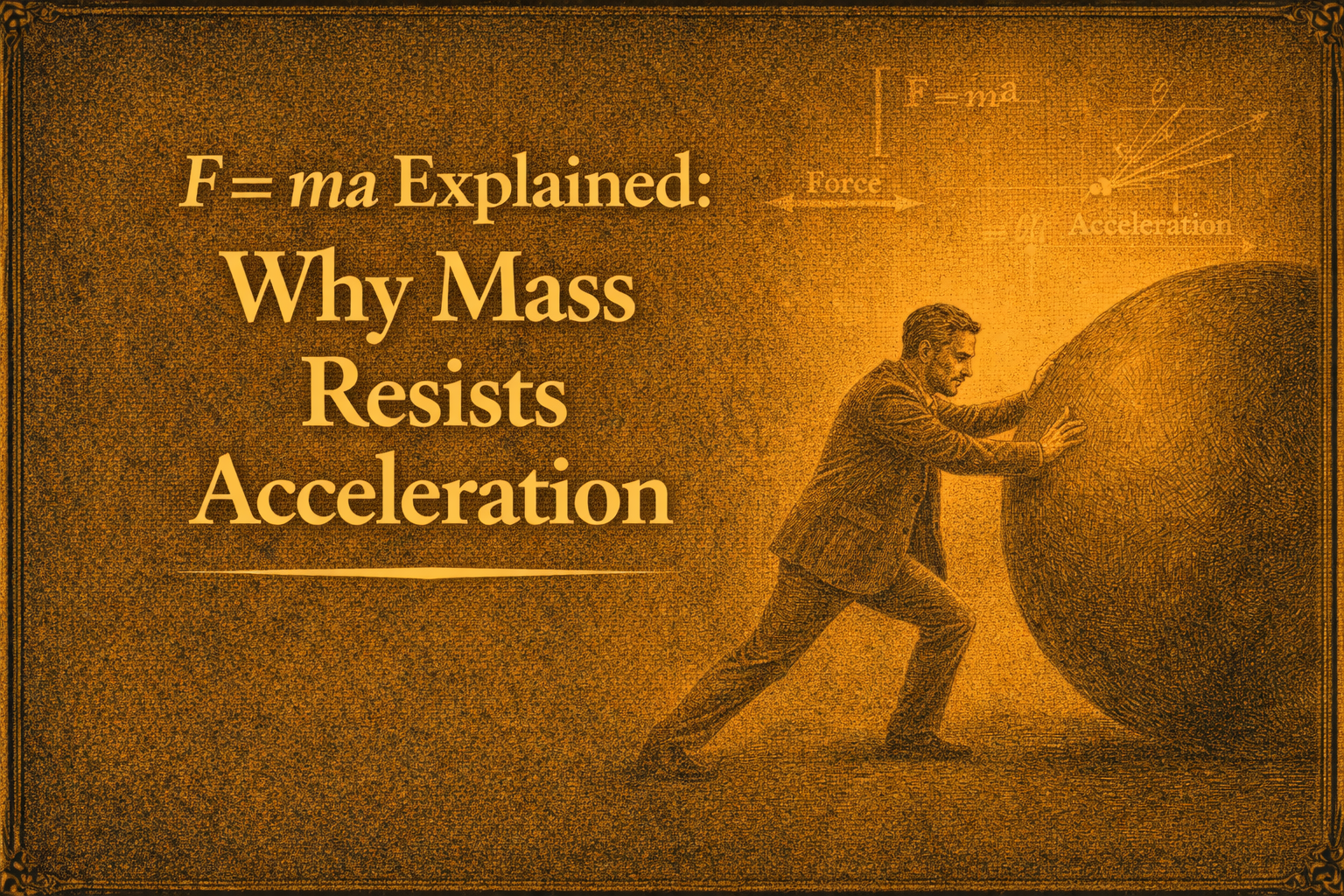
F = ma Explained: Why Mass Resists Acceleration
The Formula Is F=ma. The Idea Is That Heavy Things Resist Change More Than Light Ones.
Inertia isn’t reluctance. It’s physics. Here’s what mass actually means before the equation appears
The Formula Is F = ma.
The Idea Is That Heavy Things Resist Change More Than Light Ones.
Newton’s Second Law tells you exactly how much force it takes to change how something moves — and why a truck needs a bigger engine than a bicycle.
Class 9 Physics | CBSE / ICSE | Chapter: Laws of Motion — Newton's Second Law
What Will You Learn in This Article?
Have you ever wondered why kicking a football sends it flying — but kicking a boulder barely moves it?
In this article, you will learn:
- What Newton’s Second Law is — in plain language, before the formula
- What F = ma actually means — each letter, separately
- What inertia is — and why mass is not the same thing as weight
- How to solve numerical problems — step by step, with worked examples
- What mistakes students make — and how to avoid them in exams
By the end, you will understand Newton’s Second Law completely — explained in simple English, no tuition needed.
Section 1: Start Here — Something You Already Know
Imagine two trolleys on a smooth floor. One is empty. One is loaded with bricks.
You push both with the same force — one hard shove each.
The empty trolley shoots forward fast. The loaded trolley barely moves.
Same force. Very different results. Why?
Because the loaded trolley has more mass. And more mass means more resistance to change.
That resistance — the tendency of an object to stay in its current state — has a name in physics.
It is called inertia. And Newton’s Second Law is the formula that makes inertia measurable.
Section 2: Where Does F = ma Come From?
Newton gave us three laws of motion. Before going into the second, here is where each one sits:
| Law | Name | Core Idea (Plain English) |
| First | Law of Inertia | An object keeps doing what it is doing — moving or staying still — unless a force acts on it. |
| Second | F = ma | The acceleration of an object depends on the force applied and its mass. This is today’s lesson. |
| Third | Action-Reaction | Every force has an equal and opposite force acting back. |
Section 3: What F = ma Actually Means — Letter by Letter
The formula has three letters. Students rush past them. That is the first mistake.
Each letter hides a full idea.
| F — Force
Force is a push or a pull. It is what causes a change in motion. Without force, nothing accelerates. Unit: Newton (N) | Symbol: F | Type: Vector (it has direction) 1 Newton = the force needed to accelerate a 1 kg object at 1 m/s² |
| m — Mass
Mass is the amount of matter in an object. It is also the measure of inertia — how much an object resists a change in its motion. Unit: kilogram (kg) | Symbol: m | Type: Scalar (no direction) Important: Mass does not change based on where you are. A 10 kg rock has the same mass on Earth, on the Moon, and in space. |
| a — Acceleration
Acceleration is the rate at which velocity changes. It is not just speeding up. Slowing down is also acceleration (negative). Changing direction is also acceleration. Unit: m/s² (metres per second squared) | Symbol: a | Type: Vector |
Section 4: The Relationship — What the Formula Is Actually Saying
F = ma is not just a formula you plug numbers into. It describes a relationship between three quantities.
Here is how to read it:
| More force → more acceleration (if mass stays the same)
Push harder on the same object — it speeds up faster. More mass → less acceleration (if force stays the same) Apply the same force to a heavier object — it accelerates less. This is inertia in action. Force and acceleration are directly proportional. Double the force → double the acceleration. Halve the force → halve the acceleration. Mass and acceleration are inversely proportional. Double the mass → half the acceleration (with the same force). |
Section 5: Inertia — The Hidden Idea Inside the Formula
Newton’s First Law introduced inertia. Newton’s Second Law made it measurable.
Inertia is not a force. It is a property — the resistance an object has to any change in its motion.
Mass is the measure of inertia. More mass means more inertia, which means more resistance to change.
| High Inertia (large mass)
A loaded truck on a highway. Hard to get moving from rest. Hard to stop once moving. Even a large force produces a small acceleration. |
Low Inertia (small mass)
A football on the same road. Easy to kick into motion. Easy to stop. A small force produces a large acceleration. |
This is why mass and weight are different — and why students often confuse them.
| Property | Mass | Weight |
| What it is | Amount of matter in an object | The force of gravity pulling on the object |
| Type | Scalar | Vector (acts downward) |
| Unit | kg | Newton (N) |
| Changes with location? | No — same everywhere | Yes — less on the Moon, zero in space |
| Formula | Given directly | W = mg |
| Example (70 kg person) | Mass = 70 kg always | Weight = 70 × 9.8 = 686 N on Earth |
Section 6: Real-World Examples
Example 1: Kicking a Football vs a Boulder
You kick a football (0.45 kg) and a boulder (45 kg) with the same force — say 90 N.
Football: a = F/m = 90 / 0.45 = 200 m/s². It flies.
Boulder: a = F/m = 90 / 45 = 2 m/s². It barely shifts.
Same force. The boulder has 100 times the mass. It gets 1/100th of the acceleration.
Example 2: Why Cars Have Different Engines
A small car (800 kg) and a loaded truck (8000 kg) both need to accelerate at 3 m/s² on a highway.
Car: F = ma = 800 × 3 = 2,400 N needed.
Truck: F = ma = 8000 × 3 = 24,000 N needed.
The truck needs 10 times the force for the same acceleration. That is why trucks have much bigger engines.
Example 3: Catching a Cricket Ball
A fast ball arrives at 40 m/s and needs to be stopped in your hands.
If you stop it abruptly (0.01 seconds), the deceleration is enormous — the force on your hand is enormous. It hurts.
If you pull your hands back slowly (0.5 seconds), the deceleration is much smaller — the force is smaller. Cricketers do this automatically. F = ma explains why.
Section 7: Three Forms of the Formula — Rearranging F = ma
Depending on what the question asks, you rearrange the same formula three ways:
| To find Force:
F = m × a To find Mass: m = F ÷ a To find Acceleration: a = F ÷ m |
Section 8: Worked Examples — Step by Step
Worked Example 1 — Find Force
Problem: A 5 kg object accelerates at 3 m/s². What force is acting on it?
- Write what you know: m = 5 kg, a = 3 m/s²
- Write the formula: F = m × a
- Substitute: F = 5 × 3
- Answer: F = 15 N
Worked Example 2 — Find Acceleration
Problem: A force of 24 N acts on a 6 kg object. What is the acceleration?
- Write what you know: F = 24 N, m = 6 kg
- Rearrange: a = F ÷ m
- Substitute: a = 24 ÷ 6
- Answer: a = 4 m/s²
Worked Example 3 — Find Mass
Problem: A force of 50 N produces an acceleration of 2 m/s². What is the mass?
- Write what you know: F = 50 N, a = 2 m/s²
- Rearrange: m = F ÷ a
- Substitute: m = 50 ÷ 2
- Answer: m = 25 kg
Worked Example 4 — Weight and Force Combined
Problem: A 10 kg box is pushed across a smooth floor. The engine applies 40 N. What acceleration does it get? (Take g = 9.8 m/s²)
Note: The floor is smooth — no friction. The 10 kg is mass, not weight. We do not need g here since we are not asked about gravity.
- Write what you know: m = 10 kg, F = 40 N
- Formula: a = F ÷ m
- Substitute: a = 40 ÷ 10
- Answer: a = 4 m/s²
Section 9: Common Mistakes — Read This Before Your Exam
| Mistake 1: Confusing mass and weight
Many students think that mass and weight both mean 60 kg. But actually, mass is in kg. Weight is in Newtons. Weight = mass × g. A 60 kg person weighs 588 N on Earth, not 60 kg. |
| Mistake 2: Thinking more mass means more force produced, not less acceleration
Many students think: a heavier object hits harder, so it has more force. Therefore, it accelerates more. But actually, for the same applied force, more mass means less acceleration — not more. More mass resists the change. |
| Mistake 3: Forgetting that the unit of force is Newton, not kg
Many students write: F = 5 × 3 = 15 kg But actually: F = 5 × 3 = 15 N (Newtons). kg × m/s² = N. Always write the unit. |
| Mistake 4: Thinking acceleration only means speeding up
Many students think: acceleration = the object is going faster. But actually, acceleration is any change in velocity. Slowing down is negative acceleration. Changing direction is also acceleration. Brakes apply force — that force causes (negative) acceleration. |
Section 10: Remember — Quick Summary
| Remember:
• F = ma is Newton’s Second Law of Motion. • F is force (Newtons), m is mass (kg), and a is acceleration (m/s²). • More force on the same mass → more acceleration. • More mass with the same force → less acceleration. • Mass measures inertia — resistance to change in motion. • Mass is scalar. It never changes. Weight is a force — it changes with gravity. • F = ma can be rearranged: a = F/m and m = F/a. • Always write units in your answer. Force is in Newtons (N). |
Section 11: Practice Questions
Try these without looking at the answers first.
- A 4 kg object accelerates at 5 m/s². What force is acting on it?
- A force of 36 N causes an acceleration of 4 m/s². What is the mass of the object?
- A 1200 kg car engine exerts a force of 6000 N. What is the car’s acceleration?
- Two objects — one of 2 kg and one of 8 kg — are pushed with the same force of 16 N. Calculate the acceleration of each. Which one is harder to move? Why?
- A 70 kg person stands on a weighing scale inside a lift. The lift accelerates upward at 2 m/s². What is the apparent weight shown on the scale? (Take g = 10 m/s²)
Answers
- Q1: F = m × a = 4 × 5 = 20 N
- Q2: m = F ÷ a = 36 ÷ 4 = 9 kg
- Q3: a = F ÷ m = 6000 ÷ 1200 = 5 m/s²
- Q4: 2 kg object: a = 16 ÷ 2 = 8 m/s². 8 kg object: a = 16 ÷ 8 = 2 m/s². The 8 kg object is harder to move — it has more mass, therefore more inertia.
- Q5: When the lift accelerates upward, the effective force = m(g + a) = 70 × (10 + 2) = 70 × 12 = 840 N. The person feels heavier.
Frequently Asked Questions
Q: Is F = ma only for large objects, or does it apply everywhere?
It applies to all objects — from a grain of sand to a planet. Newton’s Second Law is universal. The numbers change, but the relationship between force, mass, and acceleration stays the same.
Q: What if two forces act on the same object?
You add them up first (as vectors, considering direction), and use the net force in F = ma. If a 10 N force pushes right and a 4 N force pushes left, the net force is 6 N rightward. That net force causes the acceleration.
Q: Why does the formula use multiplication and not addition?
Because force, mass, and acceleration are not in the same relationship as adding ingredients. The formula reflects a proportional relationship — double the force, double the result. Multiplication is the right mathematical operation for proportional quantities.
Q: What happens if force is zero?
If net force is zero, then F = ma gives 0 = ma, which means a = 0. The object does not accelerate. It either stays still or keeps moving at constant velocity. That connects back to Newton’s First Law.
Q: Does F = ma apply when objects are at rest?
Yes. An object at rest has zero velocity and zero acceleration. The net force on it is also zero. All the forces acting on it balance out. If you then apply an unbalanced force, F = ma tells you exactly how it will start moving.
Dhruv Chandravanshi
Writes about how matter, numbers, and systems behave under rules — from physics to accounting, from chemistry to economic logic.
Long-Form Writing
➡️ Medium: https://medium.com/@Dhruv_Chandravanshi
➡️ Substack: https://dhruvchandravanshi.substack.com/
Official Website
➡️ https://www.chandravanshi.org/en/author/dhruvtimes/
Social Platforms
➡️ Facebook: https://www.facebook.com/DhruvTimes/
➡️ X: https://x.com/Dhruv_Times
➡️ LinkedIn: https://www.linkedin.com/in/dhruv-chandravanshi/
➡️ Instagram: https://www.instagram.com/dhruv_times/
Rules first.
Structure always.
Clarity over shortcuts.
