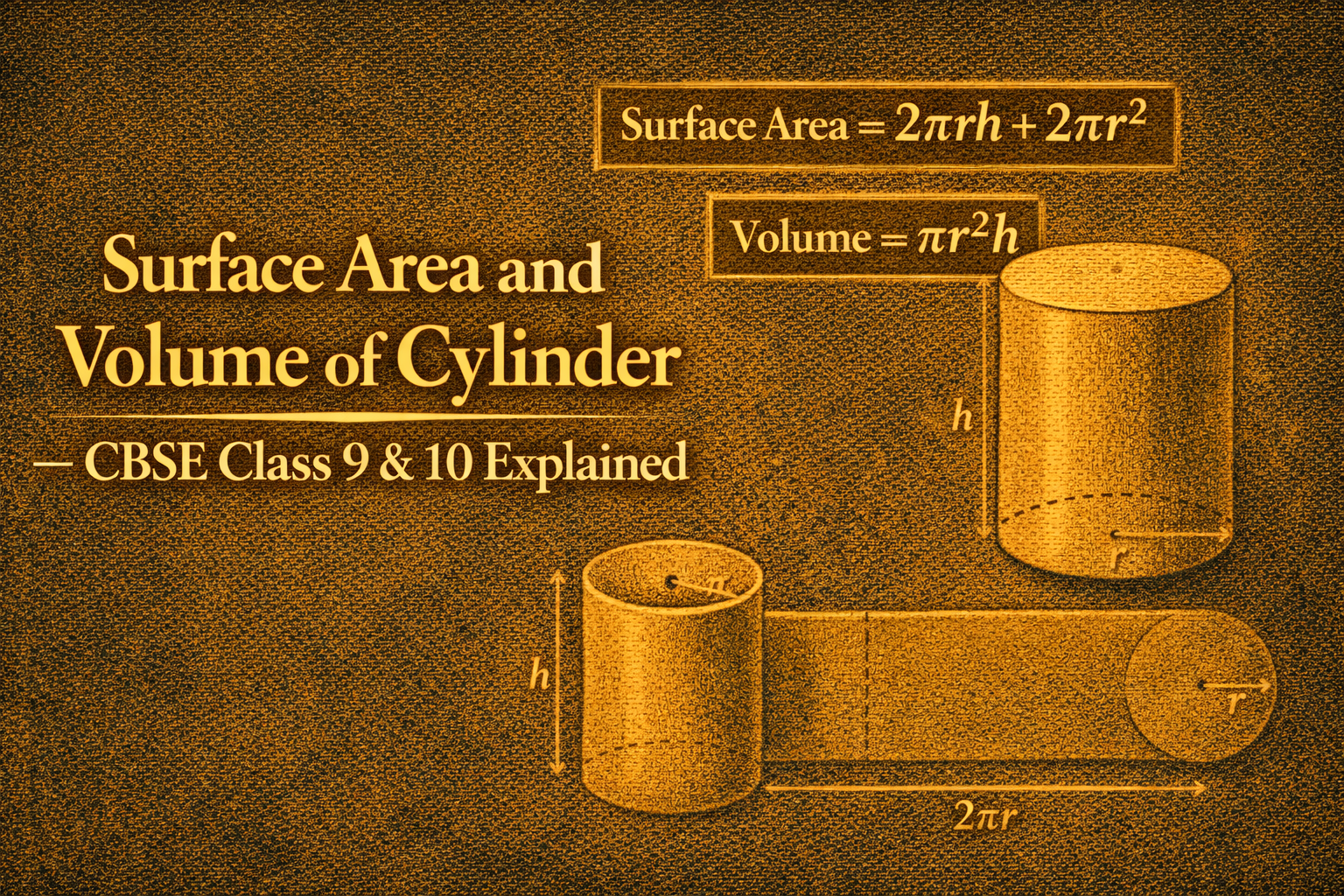
Surface Area and Volume of Cylinder — CBSE Class 9 & 10 Explained
Volume equals base area multiplied by height. Visualise the cylinder before applying V = πr²h.
By Dhruv Chandravanshi | Class 9 & 10 Mathematics | CBSE
Have You Ever Wondered How a Factory Knows Exactly How Much Metal Sheet Goes Into Making One Tin Can?
In this article, you will learn:
-
What a cylinder actually is — understood as a physical shape before applying formulas
-
Why do surface area and volume answer two completely different questions about the same object
-
What CSA, TSA, and volume mean — and when each formula is used
-
What CBSE Class 9 and 10 expect in mensuration problems — and the common confusion that costs students marks
By the end, you will see that every cylinder formula describes something you can visualise and touch.
Each formula simply expresses a geometric observation using algebra.
A Simple Observation from a Lassi Glass
Arjun’s mother makes lassi every morning in Patna.
She uses a tall steel glass — the common cylindrical glass seen in homes and chai stalls across Bihar.
Arjun examines it carefully.
The shape is simple:
-
A circle at the bottom
-
The same circle at the top
-
A curved side connecting both
If the curved side were cut and unrolled, it would form a rectangle.
So the cylinder consists of three parts:
-
Bottom circular base
-
Top circular base
-
Curved rectangular surface
Now Arjun asks two questions:
-
How much lassi can this glass hold?
-
How much steel sheet is needed to make the glass?
Both questions relate to the same shape but measure different things.
Two Different Ideas: Surface Area vs Volume
A cylinder leads to two types of measurement.
Surface Area
Surface area measures how much material covers the outside.
Imagine cutting the cylinder open and laying it flat.
You would see:
-
One rectangle (the curved surface)
-
Two circles (top and bottom)
Adding their areas gives the total surface area.
Volume
Volume measures how much space is inside the cylinder.
Imagine stacking many thin circular discs one above another until they reach the height of the cylinder.
Each disc has an area:
πr²
Stack them to a height h.
Total volume becomes:
πr²h


Important Terms for a Cylinder
A cylinder is a three-dimensional shape with two identical circular bases connected by a curved surface.
Key symbols:
r → radius of the circular base
h → height of the cylinder
π (pi) → constant ≈ 22/7 or 3.14
Three Important Formulas
Curved Surface Area (CSA)
This measures only the curved side.
CSA = 2πrh
Total Surface Area (TSA)
This includes the curved side plus both circular bases.
TSA = 2πrh + 2πr²
or
TSA = 2πr(h + r)
Volume
This measures the space inside the cylinder.
V = πr²h
How These Formulas Are Derived
Curved Surface Area
Cut the cylinder along its height and open it.
The curved surface becomes a rectangle.
-
Height of rectangle = h
-
Length of rectangle = circumference of base = 2πr
Area of rectangle:
CSA = 2πr × h
CSA = 2πrh
Total Surface Area
The cylinder also includes two circular ends.
Area of one circle = πr²
Two circles:
2πr²
Add this to the curved surface.
TSA = 2πrh + 2πr²
Volume
Imagine stacking circular layers.
Each circular base has an area:
πr²
Multiply by height:
V = πr²h
Choosing the Correct Formula
Before calculating, read the question carefully.
| Question Type | Formula |
|---|---|
| Label, wrapper, curved side only | CSA |
| Entire outer surface, including top and bottom | TSA |
| Capacity, space inside, litres | Volume |
Worked Examples
Example 1 — Curved Surface Area of a Tin Can
Radius = 7 cm
Height = 15 cm
CSA = 2πrh
CSA = 2 × (22/7) × 7 × 15
CSA = 660 cm²
Example 2 — Total Surface Area of a Water Tank
Radius = 3.5 m
Height = 10 m
TSA = 2πr(h + r)
TSA = 2 × (22/7) × 3.5 × (10 + 3.5)
TSA = 297 m²
Example 3 — Volume of a Lassi Glass
Radius = 4 cm
Height = 12 cm
V = πr²h
V = (22/7) × 16 × 12
V ≈ 603 cm³
This equals about 603 millilitres of liquid.
Example 4 — Finding Height from Volume
Volume = 1540 cm³
Radius = 7 cm
V = πr²h
1540 = (22/7) × 49 × h
1540 = 154h
h = 10 cm
Visual Understanding of a Cylinder


Real-Life Applications
Water Pipes
Engineers calculate how much water flows through cylindrical pipes using:
V = πr²h
Tin Cans and Containers
Factories calculate metal sheet requirements using surface area formulas.
Storage Tanks
Capacity of tanks and wells is determined using volume calculations.
Common Mistakes Students Make
Mistake 1 — Confusing CSA and TSA
CSA includes only the curved surface.
TSA includes the curved surface and both circular ends.
Mistake 2 — Mixing Surface Area and Volume Formulas
Surface area uses 2πr.
Volume uses πr².
Mixing them produces incorrect units.
Mistake 3 — Using Diameter Instead of Radius
Many questions give the diameter.
Remember:
r = d ÷ 2
Always convert before substitution.
Mistake 4 — Using the Wrong Value of π
The question usually specifies:
π = 22/7 or π = 3.14
Use the value provided.
Important Unit Conversions
1 m = 100 cm
1 m² = 10,000 cm²
1 m³ = 10,00,000 cm³
1 litre = 1000 cm³
Core Idea in Simple Words
A cylinder has:
-
Two circular bases
-
One curved surface connects them
The formulas come from simple observations:
CSA = 2πrh
TSA = 2πrh + 2πr²
Volume = πr²h
Surface area measures the outside covering.
Volume measures the space inside.
Practice Questions
-
A cylindrical water tank has a radius of 1.4 m and a height of 5 m. Find its CSA, TSA, and volume.
-
A cylindrical tin can has a radius of 7 cm and a curved surface area of 440 cm². Find its height.
-
A cylindrical well has a diameter of 140 cm and a depth of 20 m. Find the volume of earth removed.
-
A hollow pipe has an inner radius of 4 cm, an outer radius of 4.5 cm, and a length of 21 m. Find the volume of material used.
-
Compare the volume of a cylinder and a cone with the same base radius and height.
Frequently Asked Questions
When should CSA be used?
Use CSA when the problem involves only the curved side of the cylinder.
When should TSA be used?
Use TSA when the entire outer surface, including both ends, is considered.
Why does volume use r²?
Because volume uses the area of the circular base, which is πr².
How do I convert litres to cubic centimetres?
1 litre = 1000 cm³.
What happens if the radius doubles?
Since volume depends on r², doubling the radius increases the volume four times.
Related Topics
-
Surface Area and Volume of a Cone
-
Surface Area and Volume of a Sphere
-
Areas Related to Circles
This article follows the CBSE Class 9 and Class 10 Mathematics syllabus (Surface Areas and Volumes) and aligns with NCERT concepts.
Dhruv
About Author Dhruv Chandravanshi
Dhruv Chandravanshi writes about physical and logical systems — from motion to matrices — uncovering the structures that govern how matter and numbers behave.
| Platform | Description | Link |
|---|---|---|
| Substack | Newsletter essays and published writing | dhruvchandravanshi.substack.com |
| Medium | Long-form essays and analytical writing | medium.com/@Dhruv_Chandravanshi |
| Medium Publication — Judgment Under Pressure | Publication on decision-making and systems thinking | medium.com/judgment-under-pressure |
| Medium Publication — The Honest Confusion | Articles explaining confusing school concepts | medium.com/the-honest-confusion |
| Medium Publication — संरचना | Long-form analytical essays in Hindi | medium.com/sanrachna-official |
| Chandravanshi.org | Author profile and articles | chandravanshi.org/en/author/dhruvtimes |
| Professional posts and articles | linkedin.com/in/dhruv-chandravanshi | |
| Posts, updates, and discussions | facebook.com/DhruvTimes | |
| Short video insights and reels | instagram.com/dhruv_times |