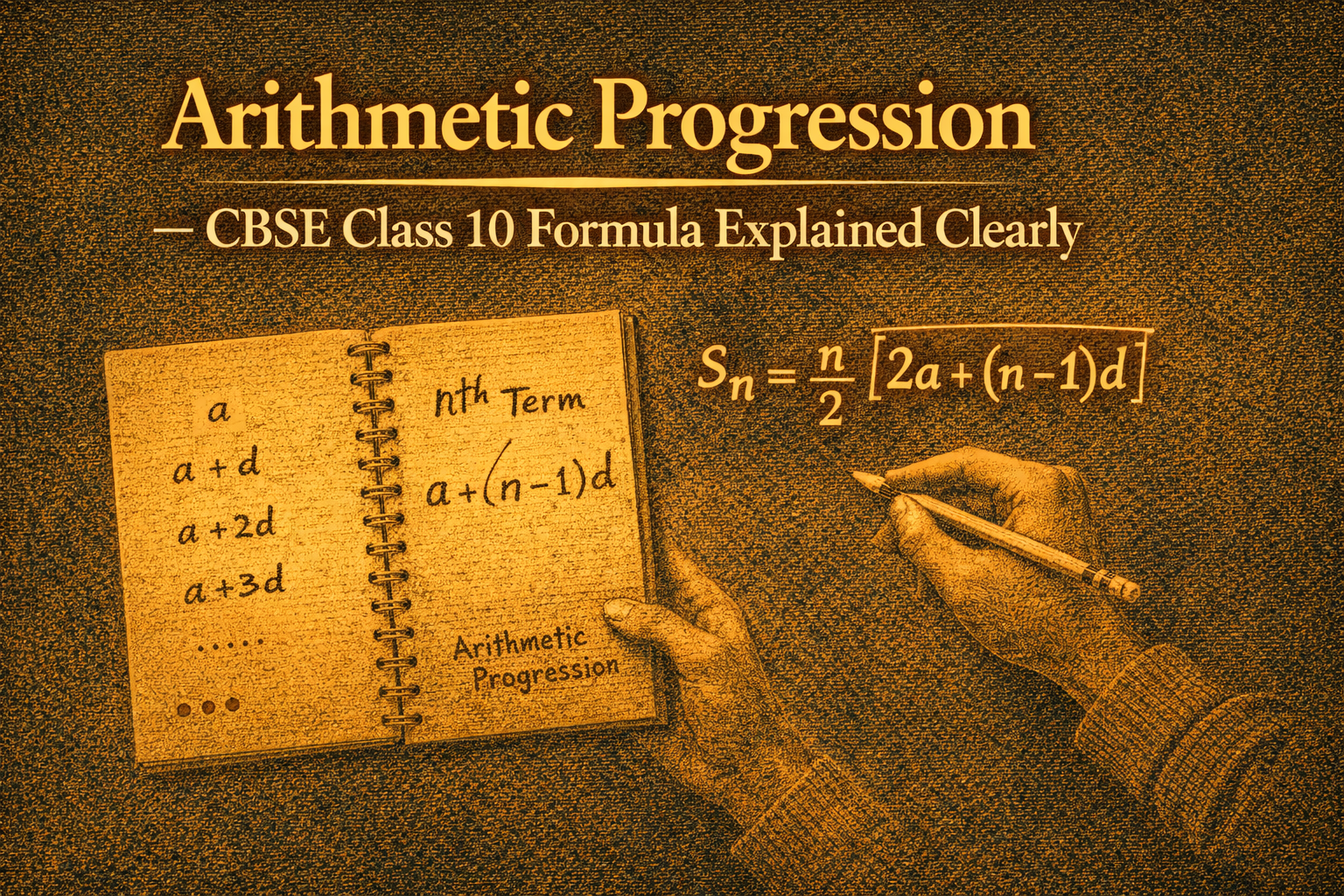
Arithmetic Progression — CBSE Class 10 Formula Explained Clearly
The formula aₙ = a + (n − 1)d tracks repeated addition. Learn what each term represents before attempting sequence problems.
By Dhruv Chandravanshi | Class 10 Mathematics | CBSE
Have You Ever Noticed That Some Patterns Just Keep Adding the Same Number — Over and Over?
In this article, you will learn:
-
What an arithmetic progression actually is — felt as a pattern before being named as a formula
-
What a, d, n, and aₙ represent — not as symbols but as real values in a sequence
-
How the nth term formula works — and why it is built the way it is
-
What CBSE Class 10 expects — and the exact place most students lose marks in AP questions
By the end, you will see that the AP formula is not something to memorise blindly.
It is a formula you could build yourself once you recognise the pattern it describes.
A Pattern Hidden in Rows of Chairs
Arjun’s school in Patna holds a prize distribution ceremony every year.
The chairs are arranged in rows.
-
Row 1 → 5 chairs
-
Row 2 → 8 chairs
-
Row 3 → 11 chairs
-
Row 4 → 14 chairs
Each row has three more chairs than the previous one.
The person arranging the chairs does not recount every row.
He simply adds 3 chairs each time.
Arjun sits in the 5th row.
He wonders how many chairs are in his row.
His teacher glances at the arrangement and immediately says:
17 chairs.
No counting.
Just recognising the pattern.
Understanding the Pattern
Look closely at the sequence:
5, 8, 11, 14, 17 …
Each term increases by 3.
Now rewrite the pattern differently:
-
Row 1 → 5
-
Row 2 → 5 + 1×3
-
Row 3 → 5 + 2×3
-
Row 4 → 5 + 3×3
-
Row 5 → 5 + 4×3
Notice something important.
The multiplier of 3 is always one less than the row number.
For the 5th row:
Chairs = 5 + (5 − 1) × 3
Chairs = 5 + 12
Chairs = 17
Now try row 100:
Chairs = 5 + (100 − 1) × 3
Chairs = 5 + 297
Chairs = 302
The same pattern works for any row.
This predictable pattern is called an Arithmetic Progression.
What Is an Arithmetic Progression?
Mathematicians define it formally.
An Arithmetic Progression (AP) is a sequence of numbers where the difference between consecutive terms is constant.
That constant difference is called the common difference.
Example sequence:
5, 8, 11, 14, 17 …
Common difference:
8 − 5 = 3
11 − 8 = 3
14 − 11 = 3
Since the difference remains constant, this sequence is an AP.
Important Symbols in AP
Five symbols appear frequently in AP problems.
a
The first term of the sequence.
Example: 5
d
The common difference.
Example: 3
n
The position of the term.
Example: 5th term, 20th term, 100th term.
aₙ
The value of the nth term.
Sₙ
The sum of the first n terms.
The Nth Term Formula
The general formula for an arithmetic progression is:
aₙ = a + (n − 1)d
This formula directly calculates the value of any term in the sequence.
Example from the chair pattern:
a = 5
d = 3
n = 5
a₅ = 5 + (5 − 1) × 3
a₅ = 5 + 12
a₅ = 17
No need to list all the terms.
Why the Formula Uses (n − 1)
The formula includes (n − 1) rather than n for a reason.
The first term already exists.
To reach the second term, you add d once.
To reach the third term, you add d twice.
So by the nth term, you have added d exactly (n − 1) times.
That is why the formula becomes:
aₙ = a + (n − 1)d
How to Identify an AP
Follow these steps.
Step 1 — Check the Differences
Example sequence:
3, 7, 11, 15, 19 …
Differences:
7 − 3 = 4
11 − 7 = 4
15 − 11 = 4
The difference is constant.
So this sequence is an AP.
Step 2 — Identify a and d
Example:
5, 8, 11, 14 …
a = 5
d = 3
Step 3 — Apply the Formula
aₙ = a + (n − 1)d
Substitute values and calculate.
Sum of an Arithmetic Progression
Sometimes we need the sum of several terms, not just one term.
The formula is:
Sₙ = n/2 × (2a + (n − 1)d)
Another useful version is:
Sₙ = n/2 × (a + l)
where l is the last term.
This second formula is convenient when the first and last terms are known.
Worked Examples
Example 1 — Find a Specific Term
AP:
7, 11, 15, 19 …
Find the 20th term.
a = 7
d = 4
n = 20
a₂₀ = 7 + (20 − 1) × 4
a₂₀ = 7 + 76
a₂₀ = 83
Example 2 — Find the Position of a Term
AP:
5, 8, 11, 14 …
Which term equals 50?
a = 5
d = 3
50 = 5 + (n − 1) × 3
45 = 3(n − 1)
n − 1 = 15
n = 16
So 50 is the 16th term.
Example 3 — Find the Sum of Terms
AP:
2, 5, 8, 11 …
Find the sum of the first 15 terms.
a = 2
d = 3
n = 15
S₁₅ = 15/2 × (2×2 + 14×3)
S₁₅ = 15/2 × (4 + 42)
S₁₅ = 15/2 × 46
S₁₅ = 345
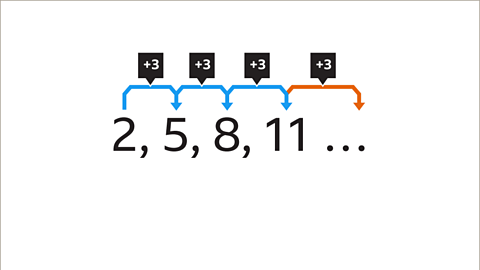
Visualising Arithmetic Progressions


Real-Life Examples of AP
Monthly Savings
A student saves money each month.
January → ₹200
February → ₹250
March → ₹300
Each month increases by ₹50.
This is an AP.
Ladder Rungs
Suppose ladder rungs shorten by 2 cm with each step.
45 cm, 43 cm, 41 cm …
This is also an AP with a negative common difference.
Seating Arrangements
Stadium seating and theatre rows often increase by a constant number of seats.
Architects frequently use AP calculations to plan such layouts.
Common Mistakes Students Make
Mistake 1 — Confusing d with the second term
Example:
5, 8, 11, 14
Second term = 8
Common difference = 8 − 5 = 3
Using 8 instead of 3 gives wrong results.
Mistake 2 — Mixing the Term Formula with the Sum Formula
aₙ finds a single term.
Sₙ finds the sum of many terms.
Using the wrong formula leads to incorrect answers.
Mistake 3 — Thinking AP Must Increase
An AP can also decrease.
Example:
20, 17, 14, 11 …
Here:
d = −3
The sequence is still an AP.
Important AP Formulas for CBSE
aₙ = a + (n − 1)d
Sₙ = n/2 × [2a + (n − 1)d]
Sₙ = n/2 × (a + l)
Types of Questions CBSE Often Asks
-
Find the nth term of an AP
-
Find the number of terms when a term value is given
-
Find the sum of the first n terms
-
Word problems based on savings, seating, and distances
-
Determine whether the given numbers form an AP
Core Idea in Simple Words
An arithmetic progression is simply a sequence where the same number is added repeatedly.
The first term is a.
The fixed addition is d.
To reach the nth term, we add d exactly (n − 1) times.
That is why the formula becomes:
aₙ = a + (n − 1)d
Practice Questions
-
The first term of an AP is 3, and the common difference is 4. Write the first five terms. Find the 25th term.
-
Which term of the AP 7, 13, 19, 25… equals 205?
-
Find the sum of the first 20 terms of the AP 4, 9, 14, 19…
-
The sum of three consecutive terms in an AP is 27, and their product is 504. Find the terms.
-
The 7th term of an AP is 32, and the 13th term is 62. Find the first term and common difference.
Frequently Asked Questions
What is the difference between a sequence and a series?
A sequence lists numbers in order. A series represents the sum of those numbers.
Can the common difference be negative?
Yes. If the difference is negative, the sequence decreases but still forms an AP.
Can the common difference be a fraction?
Yes. For example: 1, 1.5, 2, 2.5 … is an AP with d = 0.5.
What happens if d = 0?
All terms remain equal: a, a, a, a…
Why does the sum formula contain n/2?
Because pairs of terms (first + last, second + second-last) add to the same value, forming n/2 equal pairs.
Related Topics
-
Quadratic Equations
-
Real Numbers and Number Patterns
-
Statistics and Mean
This article follows the CBSE Class 10 Mathematics syllabus (Chapter 5 — Arithmetic Progressions) and aligns with NCERT mathematics concepts. All examples and formulas correspond to standard CBSE examination patterns.
Dhruv
About Author Dhruv Chandravanshi
Dhruv Chandravanshi writes about physical and logical systems — from motion to matrices — uncovering the structures that govern how matter and numbers behave.
| Platform | Description | Link |
|---|---|---|
| Substack | Newsletter essays and published writing | dhruvchandravanshi.substack.com |
| Medium | Long-form essays and analytical writing | medium.com/@Dhruv_Chandravanshi |
| Medium Publication — Judgment Under Pressure | Publication on decision-making and systems thinking | medium.com/judgment-under-pressure |
| Medium Publication — The Honest Confusion | Articles explaining confusing school concepts | medium.com/the-honest-confusion |
| Medium Publication — संरचना | Long-form analytical essays in Hindi | medium.com/sanrachna-official |
| Chandravanshi.org | Author profile and articles | chandravanshi.org/en/author/dhruvtimes |
| Professional posts and articles | linkedin.com/in/dhruv-chandravanshi | |
| Posts, updates, and discussions | facebook.com/DhruvTimes | |
| Short video insights and reels | instagram.com/dhruv_times |