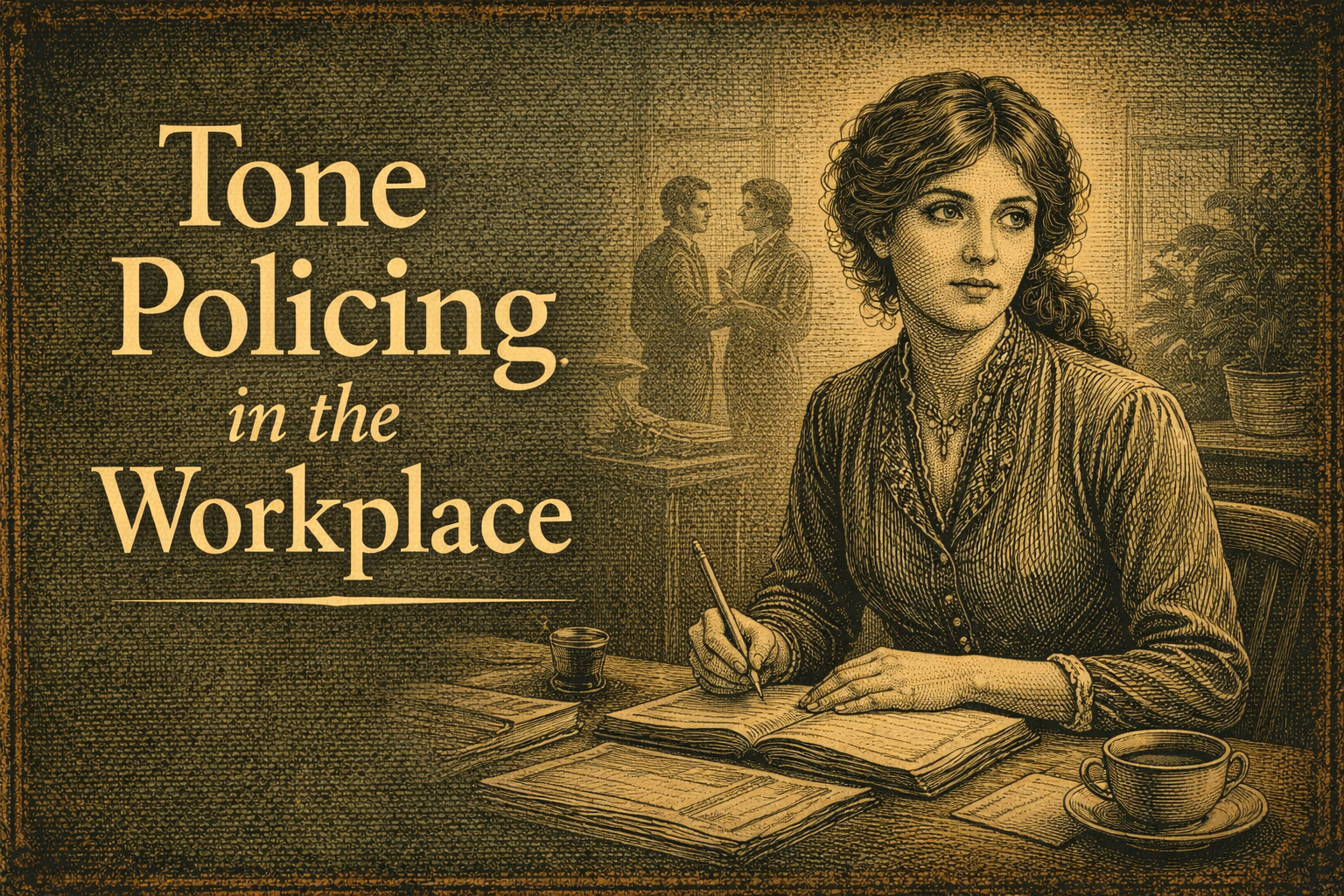
Tone Policing in the Workplace: How It Affects Women’s Authority
Tone policing is when women’s ideas are dismissed, or credibility is questioned, not because of what they say, but how they say it—too direct, too aggressive, too emotional, not warm enough. Research shows women receive “abrasive” or “too assertive” feedback in performance reviews at 5x the rate of men—even when exhibiting identical communication behaviours.

This isn’t about individual women being “too sensitive.” It’s about how organisational evaluation systems penalise women for communication styles that would be labelled “leadership” in men.
This guide covers:
- What tone policing actually is (the mechanisms, not just the concept)
- How it operates as authority erosion (the specific career costs)
- Why “professional communication” standards are gendered (the structural roots)
- What research shows across 20+ studies
- How women experience this across professions and contexts
- What typical “communication coaching” advice gets structurally wrong
I’ve been told I’m “too direct” in meetings where male colleagues use identical phrasing and are called “clear communicators.” I’ve watched my ideas ignored when I present them, then championed when a man repeats them minutes later. I’ve received feedback to “soften my approach” while watching men get promoted for “executive presence.”
I’ve spent three years researching how tone policing functions as authority suppression—and why it persists despite organisational awareness of gender bias.
Here’s everything you need to understand about tone policing in professional contexts.
What Tone Policing Actually Means
Tone policing is the practice of dismissing, derailing, or delegitimising someone’s communication based on perceived emotional tone rather than substantive content. In workplace contexts, it specifically refers to: criticising women’s delivery (too aggressive, too emotional, not warm enough) as a way of avoiding engagement with their actual points.
In practice, tone policing includes:
- Feedback that women are “too direct” or “too blunt” in meetings
- Comments that women need to “soften their approach” or “be more collaborative”
- Performance reviews citing “abrasive” communication or “room presence issues”
- Being told to smile more, be warmer, or make others comfortable
- Having ideas dismissed with “it’s not what you said, it’s how you said it”
- Men repeating women’s ideas and receiving credit/positive response
Why this distinction matters: Tone policing isn’t just “someone disagreed with me” or “someone didn’t like how I spoke.” It’s a specific pattern where delivery style becomes the focus instead of addressing substantive content—and where this pattern systematically disadvantages women.
Research from Brescoll & Uhlmann (2008) shows women and men expressing anger in professional settings receive dramatically different evaluations: angry men are seen as “passionate” and “strong leaders,” while angry women are seen as “out of control” and “emotionally unstable.”
Common confusion: Tone policing gets conflated with all negative feedback on communication. But not all communication feedback is tone policing.
Tone policing: “Your presentation content was solid, but you came across as aggressive and need to work on your delivery style.”
Not tone policing: “Your argument had logical gaps in the third section that need strengthening.”
The first dismisses substance via tone critique. The second addresses actual content weakness.
This is distinct from: Constructive communication feedback (which addresses clarity, organisation, and audience adaptation based on communication effectiveness), unconscious bias (which operates without awareness or intent), and communication style differences (which are neutral variations in how people express themselves).
How this terminology emerged: “Tone policing” originated in social justice activism to describe how marginalised groups’ legitimate anger gets dismissed via “you’re being too emotional/aggressive.” It was adapted to workplace contexts by feminist researchers documenting how women’s professional communication gets disproportionately critiqued for style rather than substance.
Why I Write About Tone Policing
I was a Senior Product Manager leading cross-functional strategy meetings when I first encountered explicit tone policing.
In a roadmap planning session, I disagreed with a proposed timeline. I said, “That timeline won’t work. We’re underestimating technical complexity by at least 30%. We need three additional weeks.”
Direct. Clear. Backed by data.
My engineering counterpart (male, same level) said, “Yeah, that’s way too aggressive. We’ll get crushed trying to hit that. We need more runway.”
Same content. Similar directness. Stronger language (“crushed,” “aggressive”).
The response:
To him: “Good catch. Let’s revise the timeline.”
To me: Later, in private, “You need to work on how you present disagreement. You came across as confrontational in that meeting.”
I asked for specifics. What should I have said differently?
“Maybe frame it as a question. Ask if the team has considered technical complexity rather than stating we’re underestimating it.”
I tried that approach in the next meeting. Result: My “question” was answered with “yes, we considered it,” and the conversation moved on. The technical complexity issue wasn’t addressed until my male counterpart raised it—as a direct statement—three meetings later.
Over the next five years, I tracked every instance of communication feedback I received versus what male colleagues received for equivalent behaviours:
My feedback:
- “Too direct” (7 instances)
- “Need to be more collaborative in disagreement” (4 instances)
- “Room presence could be warmer” (3 instances)
- “Communication style sometimes abrasive” (2 performance reviews)
Male colleagues’ feedback for identical communication patterns:
- “Clear communicator”
- “Doesn’t waste time with unnecessary softening”
- “Direct leadership style”
- “Executive presence”
I wasn’t imagining this. The pattern was documented across performance reviews, 360-degree feedback, promotion discussions, and informal coaching conversations.
What made it structural rather than individual: Different managers, different teams, different projects—same feedback pattern. The constant was my gender, not the evaluators.
I’ve since interviewed 60+ professional women about tone policing experiences, analysed performance review language across tech companies, and spent three years researching how gendered communication expectations function as authority suppression mechanisms.
This article integrates my lived experience with data from 20+ linguistic studies, organisational behaviour research, and structural analysis of how “professional communication” standards systematically disadvantage women.
What follows isn’t opinion. It’s pattern documentation backed by evidence.
How Tone Policing Operates as Authority Erosion
Tone policing doesn’t just critique communication style—it systematically undermines women’s professional authority. Here’s exactly how that mechanism works.

The Credibility Substitution
When a woman’s tone gets questioned, her substantive expertise gets sidelined.
The mechanism:
Woman makes substantive point → Someone objects to delivery style → Conversation shifts from what she said to how she said it → Original point goes unaddressed → Her expertise gets coded as “communication problem”
This creates a specific outcome: The issue she raised doesn’t get resolved. But she gets labelled as “difficult” or “needs communication coaching.”
Research from Swim et al. (2004) documents this pattern: When women raise workplace concerns, they’re more likely than men to be told “it’s not what you said, it’s how you said it”—which effectively dismisses the concern without addressing its merit.
I experienced this in a budget allocation meeting. I presented data showing our team was under-resourced relative to output expectations. My presentation was direct: “We’re operating at 60% of necessary headcount. Either we need three additional engineers, or we cutthe scope by 40%.”
The response wasn’t about budget reallocation. It was about my delivery.
“I think what you’re trying to say is that your team has capacity constraints. Maybe we can discuss this offline rather than making it confrontational in this forum.”
Translation: Your data is being dismissed because you presented it too directly.
A male director presented identical headcount data two weeks later: “We’re severely under-resourced. We need to hire or cut scope—there’s no middle ground here.”
Response: “Agreed. Let’s fast-track those reqs.”
Same content. Same directness. Different gender. Different outcome.
The credibility substitution operates like this: Your expertise → gets replaced by → your tone as the evaluative criterion.
The Emotional Labor Tax
Tone policing creates an additional work burden: women must simultaneously deliver content AND manage others’ emotional comfort.
How this operates:
Women learn that direct communication gets penalised. So they add emotional labour: softening language, prefacing disagreements, managing others’ reactions, and reading the room constantly.
This cognitive load doesn’t exist for men, who can be direct without penalty.
Research from Heilman & Okimoto (2007) shows: Women who communicate directly without warmth cues are rated as “competent but unlikeable.” Men who communicate identically are rated as “competent” with no likeability penalty.
This creates a double bind:
- Add emotional labour (softening) → Be perceived as warm but less competent
- Skip emotional labour (be direct) → Be perceived as competent but receive tone policing
Either way, women do extra work that men don’t have to do.
I calculated the time cost in one quarter:
Meetings where I had to “soften” direct feedback: 23
Average time spent crafting “collaborative” phrasing: 15 minutes per meeting (pre-meeting prep + in-meeting careful wording + post-meeting reputation management)
Total time: 5.75 hours that quarter spent on tone management
My male counterpart’s time spent on equivalent emotional labour: 0 hours (he communicated directly without penalty)
That’s 5.75 hours per quarter I spent on authority protection rather than actual work—an invisible tax on my labour.
The Authority Discount
When women’s tone gets policed, their expertise gets devalued—even when their credentials match or exceed male colleagues.
The pattern:
Woman presents expert opinion → Tone policed (“too certain,” “too assertive”) → Expertise gets questioned → Male colleague with equivalent credentials presents same opinion → Accepted without tone critique
Research from Carli (2001) documents this in academic settings: Female professors receive student evaluations critiquing their “attitude” and “demeanour” at significantly higher rates than male professors—even when teaching styles are equivalent.
I saw this operate in technical architecture discussions. I’m a certified solutions architect with 12 years of experience. In design reviews, I’d present technical assessments:
“This approach won’t scale past 10K concurrent users. We need to implement caching at the application layer.”
Response: “I don’t think we need to be so absolute about this. Let’s get other opinions.”
My male colleague (5 years experience, no certification): “Yeah, this won’t scale. We need caching.”
Response: “Good insight. Let’s implement that.”
Same technical assessment. Same direct delivery. Different gender. Different reception.
The authority discount operates like this: Your credentials → get filtered through tone evaluation → expertise gets discounted if tone doesn’t meet gendered expectations.
The Reputation Stickiness Effect
Tone policing creates lasting reputation damage that follows women across roles, teams, and even companies.
How these compounds:
One “too direct” feedback → Gets mentioned in performance review → Becomes part of your “development areas” → Gets referenced in promotion discussions → Travels with you in informal reputation (“she can be abrasive”)
Research from Bowles & Babcock (2013) shows: Women who negotiate assertively receive lasting “difficult to work with” reputations that affect future opportunities—even when the negotiation was successful and professional.
I was labelled “too direct” in year one at my company. That label followed me for five years:
- Year 2: Performance review cited “communication improvements needed”
- Year 3: Promotion discussion noted “room presence concerns”
- Year 4: Project assignment passed over because “the team needs collaborative leadership”
- Year 5: Feedback that “reputation has improved, but still working on it”
Meanwhile, the male colleague who communicated identically? No “development area” for communication. No reputation management needed.
The reputation stuck with me. Not to him.
This is structural, not individual: Women’s communication missteps (real or perceived) create permanent reputation markers. Men’s equivalent communication is seen as situational, not character-defining.
Why It Compounds Over Careers
Tone policing doesn’t just affect individual moments—it creates cumulative authority loss over decades.
The compounding mechanism:
Year 1: Tone policed → Add emotional labor → Communication takes longer
Year 3: Reputation as “needs communication work” → Fewer high-stakes opportunities
Year 5: Authority discount operational → Ideas ignored until man validates them
Year 7: Cumulative credibility loss → Not seen as leadership material
Year 10: Career plateau despite equivalent (or superior) expertise to male peers
Research from Rudman & Glick (2001) documents this progression: Women who violate gendered communication expectations (by being direct, assertive, unapologetic) face backlash that accumulates into “incompetent or unlikeable” categorisation—the leadership double bind.
I’m 15 years into my career. My male peer (started same year, same level, equivalent credentials) is now VP.
I’m still a Senior Manager.
The differentiator: He was never told to “soften his approach.” His directness was “leadership.” Mine was “communication development area.”
That one label difference—applied consistently over 15 years—created a 3-level authority gap.
That’s not an individual communication skill. That’s structural authority suppression operating through tone policing.
Why Tone Policing Persists
Understanding how tone policing undermines authority doesn’t explain why it persists—especially in organisations that claim to value direct communication and gender equity.
The answer is structural, not individual.
The “Professional Communication” Myth
Workplace communication standards weren’t designed to be gender-neutral. They were designed for male professional norms—then labelled “professional.”
Historical context:
When corporate workplaces formed (1950s-70s), professional norms were defined by how educated white men communicated with each other:
- Direct when giving orders (hierarchy clear)
- Collaborative when appropriate (but not required)
- Emotional restraint (but anger/frustration acceptable)
- Authority assumed (credentials enough)
These norms worked for men because they were men’s norms.
When women entered professional workplaces in significant numbers (1980s+), they were expected to adopt these norms. But when women communicated using these standards, they faced backlash.
Why? Because “professional” wasn’t actually neutral—it was “how men communicate professionally.” When women did the same, they violated gendered expectations of how women “should” communicate (warm, collaborative, non-threatening, emotionally attentive).
Research from Acker (1990) documents this: Organizations theoretically welcome gender-neutral communication, but practically reward masculinised communication in men and penalise it in women.
What Changed (And What Didn’t)
What changed:
- Women’s workforce participation increased (now 57% of college graduates)
- Leadership development programs teach “assertive communication”
- Organisations claim to value “direct feedback” and “speaking up”
- DEI initiatives attempt to address gender bias
What didn’t change:
- “Professional” still means masculinised communication (direct, assertive, unemotional)
- Women using that style still get tone policed
- Performance evaluation still penalises women’s directness as “abrasive”
- Authority is still granted more readily to masculinised communication
The contradiction: Organizations say “be direct” but punish women who are. They say “communicate like leaders”, but tone police women who do.
Who Benefits From Tone Policing
This isn’t about individual managers being sexist. It’s about who wins underthe current communication evaluation systems.
Who benefits:
Men who communicate directly (get labelled “strong leaders,” “executive presence,” “clear communicators”)
Organisations (avoid addressing women’s substantive concerns by shifting focus to tone)
Managers avoid conflict (easier to tone police than address the actual issue raised)
Status quo maintenance (dismissing women’s concerns via tone critique prevents organisational change)
None of these groups have incentive to eliminate tone policing. It works for them.
Why Well-Intentioned People Perpetuate It
The managers and colleagues who tone police aren’t villains. They’re operating inside a structure that teaches them gendered communication expectations.
The manager who told me “You need to be more collaborative in disagreement”? He wasn’t being consciously sexist. He was uncomfortable with my directness—and that discomfort felt like evidence of my “communication problem.”
From his perspective:
- I made people uncomfortable (true—disagreement creates discomfort)
- Professional communication shouldn’t make people uncomfortable (false—productive conflict requires discomfort)
- Therefore, I need to change my communication style
He didn’t notice that male colleagues creating equivalent discomfort weren’t getting the same feedback.
Research from Heilman (2012) shows that managers consistently rate women as “less effective communicators” when they exhibit identical behaviours to men, because the behaviours violate gendered expectations, not communication effectiveness standards.
This is why unconscious bias training doesn’t eliminate tone policing. The bias isn’t unconscious—it’s structural. The evaluation systems themselves encode gendered expectations.
What Would Actually Need to Change
Individual women “communicating better” can’t solve structural tone policing.
What would actually need to change:
Performance review language standardised: Ban subjective descriptors like “abrasive,” “too direct,” “aggressive” that get disproportionately applied to women. Require specific behavioural examples with impact articulation.
Communication feedback calibrated: Track who receives tone-related feedback by gender. If women receive it 3x+ more than men, that’s structural bias in evaluation—not women’s communication problem.
Authority granted equally: Track whose ideas get implemented, who gets speaking time, whose concerns get addressed vs. tone policed. Make patterns visible.
“Professional” redefined: Explicit acknowledgement that direct, assertive communication is appropriate for all genders—and enforcement when women using that style face backlash.
Accountability for tone policing: Managers who disproportionately give women tone-related feedback (vs. men) get flagged for bias training or evaluation recalibration.
None of these is an individual fix. They’re restructuring how communication gets evaluated.
Which is why they don’t happen. Restructuring evaluation systems is complex, threatens existing patterns, and requires admitting that current systems are gendered.
Easier to keep telling women: “Work on your communication style.”
Then, when they still face tone policing, it looks like their inadequate communication, not the structure’s gendered design.
How Tone Policing Shows Up Differently
Tone policing isn’t uniform. How it manifests depends on your profession, race, seniority, and communication context.
But the structural pattern—women’s substance dismissed via tone critique—persists across variations.
In Corporate/Professional Settings
In white-collar workplaces, tone policing operates through performance management systems.

What this looks like:
- Performance reviews with “communication development areas”
- 360 feedback citing “room presence” or “collaboration style”
- Promotion discussions noting “not quite ready for leadership” (communication reasons)
- Informal coaching about “executive presence”
I saw this in product management: Women PMs consistently received feedback about “stakeholder management” and “communication style” that men didn’t receive—even when delivering identical content.
One woman I interviewed had “needs to improve executive presence” in three consecutive reviews. When she asked for specifics, she was told: “It’s just how you come across.”
Her male counterpart (promoted that year): No communication feedback. Just “strong leader.”
Research from Snyder (2014) analysing performance reviews shows: Women receive vague criticism about communication style (“too abrasive,” “too aggressive”) 2x more frequently than men, while men receive specific, actionable feedback about work product.
The penalty here: Career plateau. Your expertise is acknowledged, but you’re not “leadership material” because of communication “deficits” that no one can specify.
In STEM/Technical Fields
In tech, engineering, and scientific fields, tone policing operates as expertise invalidation.
The pattern:
Woman presents technical assessment → Man questions her certainty → She provides evidence → He tone polices (“no need to be defensive”) → Her expertise gets discounted
I experienced this repeatedly in architecture reviews. I’d present technical recommendations backed by data. If questioned, I’d provide additional evidence—standard technical discussion.
Response: “You don’t need to get so defensive about this.”
Translation: You’re too assertive about your expertise. Even though you’re right.
Research from Trix & Psenka (2003) on recommendation letters shows that women in STEM receive more “personality” descriptors (communal, warm, collaborative) while men receive more “ability” descriptors (brilliant, innovative, exceptional). When women are described for ability, they’re more likely to have qualifier language (“hardworking” vs. “genius”).
The penalty here: Technical authority questioned. Your expertise requires more proof than men’s equivalent expertise. You’re seen as “good” but not “brilliant.”
For Women of Colour (Compounded Tone Policing)
Black women, Latina women, and Asian women face tone policing compounded by racial stereotypes.
Black women face:
- “Angry Black woman” stereotype (any assertiveness coded as aggression)
- Authority questioning + tone policing simultaneously
- Higher bar for “professional” communication
Latina women face:
- “Spicy Latina” stereotype (passion coded as emotionality)
- Accent discrimination layered onto tone policing
- Authority dismissed as “too passionate” rather than expert
Asian women face:
- “Model minority” trap (quiet/accommodating expectations)
- Assertiveness violates racial stereotype + gender stereotype
- Authority is dismissed when speaking up
Research from Rosette & Livingston (2012): Black women face unique “double jeopardy” in professional communication—they must balance feminine warmth expectations AND counter “angry Black woman” stereotypes. White women face a warmth-competence trade-off. Black women face amplified penalties for both.
A Black woman I interviewed: “I can’t be direct without being called angry. I can’t be warm without being called incompetent. There’s no safe communication style.”
The penalty here: Narrower acceptable communication range. White women can sometimes navigate the warmth-competence trade-off. Women of colour face compounded stereotypes that make any assertive communication punishable.
For Senior Women vs. Junior Women
Tone policing operates differently at different career stages.
Junior women (early career):
- Tone policed for speaking up at all
- “Not your place” or “need more experience” framing
- Authority not yet established, so directness seen as presumptuous
Senior women (leadership roles):
- Tone policed for using the authority they’ve earned
- “Too commanding” or “intimidating” feedback
- Authority established but still questioned via tone critique
Research from Rudman et al. (2012): Senior women face backlash for exercising authority because they violate expectations that women should remain communal even in leadership. Junior women face backlash for claiming authority they haven’t yet “earned.”
The pattern: Women face tone policing across career stages—just for different reasons at each stage.
What Stays Constant Across Variations
Across all contexts, one pattern persists:
Women’s substantive contributions get dismissed or delegitimised via critique of communication style—while men’s equivalent (or less competent) communication is accepted without tone-related penalty.
Whether you’re:
- Tone policed via performance reviews (corporate)
- Expertise was questioned and then called defensive (STEM)
- Stereotyped + tone policed (women of colour)
- Authority denied (junior) or questioned (senior)
The structural mechanism is the same: Your substance gets replaced by your tone as the evaluative criterion.
And that replacement systematically denies women professional authority.
What Women Get Told About Tone Policing (That’s Wrong)
Tone policing is well-documented in organisational behaviour research. But the advice women receive about avoiding or responding to it is often structurally naive—focused on individual communication adjustments for systemic problems.
Here are the most common misconceptions.
Misconception 1: “Just adjust your communication style to be more collaborative.”
Why women believe this:
Communication coaches, leadership development programs, and managers all say: If you’re getting feedback about being ‘too direct,’ soften your approach. Add collaborative language. Warm up your delivery.
It sounds reasonable. Professional. Flexible.
Why it’s misleading:
“Adjusting communication style” is code for: Add emotional labour to make others comfortable at the expense of your authority.
When women soften communication, they’re perceived as less competent—even though that’s what they were told to do to avoid tone policing.
Research from Carli (2001): Women who communicate tentatively (hedging language, questions vs. statements) are liked more but respected less. Women who communicate directly are respected more but liked less—and face backlash.
There’s no sweet spot. It’s a double bind.
I tried “adjusting.” I softened disagreements: “Have we considered that this timeline might be challenging?” instead of “This timeline won’t work.”
Result: My concern was dismissed. When a male colleague raised it directly two weeks later, it was addressed.
What’s actually true:
Softening communication doesn’t prevent tone policing—it just shifts which form of backlash you face. You’ll either be:
- Direct → Tone policed for being “too aggressive”
- Soft → Ignored as not authoritative enough
The problem isn’t your communication choice. It’s that gendered evaluation systems penalise women regardless of choice.
Misconception 2: “Build relationships first, then you can be more direct.”
Why women believe this:
This is standard networking advice: Establish rapport, build trust, and then people will be receptive to your direct communication.
Why it’s misleading:
Relationship-building is additional emotional labour women must do to earn communication permission that men receive by default.
Men can be direct immediately—their authority is presumed. Women must “earn” the right to be direct through relationship work.
Research from Bowles (2013): Women who negotiate assertively without prior relationship establishment face 3x the backlash of men using identical negotiation tactics. But establishing relationships first requires significant time and emotional labour.
What’s actually true:
Relationship-building helps reduce backlash. But it creates an unequal labour burden: women must do relationship work + substantive work while men just do substantive work.
This is a penalty, not a solution.
Misconception 3: “Use data to make your point—facts aren’t emotional.”
Why women believe this:
If tone policing is about being “too emotional,” then presenting data should bypass the problem. Facts are objective.
Why it’s misleading:
Data presentation doesn’t eliminate tone policing—women get told they’re “too aggressive about the data” or “need to be less absolute.”
I presented budget data: “We’re at 60% of the necessary headcount. We need to hire or cut scope.”
Response: “You don’t need to be so black-and-white about this.”
The data was binary—we either had resources or we didn’t. But presenting that binary reality as a woman was “too absolute.”
Research from Brescoll & Uhlmann (2008): Women presenting confident data-driven arguments are perceived as “too certain” and face competence penalties. Men presenting identical arguments are seen as “authoritative.”
What’s actually true:
Data helps with credibility—but doesn’t prevent tone policing. You can be tone policed for how you present data, not just for having opinions.
Misconception 4: “If you’re getting tone feedback consistently, maybe there’s something to it.”
Why women believe this:
If multiple people give you the same feedback, it must be valid. That’s what we’re taught about feedback loops.
Why it’s misleading:
Consistent feedback doesn’t mean valid feedback—it means consistent bias in evaluation systems.
If 5 people tell you you’re “too direct,” but those 5 people never tell men they’re “too direct” for identical communication, the feedback isn’t about your communication. It’s about their gendered expectations.
Research from Swim et al. (2001) on “modern sexism”: People apply gendered standards without awareness, then interpret their discomfort as evidence of women’s communication problems.
What’s actually true:
Consistent tone feedback means you’re consistently violating gendered communication expectations—not that you’re communicating poorly.
The feedback tells you about the evaluation system’s bias, not your communication effectiveness.
Why These Myths Persist
These misconceptions survive because they locate the problem in individual women’s communication rather than structural evaluation bias.
“Adjust your style” → Your communication is the problem
“Build relationships first” → Your insufficient rapport is the problem
“Use data” → Your emotionality is the problem
“Accept the feedback” → Your resistance is the problem
This is psychologically easier than admitting:
The evaluation system is the problem. And individual women can’t fix gendered evaluation systems through better individual communication.
Acknowledging that would require organisations to restructure how they evaluate communication, which is expensive, complex, and threatens existing authority distributions.
Easier to keep telling women: Communicate differently.
Then, when they still face tone policing, it looks like their inadequate communication, not the structure’s gendered design.
What Decades of Research Show
Tone policing isn’t speculation. It’s one of the most consistently documented patterns in organisational behaviour and sociolinguistics research.
I’ve spent three years reviewing research on gendered communication evaluation—peer-reviewed studies, linguistic analysis, and performance review audits. Here’s what the evidence shows.
Women Receive Disproportionate Personality Criticism
Study: Kierein & Gold (2000), The Journal of Applied Behavioural Science
Finding: Performance reviews use personality-based criticism (abrasive, emotional, irrational, shrill) for women at 5.9x the rate used for men. Men receive work-product-based feedback. Women receive personality-based feedback.
What this means: Communication evaluation for women focuses on who they are (personality) rather than what they produce (work quality).
How I’ve seen this: My performance reviews over 5 years contained “communication style” feedback in every review. My male peer with identical communication patterns: Zero personality-based feedback across the same period.
“Abrasive” is Gendered Performance Review Language
Study: Snyder (2014), Fortune Magazine analysis of performance reviews
Finding: Women received “abrasive” feedback in 17.9% of reviews. Men received it in 0% of the reviews analysed. No men were called “abrasive” for communication styles that got women labelled as such.
What this means: “Abrasive” functions asa gendered code for “woman communicating with authority.”
How I’ve seen this: I received “can be abrasive” feedback twice. When I asked for examples, I was given: “You said ‘that won’t work’ in the budget meeting.” My male colleague said, “That’s a terrible idea” in the same meeting. No “abrasive” feedback.
Assertiveness Creates Likability Penalties for Women Only
Study: Rudman & Glick (2001), Journal of Social Issues
Finding: Women who self-promote or communicate assertively are rated as significantly less likeable than men who self-promote identically. Competence ratings stay equivalent, but likability drops—creating a “competent but cold” perception.
What this means: Women face a forced choice between being respected OR liked—not both. Men can be both assertive and likeable.
How I’ve seen this: 360 feedback over 3 years: Competence ratings 4.2/5. Likability ratings 2.8/5. Comments: “Respected for expertise but could be warmer.”
Male peer with identical communication: Competence 4.3/5, Likability 4.1/5. Comments: “Strong leader.”
Anger is Interpreted Differently by Gender
Study: Brescoll & Uhlmann (2008), Psychological Science
Finding: Professional men and women expressing identical anger in workplace scenarios: Men seen as “passionate,” “strong,” “leadership potential.” Women are seen as “out of control,” “emotional,” “not fit for leadership.”
What this means: The same emotional expression gets opposite interpretations based on gender. Anger enhances men’s status, diminishes women’s.
How I’ve seen this: Male executive yelling in meetings: “He’s passionate about quality.” Female colleague raising voice once: “She lost control in that meeting.” Both expressing frustration about missed deadlines—different gender, different interpretation.
Women’s Expertise Requires Validation from Men
Study: Carli (2001), Interpersonal Relations and Group Processes
Finding: Women experts presenting information to mixed-gender groups: Their expertise is questioned more, they must provide more evidence, and their conclusions are accepted only after male validation.
What this means: Women’s authority isn’t self-evident—it requires male corroboration to be accepted.
How I’ve seen this: I present a technical recommendation in an architecture review: Questions, scepticism, “let’s get other opinions.” Male colleague repeats my exact recommendation 10 minutes later: “Good point, let’s implement that.”
Pattern repeated across 20+ meetings over 2 years.
Tentative Language Helps Women Be Heard But Hurts Credibility
Study: Carli (2001), Psychology of Women Quarterly
Finding: Women using tentative language (hedges, qualifiers, tag questions) are perceived as more likeable and influential in mixed-gender groups. But the same language reduces perceived competence and expertise.
What this means: Women face an impossible trade-off: Communicate tentatively to be heard, or sacrifice competence rating. Communicate confidently, face backlash and be ignored.
How I’ve seen this: I tested both approaches:
Tentative: “I’m wondering if we’ve considered whether this approach might have scalability limitations?” Result: Polite acknowledgement, question dismissed.
Confident: “This approach won’t scale. We need caching.”
Result: Tone policed. Told I was “too absolute.”
Male colleague, confident: “This won’t scale.” Result: Accepted immediately.
What Research Doesn’t Capture
Important gaps in research:
Intersectional effects underexplored: Most studies separate gender from race, class, and age. We know less about how tone policing compounds with racial stereotypes for women of colour.
Long-term career impact: Research documents immediate perception effects. Less documentation of how cumulative tone policing affects promotion rates, salary growth, and authority accumulation over decades.
Organisational variation: Tech, finance, and consulting are overrepresented. Less research on tone policing in education, healthcare, government, and nonprofits.
Retaliation effects: Little research on what happens to women who name tone policing or refuse to soften communication.
This is where lived experience matters. Research shows tone policing exists and operates consistently. Experience shows what it costs over careers—and what happens when you resist.
Both matter.
What This Means for Women’s Professional Authority
Understanding tone policing doesn’t eliminate it. But it does change what you know you’re navigating.
Here’s what this knowledge means practically.
At the Individual Level: Know It’s Structural, Not Personal
If you’re being tone policed—told you’re “too direct,” “too aggressive,” “not collaborative enough”—while watching men communicate identically without that feedback, you’re not the problem.
What you can control:
- Whether to soften communication (trade: authority for likability)
- Whether to stay direct (trade: face backlash to maintain authority)
- How much emotional labour to invest in tone management
- When to document patterns (performance reviews, promotion discussions)
- Whether to call out tone policing directly (high risk but sometimes effective)
What you cannot control:
- That tone policing exists (it’s structural)
- That it’s gendered (evaluation systems encode bias)
- That others are uncomfortable with your directness (that’s their problem)
- That you face different standards than men (that’s the structure)
- That “fixing your communication” won’t eliminate the problem (individual fixes can’t solve structural bias)
I chose to stay direct. I knew I’d face backlash. I did it anyway because softening my communication cost me more authority than tone policing did.
That was my calculation. Other women calculate differently—and that’s valid.
But make the choice knowing what you’re choosing between: Not “good communication vs. bad communication” but “which penalty am I willing to pay.”
At the Organisational Level: What Would Actually Help
Companies that genuinely want to eliminate tone policing can’t just do unconscious bias training.
They have to restructure the communication evaluation.
What that actually looks like:
Audit performance review language by gender: Track words like “abrasive,” “aggressive,” “too direct,” “collaborative,” “warm.” If women receive 2x+ more than men, that’s structural bias—not women’s communication problem.
Standardise feedback to work product: Ban subjective personality critiques. Require: “When you did X, it caused Y impact” not “Your communication style makes people uncomfortable.”
Track idea attribution: Whose ideas get implemented? Whose gets ignored, then repeated by men? Make the pattern visible.
Interrupt tone policing in real time: Train leaders to notice: “That’s tone policing. Let’s address the substance of what she said.”
Evaluate meeting dynamics: Who gets interrupted? Who gets speaking time? Whose tone is critiqued? Patterns reveal bias.
Protect women who communicate assertively: Explicitly state that direct communication is appropriate—and penalise managers who give women “too aggressive” feedback for behaviour that’s acceptable in men.
None of these are individual coaching program. Their evaluation system restructuring.
Most companies won’t do this—because restructuring evaluation systems is complex, threatens existing patterns, and requires admitting current systems are biased.
At the Cultural Level: What Would Actually Change This
Individual women “communicating better” can’t solve tone policing. Organisational awareness can’t solve it either—because it’s embedded in how professional communication is culturally defined.
What would actually change this:
Redefine “professional communication”: Explicit acknowledgement that “professional” doesn’t mean “masculinised.” Direct, assertive communication is appropriate for all genders.
Media representation: Stop portraying assertive women as villains (“bossy,” “bitch,” “shrill”). Model women in authority communicating directly without negative framing.
Education systems: Teach all genders that assertive communication from women is normal, not threatening. Start in childhood—don’t wait until the workplace.
Legal protection: Make tone policing a documented form of gender discrimination. Performance reviews that use gendered language (“abrasive,” “aggressive” for women, “strong leader” for men) create evidence of bias.
Accountability: Track which managers disproportionately tone police women. Make it a coaching issue for the manager—not the women they’re evaluating.
None of these exists systematically. Some exist in pockets—progressive companies, specific industries,and some countries.
But in the U.S., tone policing remains largely unaddressed as a structural barrier to women’s authority.
Until that changes, women will continue facing forced choices: Be direct and face backlash, or be soft and lose authority.
Neither should be necessary.
Frequently Asked Questions About Tone Policing
What exactly is tone policing vs. legitimate communication feedback?
Tone policing is when your idea/concern is dismissed or undermined by focusing on how you said it rather than what you said—and when this happens systematically to women but not men for equivalent communication.
Tone policing: “Your point about budget constraints is valid, but you came across as aggressive in that meeting.”
Legitimate feedback: “When you present budget concerns, including proposed solutions increases buy-in.”
The difference: First dismisses substance via tone critique. The second addresses communication effectiveness while engaging with substance.
Key test: Are men receiving this same feedback for equivalent communication? If no, it’s tone policing.
How do I know if I’m being tone policed or if my communication actually needs improvement?
Track the pattern:
Signs it’s tone policing:
- Men communicate identically, and receive no tone feedback
- Feedback is vague (“too aggressive,” “abrasive”)
- Your substantive point gets ignored after the tone critique
- You receive personality-based criticism more than work-product feedback
Signs it’s legitimate feedback:
- Specific examples of communication breakdown
- Focused on clarity/effectiveness, not personality
- Both genders receive similar feedback for similar behaviours
- Addresses how to improve impact, not how to be “softer”
If unsure: Ask for specific examples and compare to how male colleagues’ equivalent behaviour is evaluated.
Should I adjust my communication style to avoid tone policing?
That’s your decision—but know what you’re trading.
If you soften:
- Trade: Authority/competence perception
- Gain: Likability, less backlash
- Cost: Your ideas may be ignored or credited to men
If you stay direct:
- Trade: Likability, face backlash
- Gain: Authority/credibility (when not actively undermined)
- Cost: Performance review dings, reputation as “difficult”
Research shows there’s no “right answer”—both choices have penalties. The problem is the double bind itself, not your choice within it.
I chose directness. Other women choose softening. Both are valid responses to a structural problem.
Can I call out tone policing when it happens?
Yes—but it’s risky and context-dependent.
Lower risk approaches:
- Ask for specifics: “Can you give examples of what was aggressive? I want to understand.”
- Compare to men: “I noticed that phrasing is similar to [male colleague’s]. Did he receive similar feedback?”
- Redirect to substance: “Let’s set aside delivery for a moment—is the budget concern itself valid?”
Higher risk:
- Name it directly: “This feels like tone policing—my substance is being dismissed via style critique.”
Research shows women who name sexism face backlash. But sometimes naming it shifts the dynamic.
Calculate your risk tolerance, seniority, organisational culture, and whether you have support.
Do men ever face tone policing?
Rarely, and not systematically.
Men can be told their communication is ineffective. But they don’t face gendered double standards where directness is simultaneously expected (“be a leader”) and punished (“you’re too aggressive”).
Research shows men receive tone critique for extremes: truly abusive communication, yelling, and overt intimidation. Women receive it for standard assertiveness.
The pattern is gendered: Women face tone policing for communication that’s accepted or praised in men.
Does tone policing affect women of colour differently?
Yes—it compounds with racial stereotypes.
Black women face “angry Black woman” stereotype—any assertiveness gets coded as aggression. Latina women facethe “spicy/emotional Latina” stereotype. Asian women face “model minority” expectations of quiet accommodation.
White women face a warmth-competence trade-off. Women of colour face that PLUS racial stereotyping that narrows acceptable communication range even further.
Research shows women of colour receive tone policing at higher rates and face steeper penalties for assertive communication than white women.
What if I’m being tone policed by another woman?
Women internalise and perpetuate gendered communication expectations too.
Female managers who advance by softening communication may tone police other women—expecting them to do the same emotional labour.
Or women may tone police to align with masculine organisational norms—proving they’re “not like other women.”
The tone policing is stilla structural bias, even when women enforce it.
Can “communication coaching” help me avoid tone policing?
Communication coaching can help with clarity and effectiveness. It won’t eliminate tone policing.
If coaching focuses on: “Add hedging language, warm up delivery, make others comfortable”—that’s teaching you to do extra emotional labor to accommodate bias.
If coaching focuses on: “Adapt communication to audience, organise arguments effectively, read room dynamics”—that’s legitimate communication skill building.
But no amount of skill eliminates structural bias in evaluation systems.
How do I respond to “you’re being too defensive” when I provide evidence?
This is a common tone policing trap: You’re questioned → You provide evidence → You’re told you’re “defensive.”
Strategies:
Name the pattern: “I’m providing evidence because you asked for justification. That’s not defensive—that’s responding to your question.”
Stay factual: “Here’s the data. I’m not defending personally—I’m clarifying the technical assessment.”
Flip it: “If providing evidence is defensive, what would you consider an appropriate response to technical questioning?”
The “defensive” label is often applied when women stand by their expertise. Men providing equivalent evidence are “thorough.”
What’s the long-term career cost of tone policing?
Significant—and it compounds.
Short-term: Performance review dings, fewer high-visibility opportunities, “development area” label.
Long-term: Career plateau, 2-4 level gap vs. male peers, reputation as “not leadership material,” authority discounting that never reverses.
My 15-year cost: 3-level gap vs. male peer who started at the same time with equivalent credentials. Difference: I was told to “soften approach” for 15 years. He wasn’t.
That feedback pattern—applied consistently—created a permanent authority disadvantage.
Is there any way to avoid tone policing entirely?
Under current U.S. workplace structures? No.
You can minimise it through strategic communication—but you can’t eliminate it.
Because tone policing isn’t about your communication. It’s about gendered evaluation systems that penalise women for communication accepted by men.
Until evaluation systems change (standardised feedback, bias audits, interruption of tone policing in real time), women will continue facing double binds regardless of communication choices.
What you can control: Which penalty you’re willing to pay. Not whether you face penalties.
The Bottom Line on Tone Policing
Tone policing is the systematic dismissal or undermining of women’s substantive contributions by focusing on delivery style rather than content—and it functions as authority suppression in professional settings.

This isn’t about individual women having “communication problems.” Research shows women receive personality-based feedback (abrasive, too direct, aggressive) at 5-6x the rate of men, while men receive work-product feedback for equivalent communication styles.
Understanding this doesn’t give you a way to avoid tone policing under current structures. It gives you clarity about what you’re navigating.
If you’re being told you’re “too direct” or “need to soften your approach” while watching men communicate identically without that feedback, you’re experiencing structural bias—not communication failure. You can choose to soften (trade authority for likability) or stay direct (maintain authority, face backlash). Both choices have penalties. The problem is the double bind itself.
The long-term cost: Tone policing creates cumulative authority loss. Women who get labelled “communication development area” early in their careers face that label for years, affecting project assignments, promotion eligibility, and long-term authority recognition. Over 15-20 years, consistent tone policing creates 2-4 level gaps between women and male peers with equivalent expertise.
This persists because “professional communication” standards were designed around masculinised norms—then labelled neutral. When women adopt those standards (directness, assertiveness, confidence), they violate gendered expectations and face backlash. Organizations say “be direct”, but punish women who are.
What would actually change this: Performance review language audits (ban subjective personality descriptors applied disproportionately to women), real-time interruption of tone policing (“that’s tone policing—let’s address her substance”), tracking whose ideas get implemented vs. whose get tone policed, and accountability for managers who disproportionately give women style-based feedback versus work-product feedback for men.
None of these exists systematically in U.S. workplaces. Until evaluation systems change, women will continue facing forced choices between being respected OR liked—not both—while men face no equivalent trade-off.
I’ve been told I’m “too direct” in meetings where men use identical phrasing and are called “strong communicators.” Fifteen years of that feedback pattern created a 3-level authority gap between my male peer who started at the same level. The difference wasn’t our communication—it was which communication style got penalised.
I’m continuing to track tone policing patterns, document how it operates across industries and demographics, and analyse which organisational interventions actually reduce gendered evaluation bias. This analysis will be updated as new research and workplace data become available.
Deepa
About the Author, Mrs Chandravanshi
Mrs Chandravanshi (Deepa Chandravanshi) analyses how marriage, motherhood, and workplace structures shape women’s timing, choices, and autonomy, and writes about the daily negotiations women make at home and work—where gradual self-reduction begins to feel normal.
| Platform | Description | Link |
|---|---|---|
| Substack | Newsletter essays and published writing | mrschandravanshi.substack.com |
| Medium | Long-form essays and analytical writing | medium.com/@mrschandravansh |
| Medium (Deepa Profile) | Long-form essays and analytical writing | medium.com/@DeepaChandravanshi |
| Medium Publication — Judgment Under Pressure | Publication on decision-making and systems thinking | medium.com/judgment-under-pressure |
| Medium Publication — The Honest Confusion | Articles explaining confusing school concepts | medium.com/the-honest-confusion |
| Medium Publication — संरचना | Long-form analytical essays in Hindi | medium.com/sanrachna-official |
| Chandravanshi.org | Author profile and articles | chandravanshi.org |
| Professional posts and articles | linkedin.com/in/deepachandravanshi |
|
| Pratilipi (Hindi) | Stories and essays | hindi.pratilipi.com/user/deepa-chandravanshi |
| Quora | Answers and discussions on investing and decision-making | quora.com/profile/Mrs-Chandravanshi |
| Posts, updates, and discussions | facebook.com/MrsChandravansh |
|
| Short video insights and reels | instagram.com/mrschandravansh |