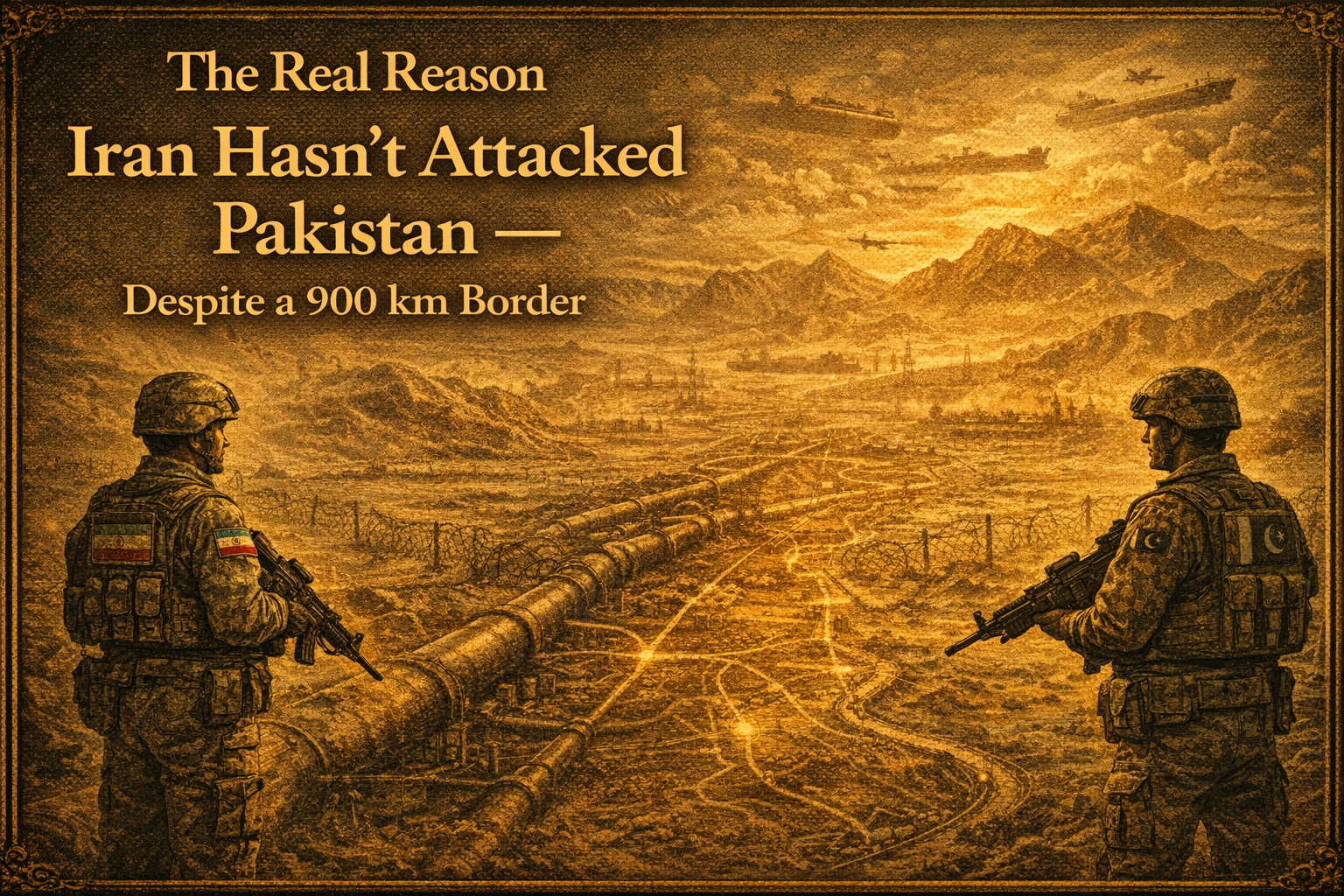
The Real Reason Iran Hasn’t Attacked Pakistan — Despite a 900 km Border
Why the leader who spent 27 years in prison chose reconciliation instead of revenge
It’s not a restraint. Its calculation is shaped by power, risk, and overlapping interests.
Pakistan shares a 900 km border with Iran.
Yet not a single missile has landed there.
That silence isn’t accidental.
It’s the result of layered strategic choices.
Iran has already shown it can strike beyond its borders. Targets linked to Jordan, Syria, and Gulf interests have been hit. Distance clearly isn’t the limitation.
So the question becomes sharper:
Why not Pakistan?
The answer begins with balance.
Pakistan isn’t inactive—it’s carefully positioned. It maintains security ties with Saudi Arabia while parts of its public sentiment lean toward Iran. At the same time, it is managing internal instability.
If Iran were to strike Pakistan, that balance would collapse overnight.
Neutrality would disappear.
Sides would be chosen.
And once that happens, the conflict stops being contained.
Right now, ambiguity works.
For Pakistan. For Iran. For everyone watching.
Then the equation expands—because China is part of it.
The China–Pakistan Economic Corridor (CPEC) is not just infrastructure. It represents over $60 billion of strategic investment running through Pakistan.
Gwadar Port sits roughly 170 km from Iran’s Chabahar Port.
That distance isn’t just geography.
It’s a strategic overlap.
Now look at the dependency chain.
Iran depends heavily on China as a major oil buyer.
China depends on Pakistan for logistics and regional access.
Pakistan anchors CPEC on the ground.
A strike on Pakistan risks disrupting this entire chain.
And once that chain is disrupted, the consequences don’t stay local.
China becomes indirectly exposed.
There’s also a quieter layer—less confirmed, but consistently discussed.
The Balochistan region stretches across both Iran and Pakistan. It’s remote, difficult terrain, with limited state control in parts.
If any discreet movement—logistics, supply, coordination—happens between the two sides, it likely passes through this space.
If that holds true, even partially, Pakistan isn’t just a neighbor.
It becomes a corridor.
And no actor willingly damages a corridor that it may depend on.
Then comes the final constraint—the one that shapes all others.
Pakistan is a nuclear-armed state.
Iran is not.
This changes the nature of risk completely.
A conflict involving a nuclear country isn’t a controlled escalation.
It’s a situation where consequences can spiral faster than they can be managed.
So Iran’s restraint isn’t hesitation.
It’s selection.
This isn’t about avoiding action.
It’s about choosing where action is worth the risk.
At this moment, Pakistan is more than a country on the map.
It functions as a junction—where the interests of China, Gulf states, and Iran intersect.
And when you strike a junction,
you don’t just disrupt one path.
You affect everything connected to it.