Heredity and Evolution — CBSE Class 10: Dominant vs Recessive Traits Explained
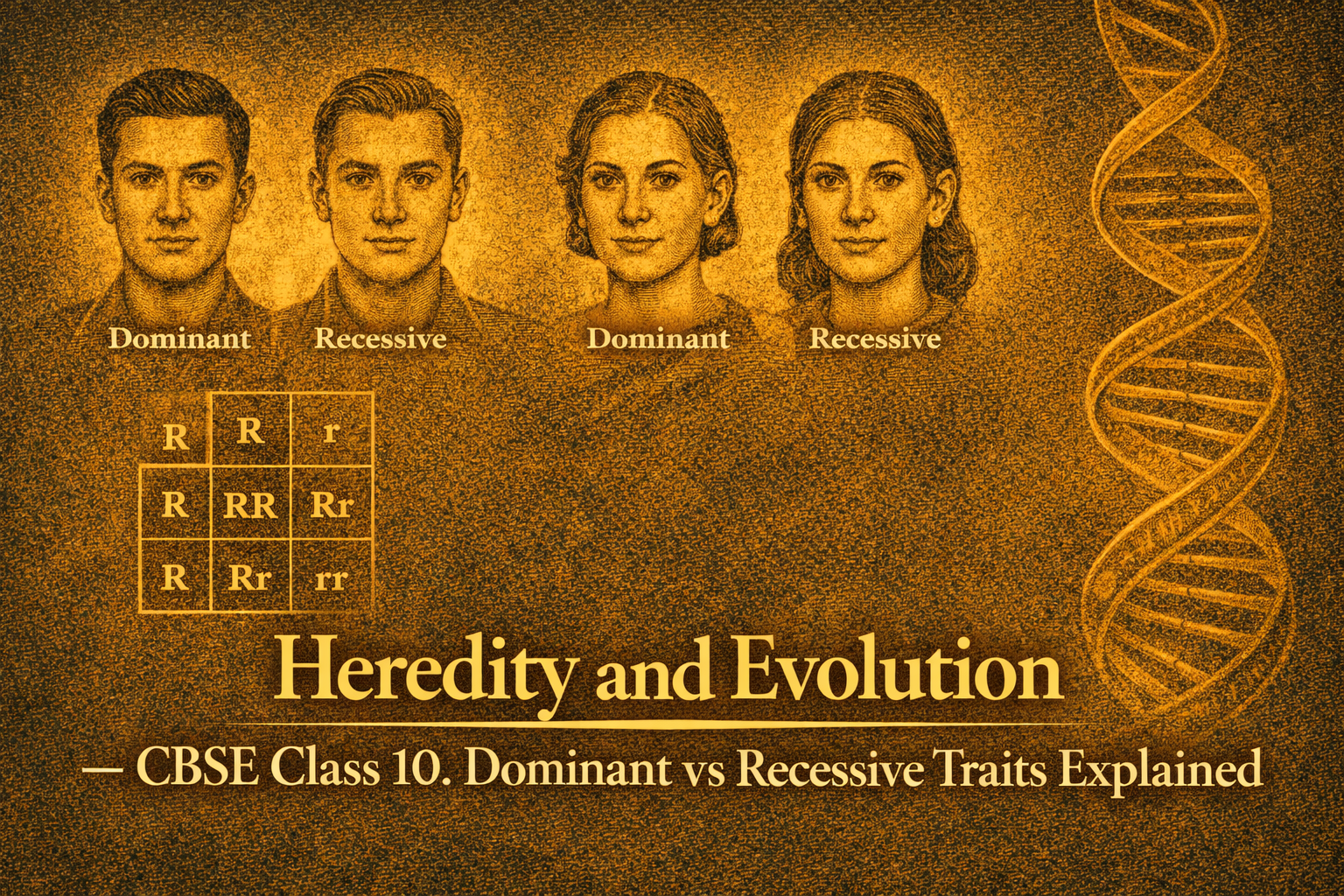
The Punnett Square shows combinations. Dominant and recessive traits explain outcomes. Understand the logic behind inheritance patterns.
By Navya Chandravanshi | Class 10 Science | CBSE
Have You Ever Wondered Why You Look Like One Parent More Than the Other?
In this article, you will learn:
-
What dominant and recessive traits actually mean — and why the names make sense once you understand the logic
-
How the Punnett Square works and what it is actually showing you
-
Why do some traits skip generations and reappear in grandchildren
-
What CBSE Class 10 expects you to write — and what most students get wrong in exams
By the end, you will understand that inheritance is not random.
It follows clear biological rules.
Once you understand those rules, the Punnett Square stops looking like a confusing grid and becomes a simple prediction tool.
A Small Family Mystery
Priya’s grandmother has a dimple on her left cheek.
Priya’s mother does not.
But Priya does.
One day, Priya asked her mother: Where did my dimple come from? You don’t have one.
Her mother smiled and showed her an old photograph of Priya’s grandmother.
Same cheek. Same dimple. Same place.
Priya’s mother had carried something silently — and passed it forward without showing it herself.
Like a letter sealed inside an envelope.
The letter stayed closed in one generation.
It opened the next.
That invisible letter has a scientific name.
And understanding how it travels across generations is exactly what this chapter explains.


What Was Actually Happening
Priya’s mother had inherited instructions from both of her parents.
One instruction said: make a dimple.
Another instruction said: no dimple.
Both instructions existed inside her body.
But only one was followed.
The stronger instruction overrode the weaker one.
So Priya’s mother had no visible dimple, but she still carried the instruction for it.
When Priya was born, she received instructions from both parents.
From her mother came the hidden dimple instruction.
From her father came another copy.
This time, both instructions matched.
So the trait finally appeared.
This pattern explains how traits can skip a generation and then suddenly appear again.
Genes, Alleles, and Traits
Scientists gave these biological instructions a name.
They are called genes.
Genes are units of hereditary information located on chromosomes inside cells.
Each gene comes in two copies — one inherited from each parent.
These two versions are called alleles.
Some alleles dominate others.
-
If an allele shows its effect even when only one copy exists, it is called dominant.
-
If an allele shows its effect only when both copies are the same, it is called recessive.
A dominant trait appears whenever the dominant allele is present.
A recessive trait appears only when both alleles are recessive.
In Priya’s case:
-
The dimple allele is dominant.
-
The no-dimple allele is recessive.
Priya’s mother carried one of each — but only the dominant instruction would normally show.
The recessive instruction remained hidden until the right combination appeared.
How Genetic Inheritance Works
The inheritance of traits follows a predictable sequence.
Step 1 — Every Individual Has Two Alleles
Each person inherits:
-
One allele from the mother
-
One allele from the father
Together they form an allele pair.
Step 2 — Dominant and Recessive Symbols
Scientists represent alleles using letters.
For dimples:
-
D = dominant allele (dimple)
-
d = recessive allele (no dimple)
Step 3 — Homozygous Dominant
If both alleles are dominant (DD):
The individual shows the dominant trait.
This condition is called homozygous dominant.
Step 4 — Heterozygous
If one allele is dominant and the other recessive (Dd):
The dominant allele is expressed.
The recessive allele remains hidden.
This is called heterozygous.
Step 5 — Homozygous Recessive
If both alleles are recessive (dd):
The recessive trait appears.
This condition is called homozygous recessive.
Step 6 — Genotype and Phenotype
Two key terms describe inheritance patterns.
Genotype
The genetic combination of alleles (DD, Dd, dd).
Phenotype
The observable physical trait (dimple or no dimple).
Two people may share the same phenotype but have different genotypes.
The Punnett Square
The Punnett Square is a grid used to predict genetic combinations.
It shows all possible allele combinations from parents.
Example:
Priya’s mother: Dd
Priya’s father: Dd
Possible combinations:
| D (father) | d (father) | |
|---|---|---|
| D (mother) | DD | Dd |
| d (mother) | Dd | dd |
Interpreting the Results
-
DD → Dominant trait
-
Dd → Dominant trait
-
dd → Recessive trait
Outcome:
-
3 individuals show the dominant trait
-
1 individual shows the recessive trait
This produces the famous 3: 1 ratio.
Gregor Mendel observed this ratio during his pea plant experiments in the 1860s.
The Punnett Square simply visualises those combinations.
Important point:
The Punnett Square predicts probabilities, not guaranteed outcomes.
Each child has an independent chance of inheriting each combination.


Real-World Examples of Dominant and Recessive Traits
Tongue Rolling
The ability to roll the tongue is commonly described as a dominant trait.
People who cannot roll their tongue usually carry two recessive alleles.
If both parents are non-rollers, none of their children will be rollers.
Attached Earlobes
Free earlobes are dominant.
Attached earlobes are recessive.
Two parents with free earlobes may have a child with attached earlobes if both parents carry the recessive allele.
Mendel’s Pea Plants
Gregor Mendel crossed:
-
Tall plants (TT)
-
Short plants (tt)
The first generation (F1) all appeared tall.
When these plants reproduced:
The second generation (F2) showed a 3 tall: 1 short ratio.
This observation became the foundation of modern genetics.


Common Mistakes Students Make
One common misunderstanding:
Many students think dominant means common.
This is incorrect.
Dominant only means the trait appears when one copy exists.
A dominant trait may still be rare in a population.
Another mistake:
Students assume that if both parents show a trait, all children must show it.
But if both parents are heterozygous carriers, a recessive trait may appear in their children.
A third mistake:
Students think the Punnett Square predicts exact outcomes.
It does not.
It predicts probability across many offspring, not guaranteed results in one family.
Important Terms for CBSE Exams
Heredity
The transmission of traits from parents to offspring.
Gene
A unit of hereditary information located on a chromosome.
Allele
Different forms of the same gene.
Dominant Allele
Expressed even when only one copy exists.
Recessive Allele
Expressed only when both copies are recessive.
Homozygous
Both alleles are identical.
Heterozygous
Alleles are different.
Genotype
The genetic composition.
Phenotype
The observable trait.
Monohybrid Cross
A genetic cross studying one trait at a time.
Mendel’s Laws
Law of Dominance
When two different alleles are present, the dominant allele expresses itself.
Law of Segregation
The two alleles separate during the formation of gametes.
Each gamete carries only one allele.
Advanced Concepts (Higher Classes)
In reality, genetics can be more complex than simple dominance.
Incomplete Dominance
Neither allele dominates.
Example:
Red flower × White flower → Pink flower.
Codominance
Both alleles express equally.
Example:
Human AB blood group, where both A and B proteins appear on red blood cells.
Polygenic Traits
Some traits are controlled by many genes.
Examples include:
-
Human height
-
Skin colour
-
Intelligence
These traits do not follow simple 3:1 ratios.
The Core Idea in Simple Words
Every physical trait you inherit comes from two gene copies — one from each parent.
If a dominant allele is present, the dominant trait appears.
If both alleles are recessive, the recessive trait appears.
The Punnett Square helps predict the possible combinations of these alleles.
This is the same pattern Gregor Mendel discovered through pea plant experiments.
Practice Questions
-
What is the difference between dominant and recessive traits?
-
Draw a Punnett Square for a cross between Tt and tt plants.
-
How can two parents with free earlobes have a child with attached earlobes?
-
Explain the difference between genotype and phenotype.
-
Why were pea plants suitable for Mendel’s experiments?
Frequently Asked Questions
Can a dominant trait skip a generation?
No. If the dominant allele is present, the trait appears. Recessive traits can skip generations.
Is blood group inheritance simple dominance?
Not completely. Blood groups A and B follow codominance, while O is recessive.
Why did Mendel choose pea plants?
They produce many offspring, grow quickly, and allow controlled cross-pollination.
What do F1 and F2 mean?
F1 refers to the first generation of offspring.
F2 refers to the offspring of the F1 generation.
Is the Punnett Square always accurate?
It accurately predicts probabilities but cannot determine the exact traits of individual children.
Related Topics
-
Evolution and Natural Selection
-
Cell Division and Meiosis
-
DNA and Gene Structure
This article follows the CBSE Class 10 Science syllabus (Chapter 9 — Heredity and Evolution) and aligns with NCERT terminology and genetic principles. The dimple example is used as a simplified illustration; real human genetics can involve multiple interacting genes.
Navya
I write about living systems — from constitutions to chromosomes — uncovering the patterns that make them coherent.
| Platform | Description | Link |
|---|---|---|
| Substack | Newsletter essays and published writing | navyachandravanshi.substack.com |
| Medium | Long-form essays and analytical writing | medium.com/@navyachandravanshi |
| Medium Publication — Judgment Under Pressure | Publication on decision-making and systems thinking | medium.com/judgment-under-pressure |
| Medium Publication — The Honest Confusion | Articles explaining confusing school concepts | medium.com/the-honest-confusion |
| Medium Publication — संरचना | Long-form analytical essays in Hindi | medium.com/sanrachna-official |
| Chandravanshi.org | Author profile and articles | chandravanshi.org/en/author/navyatimes |
| Professional posts and articles | linkedin.com/in/navya-chandravanshi |
|
| Posts, updates, and discussions | facebook.com/TimesNavya |
|
| Short video insights and reels | instagram.com/navya_times |