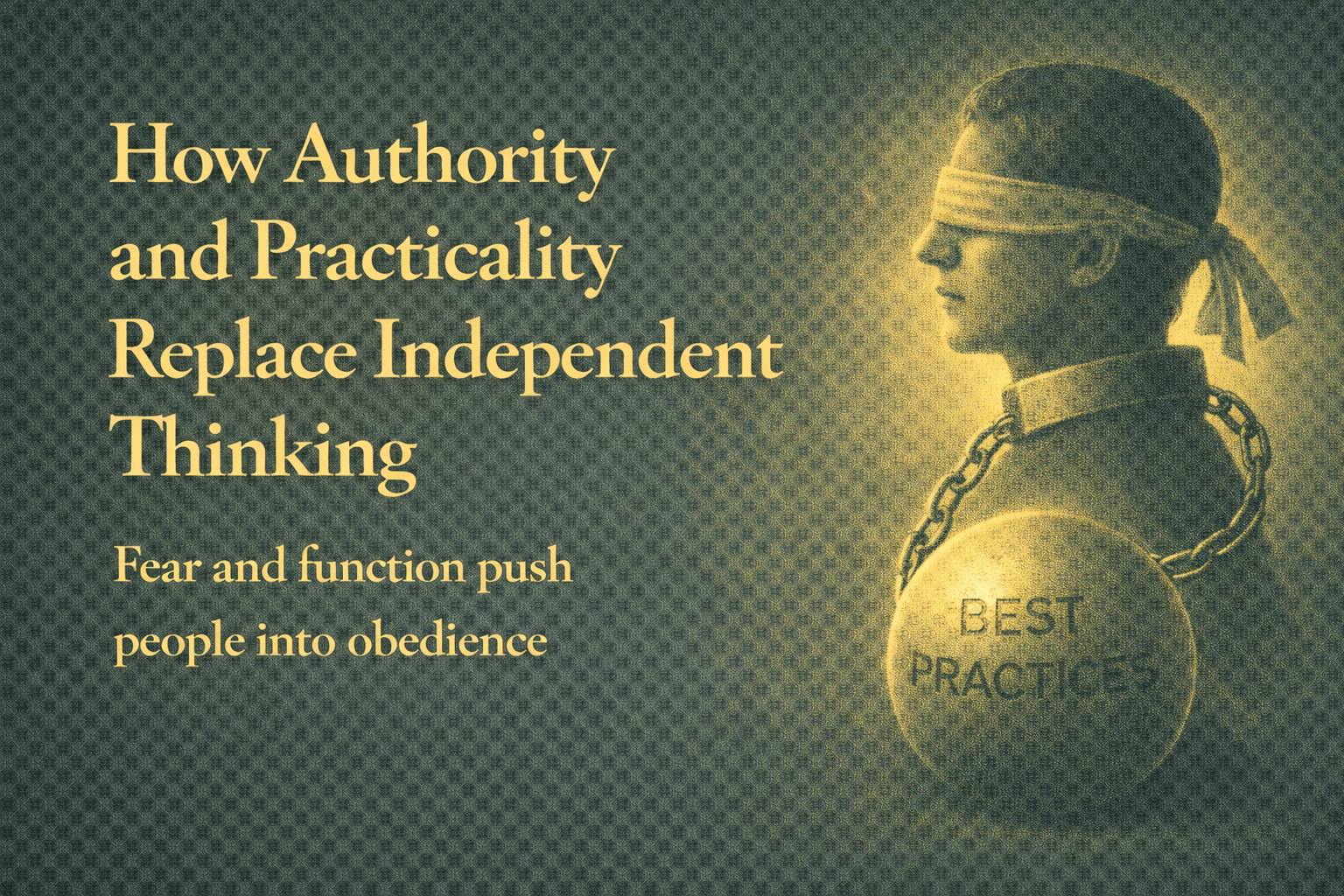
Judgment and Social Influence: How Authority and Practicality Replace Independent Thinking
When people lack enough information to decide confidently, something predictable happens. They look for external anchors—authority figures, accepted norms, or “practical” constraints—that make uncertainty feel manageable.
That’s not a weakness. It’s efficient.
The substitution starts slowly. Independent evaluation gets compressed into deference, practicality, or group alignment. Not through pressure. Through normal, professional behaviour that produces acceptable outcomes.
Most judgment failures don’t announce themselves. They feel mature, responsible, even necessary. Decisions become easier. Agreement arrives faster. Dissent seems unnecessary.
Nothing feels wrong.
This guide explains how authority and practicality replace independent thinking without anyone noticing—and why capable people are often the last to see it happening.
You’ll understand:
- How judgment differs from obedience and conformity
- The three mechanisms that compress independent evaluation
- Why does this survive longest in functioning systems
- When authority stops being useful and becomes dangerous
- What changes when you can see this pattern clearly
By the end, you’ll recognise how judgment erodes in environments that reward alignment over evaluation—and why outcomes can stay acceptable while thinking quietly disappears.
Understanding What Actually Happens to Judgment
People assume judgment fails during crises. When someone panics, gets misled, or faces coercion.
That’s rarely how it works.
Judgment disappears after things start working. After outcomes look fine. After decisions feel settled.
Judgment Means Deciding Under Uncertainty With Personal Risk
Judgment isn’t choosing when the answer is obvious. It’s not following a checklist or applying a procedure someone else designed.
Judgment appears when information is incomplete, outcomes are delayed, and responsibility cannot be fully outsourced.
It requires evaluation and ownership. When judgment is present, someone is silently asking: “If this goes wrong, am I willing to carry it?“
That question does more work than most processes.
Social Influence Works Through Substitution
Social influence isn’t persuasion. Its replacement.
External cues—authority, norms, practicality—take the place of internal evaluation. Nothing is forced. Nothing feels unsafe. The decision still feels like yours.
But the evaluation didn’t originate there.
Social influence works best when it feels reasonable. When deferring to expertise seems smart. When “being realistic” sounds mature. When alignment looks like progress.
Why These Two Interact
Judgment is effortful. Social influence is efficient.
Judgment demands time, friction, and exposure to personal risk. Social influence offers relief. Authority compresses thinking. Practicality shortens debate. Norms reduce individual exposure.
Over time, systems learn something simple: independent evaluation slows coordination.
So it gets replaced. Not by bad actors. By functioning systems.
What This Is Not
This is not manipulation. No one needs to deceive you.
This is not obedience. You can agree freely and still lose judgment.
This is not a weakness. In fact, it often happens faster for competent people who adapt quickly to incentive structures.
This is not a lack of intelligence. Smart people recognise what systems reward—and adjust accordingly.
The erosion is structural, not personal.
The Boundary Most People Miss
Independent thinking does not mean disagreement, rebellion, or being difficult.
Independent thinking means retaining evaluation authority.
You can follow the advice after evaluating it. You can respect expertise without surrendering judgment. You can act practically without replacing thinking.
The boundary isn’t behaviour. It’s ownership.
When evaluation moves outside the decision-maker, judgment thins—even if outcomes stay good, even if everyone agrees. Especially then.
That’s why this survives so long.
Three Mechanisms That Replace Evaluation
Judgment rarely disappears all at once. It gets compressed.
The system doesn’t ask you to stop thinking. It makes thinking unnecessary.
This happens through three mechanisms working together. Each looks reasonable on its own. Together, they replace independent judgment without resistance.
Authority Compresses Evaluation by Design
Authority exists for a reason. Titles, credentials, institutions, and experience store prior judgment so it doesn’t have to be rebuilt every time.
That’s the benefit.
The compression begins when authority stops being a reference and becomes a substitute.
Instead of asking “Does this make sense here, now, under these conditions?” the question quietly shifts to “Who already decided this?“
Deferring feels efficient because it is. It saves time. It reduces exposure. It limits personal risk. Authority shortens the decision path.
But it also moves responsibility upward.
When an outcome is tied to authority, accountability becomes diffused:
-
- “This was approved”
- “This is standard”
- “This comes from the top”
The decision still happens locally. The evaluation does not.
Over time, the habit forms: if someone higher-ranked already evaluated this, re-evaluation feels redundant.
That’s not laziness. That’s adaptation. The system rewards speed and alignment, not duplicate judgment.
Authority doesn’t silence thinking. It makes thinking feel unnecessary.
Practicality Functions as Social Camouflage
Practicality is the most persuasive influence because it sounds neutral.
“Be realistic.” “This is how things work.” “There’s no point overthinking this.”
Practicality doesn’t argue for correctness. It argues for acceptance. It frames disagreement as immaturity, evaluation as delay, and alternatives as naive.
This is why practicality spreads so easily. It carries no ideology, no moral language, no visible pressure. Just inevitability.
Once practicality enters a decision, the frame shifts. The question is no longer “Is this right?” It becomes “Is this workable?”
That sounds reasonable. It often is.
But “workable” has a hidden bias. It rewards compliance with existing systems, not accuracy. If a decision fits current constraints, it’s labelled practical. If it challenges them, it’s labelled unrealistic.
Practicality protects systems from scrutiny. Not because systems are fragile. Because scrutiny slows coordination.
So systems train people to internalise a rule: good judgment is judgment that doesn’t create friction.
That rule feels mature, professional, and responsible.
It’s also where independent evaluation quietly exits.
Signal Lag Hides the Cost
If this produced immediate failure, it wouldn’t last.
The reason judgment erosion survives is delay. Most substituted judgments don’t fail quickly. They produce acceptable outcomes. Sometimes even good ones.
Authority-based decisions often work because authority is usually competent. Practical decisions often work because systems are designed to absorb error.
This creates signal lag.
The cost of lost judgment doesn’t show up as a disaster. It shows up as narrower options, late corrections, fewer dissent signals, and reduced sensitivity to weak information.
Nothing breaks. Something thins.
Because outcomes remain stable, the system concludes: “This is working.”
The absence of visible failure reinforces the substitution. By the time errors appear, they look situational, context-specific, and unpredictable. Rarely structural.
So the response is adjustment, not re-evaluation. More process. More alignment. More authority.
The system tightens in response to its own blind spots.
How These Three Lock Together
Authority and practicality don’t operate separately. They form a loop.
Authority validates practicality: “If leadership agrees, this must be realistic.“
Practicality protects authority: “If this works in the real world, the authority must be right.“
Signal lag seals the loop: “If nothing failed, there’s nothing to question.”
Each component reduces the need for judgment. Each makes the reduction feel earned.
Over time, evaluation migrates away from the decision-maker. Not by force. By design.
People still decide. They just don’t evaluate.
And because the system keeps functioning, no alarm sounds.
Why This Feels Like Progress
This substitution doesn’t feel like a loss. It feels like maturity.
Decisions get faster. Alignment improves. Disagreement decreases. The environment feels calmer, more professional, more controlled.
That’s why capable people adapt quickly. They recognise the reward structure. Judgment that slows things down gets filtered out. Judgment that confirms the existing direction gets reinforced.
Eventually, judgment becomes decorative. Referenced. Acknowledged. Rarely exercised.
At the end of this process, nothing dramatic happens. People aren’t coerced. They aren’t confused. They aren’t passive.
They’re efficient.
But efficiency has replaced evaluation. And evaluation is what judgment was.
Where This Pattern Shows Up and Why It Matters
Judgment erosion doesn’t announce itself. It changes outcomes quietly.
Things still function. Decisions still get made. Life keeps moving.
That’s why this matters across domains where consequences are real but delayed.
In Organisations and Work Environments
Most organisational failures don’t start with bad decisions. They start with unchallenged ones.
Meetings end faster. Consensus forms early. Disagreement moves offline—or disappears entirely.
This looks healthy. Alignment feels like progress. Speed feels like competence.
But a consensus reached too quickly is often a consensus reached before evaluation.
Promotion-safe thinking emerges next. People learn which judgments are acceptable to express, not which judgments are accurate.
Questions become narrower. Options get filtered earlier. Risk moves from decisions to careers.
Late disagreement becomes the pattern. Concerns surface after execution. Doubts appear post-mortem. Everyone “saw it coming,” but no one said it early.
Not because people didn’t notice. Because noticing didn’t feel worth the cost.
Judgment didn’t fail. It adapted to incentives.
In Family and Social Relationships
Social erosion is harder to name because it’s framed as care.
Advice arrives wrapped in concern:
-
- “Be practical”
- “Don’t complicate things”
- “This is just how life works”
Traditions reinforce the frame. They don’t argue correctness. They argue for stability.
Dissent here doesn’t feel risky. It feels hurtful. Questioning advice becomes questioning love. Resisting norms becomes disrespect.
Independent evaluation carries emotional cost. So judgment yields quietly. Not to authority. To harmony.
Over time, people internalise a rule: good decisions are decisions that don’t disturb relationships.
This isn’t manipulation. It’s mutual preservation.
But the trade-off is subtle. Evaluation shifts outward. Personal judgment thins. Choices feel inherited, not chosen.
Nothing breaks. The agency just narrows.
In Public Discourse and Institutions
Public judgment erosion operates at scale.
Experts simplify. Institutions standardise. “Common sense” fills the gaps.
This is necessary. Complex systems require compression.
The problem begins when explanation replaces evaluation. Narratives become moralised:
-
- Responsible people agree
- Serious people accept constraints
- Questioning sounds reckless
Practicality becomes a virtue. Doubt becomes immaturity.
Public discourse rewards certainty framed as realism—not accuracy, not adaptability.
When narratives dominate, disagreement looks ideological even when it’s analytical.
People don’t stop thinking. They stop evaluating publicly. Judgment migrates to institutions. Responsibility diffuses.
And because systems still function, the erosion remains invisible.
The Shared Pattern Across All Three
In all three domains, the pattern is identical.
Judgment is not removed. It is replaced.
-
- Replaced by consensus at work
- Replaced by care in families
- Replaced by narratives in public life
Each replacement feels reasonable. Each reduces friction. Each carries a delayed cost.
The danger isn’t error. It’s atrophy.
When judgment isn’t exercised, it doesn’t disappear—it loses range. People become less sensitive to weak signals, less comfortable with uncertainty, and more dependent on external validation.
Outcomes stay stable until conditions change. That’s when the absence becomes visible.
What Most People Miss About This
Most people personalise this loss. They assume:
-
- “I wasn’t confident enough”
- “I should have spoken up”
- “I made the wrong call”
That framing is incomplete.
The loss is structural, not personal. Systems reward compliance. Relationships reward harmony. Narratives reward certainty.
Judgment erodes not because people fail—but because functioning systems make independent evaluation feel unnecessary.
By the time someone notices what’s missing, the system has already adjusted to life without it.
That’s why understanding this matters. Not to fix people. But to see what’s actually happening—before judgment quietly stops being part of the process at all.
Where Authority and Practicality Break Down
Authority and practicality aren’t flaws. They’re tools.
They exist because judgment is costly and error-prone. Most systems couldn’t function without some compression.
That’s why it matters to be precise about where these tools fail—not to reject them, but to understand their limits.
Where Authority Functions Well
There are domains where deferring judgment is rational.
High-skill environments rely on accumulated expertise: medicine, engineering, aviation, and specialised science. Re-evaluating fundamentals every time would be dangerous. Authority here prevents amateur interference.
Time-critical situations are similar. When seconds matter, evaluation must already be done. Protocols replace deliberation. Judgment happens upstream.
In these contexts, authority and practicality preserve safety.
The failure doesn’t come from using them. It comes from using them outside their design range.
When Novel Conditions Make Authority Obsolete
Authority is backwards-looking by nature. It encodes past success.
Novel conditions break that contract.
When context shifts faster than expertise updates—new technologies, new incentives, new constraints—authority still speaks with confidence. But its reference point is outdated.
Practicality worsens this:
-
- “This has worked before”
- “This is the proven way”
- “This is what everyone does”
Those statements feel stabilising. They’re also signals that the environment has changed faster than the model.
The system keeps applying yesterday’s compression to today’s uncertainty. Nothing fails immediately, which is why this persists.
When Value-Based Decisions Get Disguised as Technical Ones
Authority and practicality work best when goals are shared and measurable.
They struggle when values are involved—decisions about trade-offs, long-term direction, or what should matter.
Here, deferring judgment doesn’t remove conflict. It hides it.
Practicality reframes value disagreements as feasibility problems. Authority reframes them as settled.
“What’s realistic” replaces “what matters.”
The system moves forward. But the decision-maker’s values never entered the evaluation.
Outcomes may succeed technically. They can still feel wrong.
That discomfort isn’t confusion. It’s misalignment.
When Irreversible Stakes Demand Evaluation
Some decisions cannot be corrected. Career paths. Reputational commitments. Long-term dependencies. Structural choices.
Authority performs well when reversibility exists—when mistakes can be patched.
In irreversible contexts, compression is dangerous. Practicality pushes early commitment. Authority legitimises it. And signal lag hides the cost.
By the time consequences surface, adjustment is no longer possible.
These are the cases where judgment matters most—and is most likely to be absent.
Observable Signals at the Boundary
No checklists. No instructions. Just observable signals.
Pay attention when an authority speaks confidently about unfamiliar terrain. When practicality dismisses questions as “overthinking.” When alignment increases while optionality shrinks.
When disagreement appears only after outcomes. When decisions feel easier as the stakes grow larger.
None of these guarantees error. They indicate boundary conditions. They signal that compression is being applied where evaluation belongs.
How Judgment Differs from Related Behaviours
Judgment is often confused with nearby behaviours. They look similar on the surface. They produce different outcomes over time.
Clarifying these differences matters because people don’t choose conformity or optimisation. They slide into them while believing they’re exercising judgment.
Judgment Versus Conformity
Judgment evaluates before aligning. Conformity aligns without evaluation.
Conformity isn’t agreement. It’s synchronisation. The decision feels settled because it matches the group, not because it was independently assessed.
Judgment can still lead to alignment. But alignment is the result, not the input.
Conformity reduces friction, accelerates coordination, and protects social standing. Judgment slows things down, introduces uncertainty, and increases personal exposure.
That’s why conformity spreads faster in stable systems. It’s efficient when conditions don’t change.
Judgment carries a higher short-term cost. It earns its value when conditions shift.
Conformity dominates when stability is rewarded, dissent is costly, and outcomes are delayed. Judgment dominates when context is changing, signals are weak, and responsibility cannot be fully outsourced.
Neither is moral. They respond to different environments.
Judgment Versus Obedience
Obedience follows instruction. Judgment evaluates instruction.
Obedience requires clarity. Judgment operates without it. Obedience transfers responsibility upward. Judgment retains it locally.
This distinction matters because many people obey voluntarily while believing they’re deciding.
Obedience simplifies accountability. If something goes wrong, the chain of command absorbs blame. Judgment isolates responsibility. Success and failure attach to the decision-maker.
Systems favour obedience because it’s legible. Judgment is harder to audit.
Obedience dominates in hierarchical environments, regulated systems, and time-compressed execution. Judgment dominates when instructions are incomplete, trade-offs are ambiguous, and outcomes are irreversible.
Obedience keeps systems running. Judgment keeps them adaptive.
Judgment Versus Optimisation
Optimisation improves within a model. Judgment questions the model itself.
Optimisation assumes the goal is correct. Judgment asks whether the goal still fits the environment.
Optimisation answers “how.” Judgment answers “whether.”
Optimisation delivers efficiency, produces measurable gains, and rewards technical skill. Judgment introduces a pause, resists premature precision, and tolerates inefficiency.
That makes judgment look unproductive—until the model stops matching reality.
Optimisation dominates when variables are known, feedback is fast, and reversibility exists. Judgment dominates when models are incomplete, feedback is delayed, and errors compound silently.
Optimisation accelerates systems. Judgment protects them from their own success.
Which Framework Applies When
These frameworks aren’t competitors. They’re situational tools.
Conformity coordinates groups. Obedience executes decisions. Optimisation refines systems.
Judgment is different. It’s what you need before alignment, before execution, before improvement.
Most failures don’t come from choosing the wrong framework. They come from applying a framework beyond its range.
When conformity substitutes evaluation, judgment thins. When obedience replaces ownership, judgment disappears. When optimisation accelerates a flawed model, judgment arrives too late.
Nothing looks wrong at first. Everything looks professional.
That’s why comparison matters. Not to choose better behaviour—but to recognise which frame is currently making decisions for you.
Three Common Misunderstandings That Make This Invisible
Most misunderstandings about judgment aren’t naive. They’re reasonable conclusions drawn from incomplete models.
That’s why they persist.
“Independent Thinking Means Rejecting Authority”
People often frame authority and judgment as opposites. One speaks. The other listens.
Popular narratives reward defiance. They associate independence with resistance.
So people assume: if you respect authority, you’ve surrendered judgment.
Why this is misleading:
Rejecting authority doesn’t restore judgment. It often replaces one shortcut with another. Automatic scepticism is still automatic. Authority becomes the reference point, even in rejection.
The evaluation is reactive, not independent. That’s not judgment. That’s inversion.
What’s actually true:
Judgment doesn’t oppose authority. It evaluates it.
You can accept expert input without outsourcing evaluation. You can defer execution without deferring responsibility.
Judgment disappears only when authority replaces evaluation—not when authority exists.
“Practicality Equals Realism”
Practicality sounds grounded, experienced, and mature. “Realistic” decisions often survive scrutiny because they align with constraints.
So practicality becomes shorthand for truth.
Why this is misleading:
Practicality optimises for fit, not accuracy.
It asks: “Will this work within the current system?”
It does not ask: “Is the system itself correct?”
That distinction matters. Many incorrect decisions are highly practical. They respect constraints that no longer deserve respect.
What’s actually true:
Practicality is a filter, not a verdict. It’s useful once the evaluation is complete. It’s dangerous when it replaces evaluation.
Realism requires understanding the environment. Practicality often assumes it.
“Smart People Resist Influence”
Intelligence is associated with independence. Competence is associated with confidence.
So influence is framed as something that happens to others—less informed people, less capable people, less careful people.
Why this is misleading:
Smart people adapt faster. They recognise incentives earlier. They learn which judgments are rewarded. They internalise constraints efficiently.
That makes them more responsive to social signals—not less.
Competence accelerates conformity when systems reward alignment.
What’s actually true:
Influence isn’t about intelligence. It’s about exposure.
The more embedded someone is in a system, the more pressure they face to compress judgment.
Smart people don’t resist influence. They optimise within it.
That’s why erosion often starts at the top.
Why These Misunderstandings Survive
These misunderstandings aren’t personal failures. They’re structural outcomes.
Systems reward deference framed as professionalism, practicality framed as maturity, and alignment framed as competence.
Narratives reinforce them. Incentives lock them in. Outcomes lag behind decisions.
So people keep using the wrong models—not because they’re careless, but because the system confirms them.
Judgment erosion isn’t misunderstood by accident. It’s misunderstood because clearer explanations would expose how much thinking has already been replaced.
And that’s rarely comfortable to notice.
What This Changes About Interpretation
This isn’t a method. It’s a filter.
Not something to follow. Something that quietly alters what you notice.
The goal isn’t better behaviour. It’sa clearer interpretation.
When to Pay Attention
Judgment erosion rarely announces itself through failure. It shows up through ease.
Pay attention when decisions feel lighter than expected. When uncertainty seems to vanish early. When agreement arrives before exploration.
These moments aren’t dangerous by default. They’re informative. They signal that evaluation may have been compressed—that someone or something has already decided.
Pay attention when responsibility feels shared, but ownership feels vague. When outcomes are discussed collectively, but accountability is difficult to locate.
That diffusion isn’t accidental. It’s a sign that judgment has been distributed upward or outward.
What to Distrust
Distrust clarity that arrives too fast. Fast clarity often means the frame was inherited. Authority, precedent, or practicality may have closed the question early.
Distrust decisions that feel mature primarily because they reduce friction. When the main justification is “This avoids problems“, “This keeps things smooth“, or “This is how it’s usually done,” those signals don’t indicate correctness. They indicate fit.
Distrust confidence that grows as options shrink. When fewer alternatives are discussed, certainty tends to rise. That inversion is structural, not accidental.
What Subtly Shifts in Decisions
Once this filter is active, nothing dramatic changes.
Decisions still get made. Systems still function. Alignment still matters.
What changes is the interpretation layer.
The agreement stops being proof of correctness. Efficiency stops being proof of sound judgment. Professionalism stops being proof of evaluation.
The absence of conflict becomes a signal, not a comfort. Smooth execution becomes a question, not a confirmation.
You begin to notice where the evaluation moved—not who decided, but where deciding happened.
This doesn’t produce better outcomes immediately. It produces awareness of substitution.
Judgment doesn’t reappear automatically. It becomes visible.
And visibility is the point.
Because judgment erosion isn’t caused by bad intentions. It’s caused by systems that work well enough to make an independent evaluation feel unnecessary.
This filter doesn’t tell you what to do. It tells you when something important may no longer be happening.
That’s often enough.
Common Questions About Judgment and Social Influence
What is independent judgment?
Independent judgment is the ability to evaluate a decision under uncertainty while retaining personal responsibility for the outcome.
It doesn’t mean deciding alone. It means not outsourcing evaluation.
You can consult experts, follow norms, or accept constraints—and still exercise judgment. Judgment disappears only when the evaluation itself is transferred elsewhere.
How does authority influence decisions?
Authority influences decisions by compressing thinking. It replaces local evaluation with stored conclusions.
This is often efficient and rational. The risk appears when authority stops being a reference and becomes a substitute—when “who decided” replaces “does this still fit.”
Why does practicality feel safe?
Practicality feels safe because it aligns decisions with existing constraints. It reduces friction, exposure, and social cost.
That safety is real. The trade-off is that practicality optimises for fit within the system, not for whether the system still deserves to be fitted.
Is social influence always bad?
No. Social influence is how groups coordinate. Shared norms, authority, and practicality allow systems to scale.
The problem isn’t influence—it’s unnoticed substitution, where influence replaces evaluation instead of informing it.
How do you know when judgment is eroding?
Judgment erosion rarely shows up as failure. It shows up as easy.
Decisions feel obvious early. Disagreement disappears before the evaluation finishes. Responsibility becomes diffuse while confidence rises.
These are signals of compression, not proof of error.
Does expertise eliminate this problem?
No. Expertise often accelerates it.
Experts adapt faster to incentive structures. They learn which judgments are rewarded and which create friction.
That doesn’t make experts careless. It makes them efficient inside systems that quietly discourage independent evaluation.
How does this show up at work?
It shows up as early consensus, promotion-safe thinking, and late disagreement.
Concerns surface after execution, not before. Meetings end quickly. Decisions look aligned. Outcomes age poorly without obvious mistakes.
Judgment didn’t fail—it was filtered out by incentives.
What’s the difference between influence and coercion?
Coercion removes choice through force or threat. Influence preserves choice while shaping evaluation.
Most judgment erosion happens through influence, not coercion. That’s why it feels voluntary, reasonable, and difficult to detect.
Is independent thinking the same as disagreement?
No. Independent thinking can lead to agreement. The difference is sequence.
Judgment evaluates first, then aligns. Conformity aligns first, then rationalises.
The outcome may look identical. The process is not.
Why don’t smart people notice this happening?
Because the system keeps working. Outcomes remain acceptable. Nothing breaks immediately.
Smart people trust functioning systems. By the time erosion becomes visible, the structure has already adapted to life without judgment.
Can judgment erosion be reversed?
Judgment erosion isn’t a switch. It’s a gradual loss of range.
Visibility comes before recovery. Noticing where evaluation moved matters more than forcing it back.
Most people don’t lose judgment by making obvious mistakes. They lose it by being reasonable for too long.
Related Articles
These guides explore adjacent failures of judgment from different angles. Each examines a specific substitution that feels productive—until it isn’t.
- Consensus vs. Alignment—This piece separates agreement from evaluation and shows how teams often mistake early consensus for shared understanding.
- Clean Metrics and Dirty Judgment—Examines how dashboards, KPIs, and “objective” numbers can hide deteriorating decision quality while increasing confidence.
- Pattern Recognition Failure—Explores how repeated success turns insight into overreach and why knowing when to stop trusting a pattern matters more than spotting it early.
- Decision-Making Under Pressure—Maps how pressure reshapes evaluation, why shortcuts feel necessary, and how irreversible decisions expose the cost of delayed thinking.
Final Perspective
Judgment and social influence explain how independent thinking erodes without force, fear, or obvious error.
Nothing has to go wrong. Systems can function. Outcomes can look acceptable. That’s what makes the loss durable.
Authority compresses evaluation. Practicality rewards fit over accuracy. Social signals reduce exposure.
Each substitution feels reasonable. Each reduces friction. Together, they make judgment optional.
Understanding this doesn’t make decisions easier. It doesn’t offer better tactics or safer choices.
It clarifies where thinking silently exists—not who failed, not what went wrong.
Judgment rarely disappears duringa crisis. It thins during normalcy. When the agreement arrives early. When clarity feels earned. When responsibility is shared but never owned.
Most people don’t lose judgment by being wrong. They lose it by being reasonable for too long.
