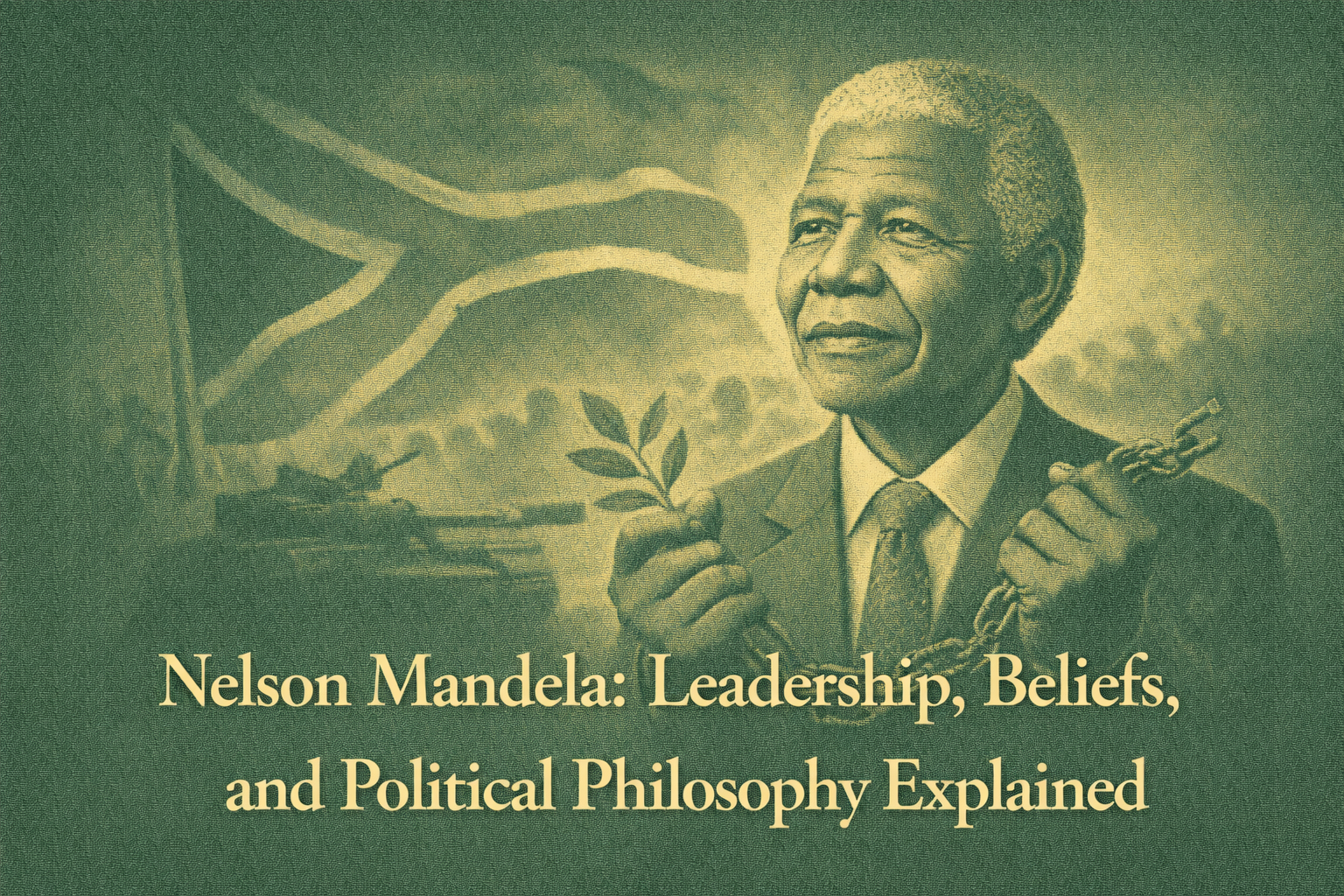
Nelson Mandela: Leadership, Beliefs, and Political Philosophy Explained
Nelson Mandela stands as one of the twentieth century’s most significant political figures. His leadership spanned decades of anti-apartheid resistance, 27 years of imprisonment, and a presidency that sought reconciliation over revenge.
This guide examines:
- Mandela’s core political beliefs and how they evolved
- His leadership approach under extreme pressure
- The philosophical framework that shaped his decisions
- Where his methods succeeded and where they faced limits
- Common misunderstandings about his political strategy
By the end, you’ll understand the system of thought that guided Mandela’s actions, not just the outcomes those actions produced.
Understanding Mandela’s Political Foundation
Nelson Mandela’s political philosophy developed through direct confrontation with apartheid’s legal structure. He didn’t begin as a radical. His early political involvement centred on constitutional reform within existing legal frameworks.
The African National Congress (ANC), which Mandela joined in 1944, initially pursued change through petitions, strikes, and passive resistance. Mandela helped establish the ANC Youth League, pushing the organisation toward more assertive action while maintaining nonviolent methods.
This approach reflected two beliefs: that moral authority mattered in political struggle, and that international pressure could force systemic change. Both assumptions were tested when the South African government banned the ANC and arrested thousands of peaceful protesters.
The Sharpeville Massacre in 1960—where police killed 69 unarmed demonstrators—marked the boundary where Mandela’s initial strategy stopped working. The government’s response to nonviolence was escalating violence. This created a decision point that would define Mandela’s leadership for the next three decades.
The Mechanics of Mandela’s Leadership Philosophy
Mandela’s leadership operated through several interconnected principles that remained consistent even as tactics shifted.
Collective Decision-Making Under Constraint
Mandela rarely acted alone. Even when he became the public face of resistance, decisions flowed through collective structures. The ANC operated through consensus where possible, majority vote where necessary. This wasn’t idealism—it was a survival strategy.
Collective leadership meant the movement could continue when key figures were arrested. It distributes risk. It also meant Mandela’s personal beliefs were constantly tested against others’ perspectives, which prevented isolation and maintained connection to ground-level realities.
Strategic Flexibility Within Fixed Goals
The goal never changed: end apartheid and establish universal suffrage. The methods are adapted to conditions.
When peaceful protest was met with violence, Mandela co-founded Umkhonto we Sizwe (MK), the ANC’s armed wing. This wasn’t abandonment of principle—it was recognition that nonviolence as a strategy requires both parties to accept its terms. When one party responds to peaceful action with lethal force, continuing peaceful action becomes suicide, not principle.
MK’s initial operations focused on sabotage of government property, deliberately avoiding casualties. This preserved moral distinction while demonstrating capacity for escalation. The strategy accepted that armed resistance would bring harsher repression, but calculated that continued passivity would bring the same outcome with less leverage.
Authority Through Sacrifice, Not Position
Mandela’s authority within the movement came from demonstrated commitment, not just organisational title. Twenty-seven years in prison—18 on Robben Island—established credibility that couldn’t be manufactured through rhetoric.
This created a dynamic where Mandela’s endorsement of negotiation carried weight precisely because he’d paid the highest personal cost for resistance. When he argued for compromise with former enemies, others could disagree, but couldn’t question his dedication to the cause.
Prison also removed Mandela from day-to-day tactical decisions while preserving his symbolic importance. This separation allowed him to embodya long-term vision while others managed immediate crises. Upon release, he returned not as someone disconnected from struggle, but as someone who’d endured its most severe consequences.
Reconciliation as Strategic Necessity
Mandela’s emphasis on reconciliation after apartheid’s end is often portrayed as moral generosity. The reality was more complex.
South Africa faced civil war as a genuine possibility. The white minority controlled the military apparatus, technical infrastructure, and economic capital. The black majority had numbers and moral legitimacy but limited institutional power. Full-scale conflict would devastate the country regardless of the victor.
Reconciliation wasn’t forgiveness without accountability. The Truth and Reconciliation Commission created space for the acknowledgement of crimes while avoiding the instability that mass prosecutions or purges would trigger. This balances competing imperatives: justice for victims, stability for transition, and prevention of revenge cycles.
The strategy worked not because all parties embraced reconciliation ideologically, but because it offered each faction an acceptable path forward. Former apartheid officials avoided prosecution in exchange for truth-telling. Victims received acknowledgement and limited compensation. International observers provided legitimacy to the process.
Mandela’s Political Philosophy in Practice
Mandela’s political thinking revealed itself most clearly during specific decision points where abstract principles met concrete circumstances.
In Anti-Apartheid Resistance
During the Rivonia Trial in 1964, Mandela faced death penalty charges for sabotage and conspiracy. His courtroom statement became a defining political document.
Instead of mounting a legal defence that might save his life, Mandela used the platform to articulate the moral case against apartheid. He accepted that armed resistance violated South African law while arguing that apartheid’s existence made obedience to law morally untenable.
This wasn’t courtroom strategy in conventional terms. Mandela calculated that his execution would generate more international pressure than his acquittal. The statement forced the regime to either martyr him or validate his arguments through clemency. They chose life imprisonment, which kept him alive while confirming the regime’s moral weakness.
In Prison Negotiations
Through the 1980s, Mandela initiated secret talks with government officials while still imprisoned. This occurred without full ANC approval and risked accusations of selling out.
Mandela understood that the apartheid government was facing multiple pressure points: international sanctions, internal resistance, and economic decline. But he also recognised that a government cornered without exit options becomes more dangerous, not less.
The talks created pathways for the regime to negotiate the surrender of power without total humiliation. This made the transition possible. Had Mandela waited for the ANC’s approval structure to authorise negotiations, the opportunity might have closed.
In Presidential Governance
Mandela served one five-year term as president, then stepped down despite widespread support for continuation. This established a precedent for peaceful power transition in a region where leaders typically remained until death or coup.
The decision reflected understanding that democratic norms require demonstration, not declaration. Mandela’s voluntary departure made it harder for successors to justify an extended rule. It also prevented the personalisation of power that undermines institutional stability.
During his presidency, Mandela maintained the Government of National Unity, including members of the former apartheid regime in cabinet positions. This preserved technical expertise while signaling that competence mattered alongside political loyalty. The approach prevented the institutional collapse that followed rapid purges in other post-colonial transitions.
When Mandela’s Approach Reached Its Limits
Mandela’s leadership philosophy succeeded in specific contexts but encountered boundaries that revealed its structural constraints.
Economic Transformation
Political liberation didn’t translate to economic equality. Mandela’s government adopted growth-oriented policies that maintained existing economic structures while expanding access. This prevented immediate capital flight but left wealth concentration largely unchanged.
The limitation wasn’t a strategic failure—it reflected real constraints. Rapid wealth redistribution would likely trigger an economic crisis and capital exodus. But gradual reform meant liberation didn’t immediately improve material conditions for most black South Africans.
Mandela’s approach prioritised political stability over economic revolution. This choice made a peaceful transition possible but deferred economic justice. Whether alternative paths existed remains debated, but the trade-off was deliberate, not accidental.
Institutional Corruption
The ANC’s transformation from liberation movement to governing party created incentives for corruption that Mandela’s moral authority couldn’t permanently counter. Patronage networks developed that Mandela couldn’t dismantle without fracturing the coalition that made governance possible.
This revealed a limitation of leadership based on personal credibility: it doesn’t automatically transfer to institutional integrity. Mandela could model ethical governance, but couldn’t build systems that enforced it after his departure.
Regional Influence
Mandela’s reconciliation model worked within South Africa’s specific power balance. Attempts to apply similar approaches to other African conflicts—such as Burundi and the Democratic Republic of Congo—produced limited results.
The limitation wasn’t philosophical inconsistency. It was that Mandela’s South African strategy succeeded because specific conditions aligned: military stalemate, economic pressure, international attention, and contained geography. Without those factors, reconciliation as a political strategy loses leverage.
What People Misunderstand About Mandela’s Politics
Several common interpretations of Mandela’s political philosophy misread what actually drove his decisions.
Misconception: Mandela Chose Nonviolence on Moral Grounds
Why people think this: Early resistance was nonviolent, and Mandela emphasised peace after release.
Why it’s misleading: Mandela chose nonviolence when it offered a strategic advantage and abandoned it when circumstances changed. His commitment was to liberation, not to nonviolence as an absolute principle.
What’s actually true: Mandela’s approach was consequentialist. Methods changed based on what produced results. The formation of MK demonstrated a willingness to use violence when nonviolence proved ineffective. Post-prison emphasis on peace reflected new political conditions, not abandonment of earlier position.
Misconception: Reconciliation Meant Forgiveness Without Justice
Why people think this: The Truth and Reconciliation Commission granted amnesty to perpetrators of apartheid-era crimes.
Why it’s misleading: Amnesty was conditional on full disclosure. The process prioritised truth-telling over prosecution, but it wasn’t blanket forgiveness.
What’s actually true: The TRC represented a compromise between competing imperatives: victims’ need for acknowledgement, perpetrators’ fear of prosecution, and society’s need for stability. It satisfied none fully but made transition possible. Mandela understood that perfect justice might prevent any justice.
Misconception: Mandela’s Authority Came from Suffering Alone
Why people think this: Twenty-seven years in prison created his global stature.
Why it’s misleading: Prison time mattered, but Mandela’s authority derived from demonstrated judgment before imprisonment, maintained relevance during confinement, and strategic action after release.
What’s actually true: Suffering without strategic capacity generates sympathy, not political authority. Mandela’s imprisonment elevated existing credibility from organising work in the 1950s. His prison writings and negotiations maintained political relevance. Upon release, his decisions—not his past—determined continued authority.
Misconception: Mandela’s Success Proves Moral Leadership Always Wins
Why people think this: Apartheid fell, Mandela became president, and civil war was avoided.
Why it’s misleading: Mandela’s success required specific structural conditions: economic pressure on the regime, international isolation, military stalemate, and constrained geography. Moral authority alone doesn’t overcome unfavourable power dynamics.
What’s actually true: Mandela succeeded because moral positioning aligned with practical leverage. The international anti-apartheid movement created economic costs for continued oppression. Domestic resistance made governance increasingly expensive. Mandela’s moral authority gave the regime a face-saving exit, but they accepted that exit because continuing apartheid was becoming unsustainable.
Interpreting Mandela’s Leadership Approach
Mandela’s political philosophy provides a framework for understanding how leadership operates under extreme constraint, not a formula for replication.
What to Watch For
Leadership through demonstrated sacrifice carries authority that rhetoric alone cannot generate. When leaders claim alignment with a cause while avoiding its costs, credibility erodes. Mandela’s willingness to face the death penalty, endure decades of imprisonment, and risk assassination during the transition established that his commitments were genuine.
This creates a standard for evaluating political leadership: do leaders accept comparable risks to those they ask others to take?
When to Distrust Simple Narratives
Mandela’s story is often simplified into a moral fable: a good man defeats an evil system through patience and forgiveness. This version makes the outcome seem inevitable and the path straightforward.
The reality involved calculated risk, strategic violence, behind-the-scenes negotiation, and compromise that disappointed some supporters. Understanding Mandela requires acknowledging these complexities, not erasing them.
How This Reframes Political Judgment
Mandela’s approach demonstrates that principled leadership doesn’t mean inflexible adherence to abstract ideals. It means maintaining core objectives while adapting methods to circumstances.
This creates a different evaluation framework: judge leaders not by consistency of tactics but by whether changing tactics served unchanged goals or whether shifting methods reflected abandoned principles.
The distinction matters because political conditions change constantly. Leaders who cannot adapt tactics become ineffective. Leaders who change principles with each tactical shift become unreliable. Mandela maintained a distinction between an adaptable strategy and a fixed purpose.
Common Questions About Mandela’s Political Philosophy
What motivated Mandela to pursue political activism?
Mandela’s activism emerged from direct experience with apartheid’s legal racism and exposure to older ANC leaders during university years. His autobiography describes specific incidents—being evicted from housing, witnessing police violence, experiencing daily indignities of racial classification—that crystallised intellectual opposition into active resistance.
How did Mandela’s political beliefs change over time?
Mandela moved from early nationalism focused on African rights to broader non-racialism that included all South Africans regardless of race. This shift occurred gradually through 1950s multiracial organising, contact with Communist Party members, and recognition that racial solidarity alone couldn’t sustain the liberation movement. Prison exposure to diverse political prisoners further broadened his perspective.
Was Mandela a socialist?
Mandela’s political economy evolved. Early ANC Youth League positions were African nationalist. Through the 1950s, he developed sympathy for socialist ideas through association with South African Communist Party members. During imprisonment,t he studied Marxist texts. Post-release economic policy was pragmatic capitalism with social welfare components, not socialist transformation. His political alliances included socialists, but his governance was social democratic rather than revolutionary socialist.
Why did Mandela refuse early release offers?
The apartheid government offered conditional release multiple times, requiring Mandela to renounce violence or leave the country. He refused because accepting would legitimise apartheid’s authority to set terms for his freedom and would separate him from the broader liberation movement. Unconditional release became a non-negotiable principle because conditional release would have undermined the political leverage his imprisonment provided.
How did Mandela maintain influence while imprisoned?
Mandela maintained influence through smuggled communications with external ANC leadership, symbolic importance as an imprisoned leader, and continuing relevance through prison writings that circulated internationally. His Robben Island cell became a meeting point for political prisoners from different factions, allowing him to broker internal movement disputes and maintain a leadership role despite physical isolation.
What was Mandela’s relationship with violence as a political tool?
Mandela viewed violence as sometimes necessary but never desirable. He co-founded MK when nonviolence proved inadequate, but insisted on targeting property rather than people initially. He rejected terrorism explicitly but accepted armed struggle against a state that used violence to maintain power. After release, he advocated laying down arms once negotiations began, viewing continued violence as an obstacle to settlement.
Did Mandela’s reconciliation approach satisfy justice demands?
Partially and unevenly. Victims who testified before the Truth and Reconciliation Commission reported mixed experiences—some found acknowledgement healing, others felt justice was denied. The approach prioritised social stability over individual accountability, which meant perpetrators of apartheid-era crimes often faced no punishment beyond public exposure. Whether this trade-off was justified remains contested among survivors and their families.
How did Mandela balance competing factions within the ANC?
Mandela used a combination of personal relationships built over decades, appeal to shared liberation goals, and strategic ambiguity on divisive issues to maintain coalition unity. He positioned himself as a synthesiser of different viewpoints rather than a factional leader, which allowed him to broker compromises. This approach prevented movement fracture but sometimes delayed the necessary confrontation of internal problems.
Further Exploration
These works examine Mandela’s political development and leadership philosophy:
- Long Walk to Freedom—Mandela’s autobiography, providing his own account of political evolution and decision-making rationale
- Conversations with Myself—Collection of Mandela’s letters, diary entries, and prison notes revealing thinking during isolation
- Mandela’s Way: Lessons on Life—Richard Stengel’s analysis of Mandela’s leadership principles based on extensive interviews
Additional context on the South African liberation struggle:
- The Rise and Fall of Apartheid—David Welsh and J.E. Spence’s examination of the system Mandela opposed and how it ultimately collapsed
- Armed and Dangerous—Ronnie Kasrils’ memoir of MK operations provides an insider view of armed resistance strategy
Final Understanding
Nelson Mandela’s political philosophy emerged from specific historical conditions—apartheid South Africa’s particular form of racial oppression, the international context of decolonisation, and the Cold War’s influence on liberation movements.
Understanding Mandela requires seeing how strategic calculation and moral conviction reinforced rather than contradicted each other. His leadership succeeded not because he chose principle over pragmatism or pragmatism over principle, but because he understood how to make each serve the other.
The pattern that emerges isn’t that moral leadership inevitably triumphs. It’s that moral authority combined with strategic judgment and favourable structural condition,s can produce political transformation without catastrophic violence.
Most political situations don’t replicate South Africa’s specific circumstances. Mandela’s example provides framework for thinking about leadership under constraint, not a template for guaranteed success.
